After three months of open conflict that has killed thousands and roiled global energy markets, the United States and Iran have reached a tentative agreement to extend their existing ceasefire for 60 days and lift restrictions on commercial shipping passing through the strategic Strait of Hormuz, multiple anonymous sources familiar with the negotiations told Reuters Thursday. The deal remains far from finalized, however: it still requires formal approval from US President Donald Trump, and Iranian state media has pushed back against claims that a binding accord has been locked in.
According to four insiders close to the talks, the 60-day extension will open the Strait of Hormuz—through which roughly 20% of the world’s daily oil and liquefied natural gas supplies transit—to unimpeded commercial traffic, creating a window for negotiators to work through thornier sticking points, most notably Iran’s nuclear program. If ratified by leadership in both Washington and Tehran, the deal would mark the most significant step toward de-escalation since hostilities broke out on February 28.
The reported breakthrough comes on the heels of a string of retaliatory strikes between the two nations, even after the initial April ceasefire took effect. US Vice President JD Vance expressed cautious optimism about the ongoing talks, telling reporters, “We are not there yet, but we are very close and we will keep working toward a deal.” He stopped short of confirming that the agreement would be finalized. This is not the first time the Trump administration has signaled a peace deal is within reach; past claims of imminent progress have been rejected by Iran, which has repeatedly emphasized that no final agreement has been reached.
Under the terms of the tentative deal, the United States would also lift its blockade on Iranian ports and ease some sanctions on Iran’s oil exports, sources confirmed. News of the potential de-escalation immediately moved global energy markets, pulling oil prices down as investors priced in the restoration of full traffic through one of the world’s most critical energy chokepoints.
But even as negotiators hailed progress, fresh violence erupted this week, underscoring just how fragile the path to lasting peace remains. The US military announced it had shot down five Iranian attack drones and struck a ground control tower in the Iranian port city of Bandar Abbas, which it said was preparing to launch a sixth drone. Separately, Kuwaiti defense forces intercepted a ballistic missile fired toward Kuwaiti territory, which hosts a major US military base. A senior US official refuted Iranian state media claims that an American military plane had been downed near the Iranian city of Bushehr.
Following the US strike on Bandar Abbas, Iran’s Islamic Revolutionary Guard Corps said it had targeted US positions and warned that any future US attacks would trigger a “more decisive response.” Kuwait condemned the missile launch, calling it a dangerous escalation and urging Iran to immediately halt such actions. This week’s second outbreak of violence coincided with Eid al-Adha, the major Islamic religious holiday widely celebrated across the region.
Pakistan, which has served as a neutral mediator between the two sides, announced that its Foreign Minister Ishaq Dar will travel to Washington Friday for talks with US Secretary of State Marco Rubio, though the exact purpose and agenda of the meeting have not been publicly clarified.
Months of talks have yet to bridge core divides between the two nations. Iran’s key demands include the full lifting of US economic sanctions, the unfreezing of Iranian overseas assets, and the withdrawal of American military forces from the Middle East. The US, by contrast, insists that Iran dismantle its nuclear program—a demand Iran has consistently rejected, maintaining that its nuclear activities are entirely peaceful for civilian energy and medical purposes. Iran also demands that any peace deal end Israeli strikes on Iranian-backed groups in Lebanon, where conflict continues to escalate. Israel reported recent air strikes on Hezbollah infrastructure in the southern Lebanese city of Tyre and the capital Beirut, strikes that killed one Lebanese soldier. Israel’s ongoing large-scale military operations against Hezbollah in Lebanon have already displaced hundreds of thousands of people.
In a separate development tied to the Hormuz dispute, the US issued a sharp warning to Oman this week, demanding that the Gulf state not assist Iran in any effort to impose tolls on vessels passing through the strait. President Trump even went so far as to threaten airstrikes on Oman Wednesday, despite decades of close economic and military ties between Washington and Muscat. US Treasury Secretary Scott Bessent later said Oman’s ambassador had confirmed the country has no plans to cooperate with Iran on toll collection. Oman has never publicly discussed joint control of the strait with Iran, and has reaffirmed its commitment to the principle of free passage through the waterway. Following the US threats, Iran issued a statement expressing solidarity with Oman against what it called “threats from US officials.”
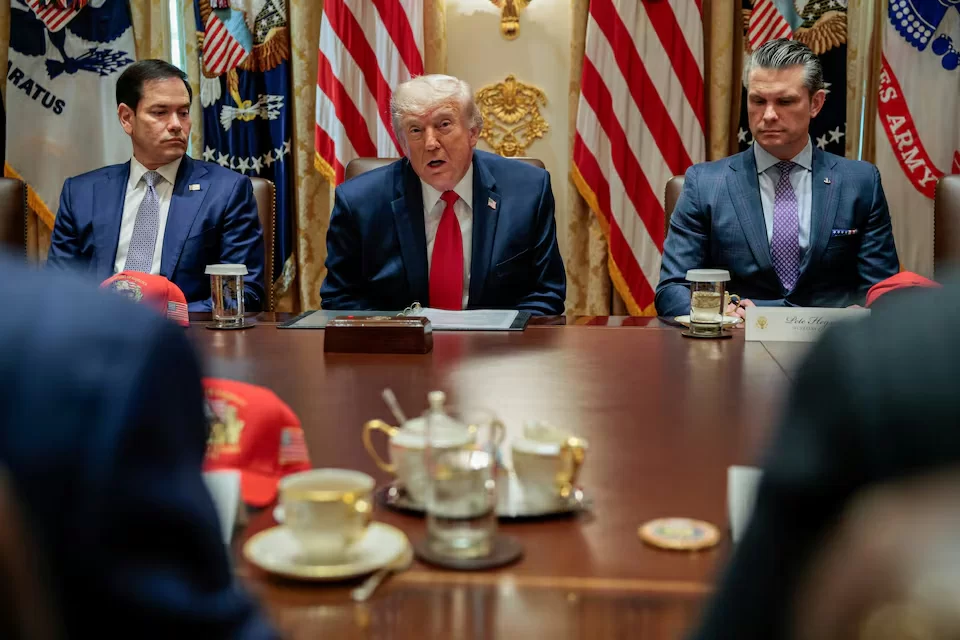
The photo accompanying this report shows US President Donald Trump, Secretary of State Marco Rubio, and Secretary of Defense Pete Hegseth attending a cabinet meeting in the White House Cabinet Room in Washington DC, credited to Reuters.