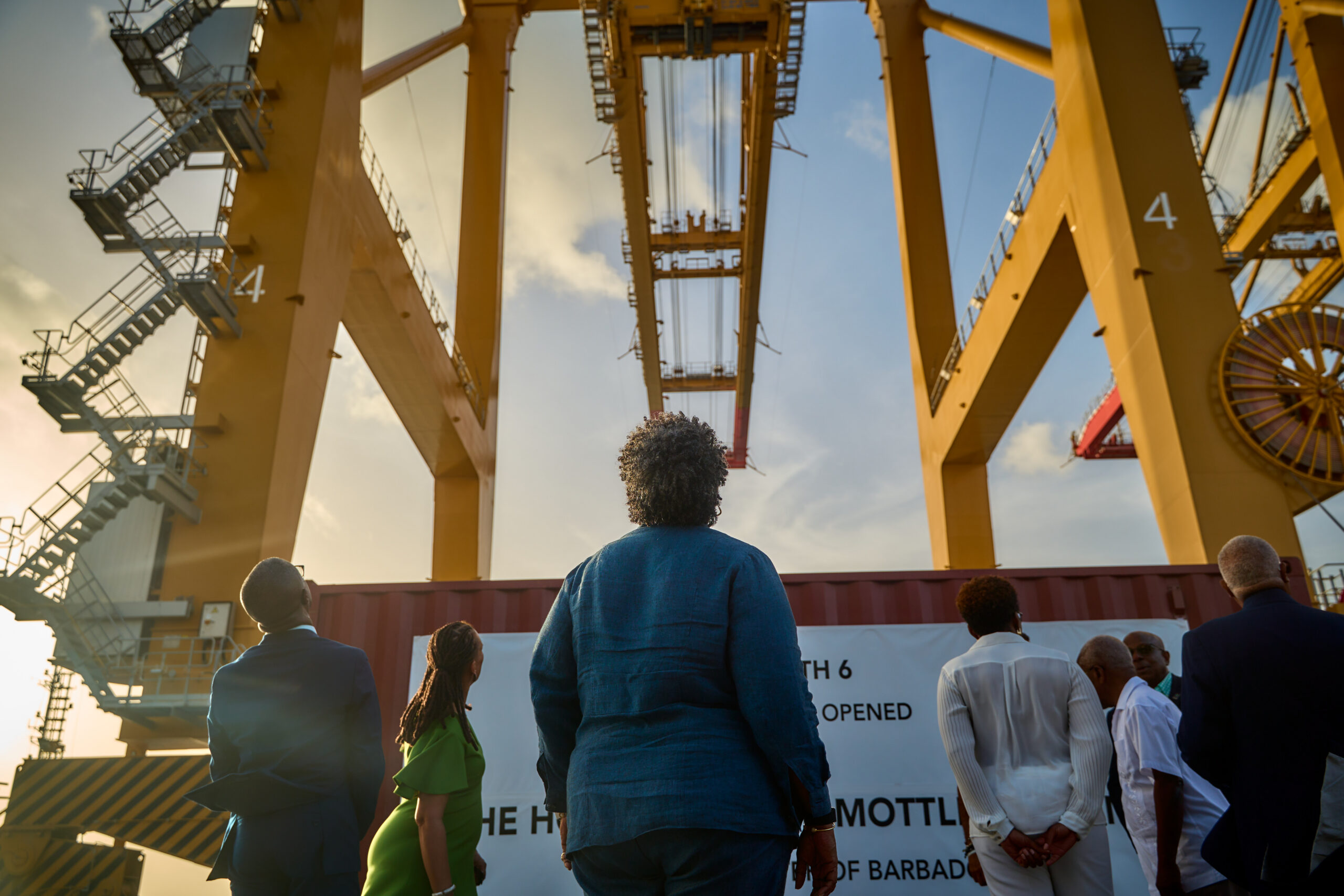
Barbados Prime Minister Mia Mottley has announced that the national government is conducting formal assessments of plans to relocate the Bridgetown Fisheries Harbour, a move prompted by severe storm damage and long-standing overcrowding that have laid bare critical structural and geographic limitations at the facility’s current site. Mottley made the announcement Thursday during the official launch ceremony for the newly completed Berth 6 at the Port of Bridgetown, where she detailed both the pressing challenges facing the existing fishing harbour and the long-term development options the administration is evaluating.
The destruction caused by Hurricane Beryl served as a critical wake-up call, exposing deep vulnerabilities at the already overcapacity site, which sustained extensive structural damage when the storm made landfall. “We saw those vulnerabilities laid bare with Hurricane Beryl, when our already congested fishing harbour suffered major damage,” Mottley stated. While most repair work has been finished to restore partial operations, the prime minister confirmed that any significant expansion at the current location is impossible. A steep underwater drop-off immediately adjacent to the existing harbour would drive expansion costs to levels that are completely unfeasible for the government, she explained.
In response to this barrier, the administration has quietly launched an evaluation of potential relocation sites and is drafting plans for a purpose-built new fish market alongside the new harbour facility. “The government has been working steadily, and will continue to advance work, on environmental impact assessments for the relocation of the Bridgetown fishing harbour, including plans to reclaim additional coastal land to accommodate both the new harbour and a new Bridgetown fish market,” Mottley said. According to her timeline, all required technical studies and geographic modelling will be finalized by the end of this year to determine if the proposed location—north of the Barbados Coast Guard station—is suitable for construction.
If approved, the new site is designed to deliver multi-purpose economic value beyond the fishing industry. Mottley outlined that the development’s core infrastructure could support not just a new fishing harbour, but also an aggregate handling facility, and offer enough extra space to accommodate both local fishing fleets and recreational pleasure craft.
Mottley also noted that Barbados’ unique coastal geography creates unusual hurdles for harbour development, setting it apart from many other Caribbean nations. Unlike neighboring territories that benefit from abundant natural inlets and sheltered bays, Barbados has a largely straight, uninterrupted coastline that severely limits available sites for sheltered vessel mooring. “That linear coastline means we have very limited options when it comes to finding safe, sheltered water for our vessels,” she explained.
While the prime minister acknowledged that the full relocation and construction project will require a substantial public investment, she emphasized that preserving and growing the domestic fishing industry is non-negotiable for Barbados’ economy and social identity. “Can you imagine Barbados without a fishing industry? Can you imagine Barbados without fishermen?” she asked. She also highlighted the sector’s untapped export potential, pointing to the island’s already thriving tuna export market, where long-line fishermen regularly ship local product to buyers across North America.