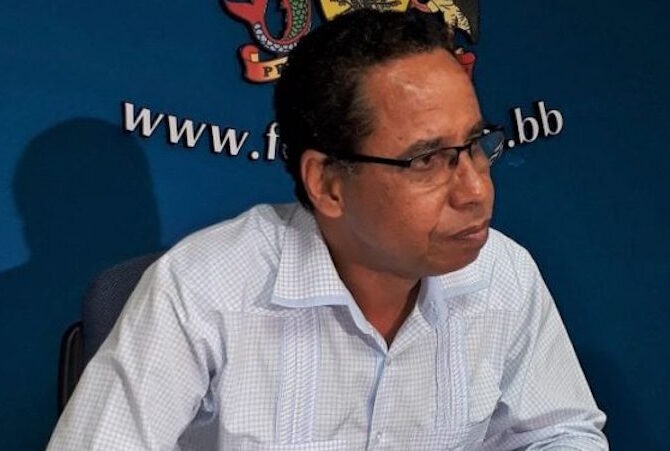
A new travel agreement allowing cross-border movement between Barbados and Guyana using only national identification cards is being hailed as a landmark step toward realizing the Caribbean Community (CARICOM)’s long-held vision of full free movement across the regional bloc, Barbados’ top envoy to the organization confirmed Wednesday.
Ambassador David Comissiong told local outlet Barbados TODAY that this new bilateral arrangement, paired with the October 2025 launch of full free movement between four founding member states – Barbados, Belize, Dominica, and St. Vincent and the Grenadines – marks a transformative breakthrough for regional integration. He emphasized that the smooth implementation of the four-nation free movement scheme, combined with the new ID-only travel policy announced by Barbadian Prime Minister Mia Mottley and Guyanese President Irfaan Ali, represents one of the most encouraging developments for CARICOM in recent years.
“The pleasant experience thus far of the full free movement along with the recent announcement of this new initiative to facilitate movement between our citizens simply with the national ID card, I think it’s a very positive development,” Comissiong said.
Since the new ID-travel policy was made public, the ambassador revealed that regional leaders have already reached out to express interest in expanding the framework to other CARICOM territories. Comissiong shared that immediately after the announcement, a fellow ambassador from one of the four full free movement nations reached out to ask why a similar ID-based system could not be rolled out across all four participating countries. He added that Barbados has long supported the principle of ID-enabled travel across the Caribbean bloc, viewing it as a practical way to cut red tape for regional citizens.
While Comissiong acknowledged that extending the arrangement to Belize could face initial hurdles, as the country lacks direct air links with Barbados, he said regional officials remain confident that a practical, functional system can be developed over time.
Beyond travel liberalization, the envoy pointed to promising shifts in regional labor mobility, highlighting migration flows from Jamaica to Barbados as a model of mutually beneficial movement. Historically, most migration from Jamaica to Barbados consisted of skilled professionals or Barbadian students returning home with spouses after completing studies at the University of the West Indies. But Comissiong noted that recent migration patterns have seen more working-class Jamaicans filling critical unmet service roles in Barbados, particularly in caregiving and domestic support.
“From what I can see, they have really fitted in well, they have found a niche, and they are responding to a real need in Barbados, especially in the area of caregivers and home helpers,” he said.
New data from Barbados’ Ministry of Home Affairs, obtained by Barbados TODAY, shows that between the launch of the four-nation free movement scheme in October 2025 and April 2026, roughly 14,758 nationals from Dominica, St. Vincent and the Grenadines, and Belize have entered Barbados under the new liberalized rules.
Comissiong also disclosed that multiple other CARICOM member states are already in the process of preparing to join the free movement framework launched by the four pioneering nations. He explained that the four founding participants always intended their initiative to be a starting point for broader regional integration, not a closed group.
“The idea always has been that the others would join us,” he said. “All the signs we are seeing with the movement of people across the Caribbean community seem to be positive [and] moving in the right direction.”