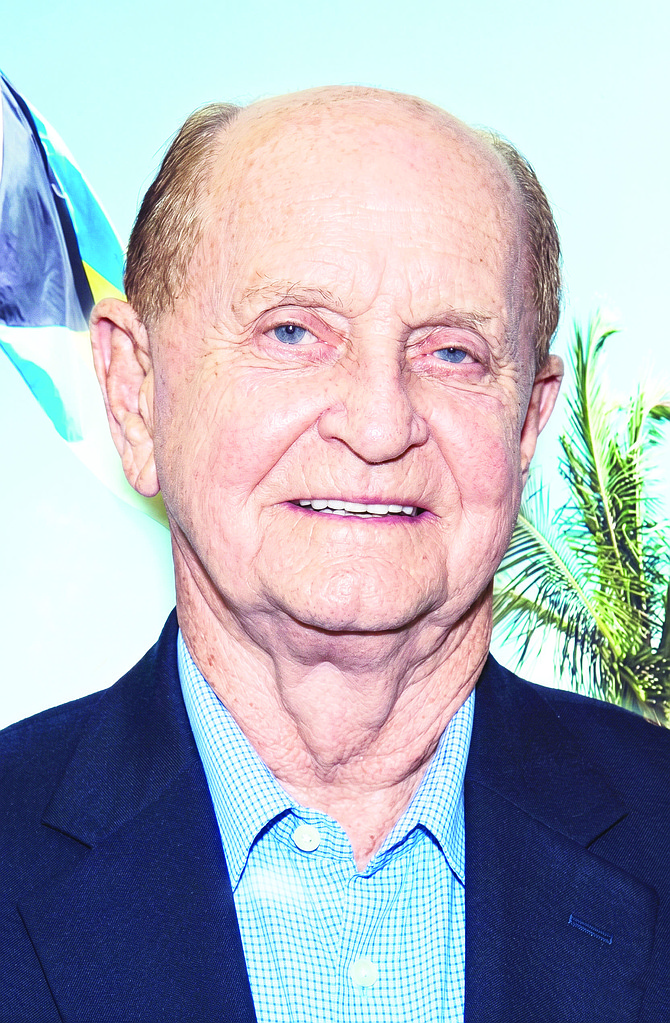
A towering figure in Bahamian business and economic development, grocery industry pioneer Rupert Roberts Jr, OBE, has died at the age of 88, just one day before what would have been his 89th birthday. He passed away peacefully on Tuesday night at the Mayo Clinic in Rochester, Minnesota, surrounded by his immediate family — wife Margaret, daughter Candy and granddaughter Paige — according to an official statement released by the Super Value group he founded. Roberts is survived by his wife, three children, multiple grandchildren and great-grandchildren, a wide network of extended family, and thousands of employees across his business enterprises.
Roberts’ career in retail began long before he launched his own brand. He cut his teeth at City Markets, working his way up from an entry-level supervisor role to store manager at a time when the entire Bahamian grocery sector was overwhelmingly dominated by foreign-owned companies. Breaking into an industry with little space for local entrepreneurs, he founded Super Value in 1965, turning a single standalone store into the nation’s largest Bahamian-owned supermarket chain over nearly six decades of steady growth. Today, the brand operates 13 locations across New Providence, balancing offerings of international consumer brands with dedicated shelf space for Bahamian farmers and local suppliers — a priority Roberts championed throughout his career. The company expanded its footprint in 2012 with the launch of Quality Markets, a subsidiary brand that extended its reach further across the local retail landscape.
Beyond the grocery sector, Roberts built a diverse business portfolio spanning real estate and multiple commercial ventures, including stakes in South Bimini International Ltd, Bahamas Paper Converting, Discount Mart Limited and Global Bahamas Limited. Alongside his commercial success, he maintained a longstanding commitment to charitable giving and community development across the archipelago, embedding social impact into his professional legacy.
Roberts also left an indelible mark on Bahamian banking. Following the 1984 Bahamianisation of Commonwealth Industrial Bank Limited — later renamed Commonwealth Bank — he was appointed as the institution’s first domestic chairman. During his tenure, the bank’s total assets surged by more than 700% to surpass $125 million, while net income grew from $1.3 million in 1984 to $4 million by 1992. Though he stepped down from the chairman role in 1988, he retained his seat on the bank’s board of directors for 36 years, continuing to shape its strategic direction for decades.
In the later stages of his public life, Roberts emerged as one of the most prominent and outspoken voices in national conversations around food pricing, inflation, import costs, taxation and strained supply chains. As ordinary Bahamian households struggled with soaring grocery bills, his insights and advocacy consistently placed him at the center of national economic debate.
One of his final interviews with local outlet The Tribune came after he spent nine weeks receiving treatment in the United States, having been airlifted abroad for medical care. In that conversation, he shared a heartfelt message of gratitude for the outpouring of support and prayers from across the country, and urged Bahamians to prioritize their health, warning: “You could develop an illness that The Bahamas is not equipped to solve. A medical condition can develop into something more expensive than you can afford.” Even amid his ongoing health challenges, Roberts made clear he had no plans to step away from work, saying: “No, no…not at all! They advised me to keep going and never stop!”
Following news of his passing, tributes poured in from across Bahamian politics, business and civil society on Wednesday. Prime Minister Philip “Brave” Davis, who recalled working under Roberts at City Markets in the 1960s before Roberts rose to become one of the nation’s top business leaders, honored Roberts as a foundational figure in The Bahamas’ economic growth, highlighting his decades of philanthropy and community support.
Opposition Leader Michael Pintard praised Roberts as a fierce advocate for Bahamian agriculture and local production, pointing to his consistent work to expand shelf space for domestic goods in retail outlets across the country. Pintard also noted that Roberts maintained an independent stance on business and economic policy, collaborating constructively with both major political parties while prioritizing national interest over partisan alignment. “I respected the fact that he did not allow politics to cloud his judgment in terms of what was in the best interest of the country, and so today I join thousands of Bahamians who mourn his passing and who thank God for the kind of life that he lived that contributed to so many persons’ upliftment, and so may he rest in peace,” Pintard said.
Don Williams, chairman of the Bahamas Chamber of Commerce and Employers Confederation, described Roberts as a leading voice for the private sector whose input shaped national discussions on pricing, retail operations and sustainable business growth. Former Retail Grocers Association president Philip Beneby remembered him as a true trailblazer for the domestic grocery industry, who partnered with stakeholders across the sector to drive growth for decades. Civil society group the Organisation for Responsible Governance also confirmed that Roberts had served on its board since the organization’s founding, playing a key role in advancing its governance and sustainability mandates.