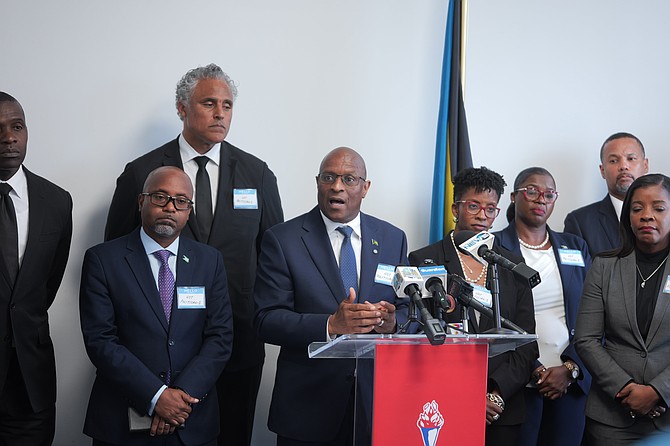
As the Bahamian government tables its 2026/2027 national budget, the country’s Opposition Leader Michael Pintard has launched a sweeping critique of the fiscal plan, centered on a fiery demand for answers over an alleged scandal involving hundreds of thousands in public funds misused for political gain ahead of the last general election.
At the heart of the controversy is a reported $200,000+ in publicly funded gift certificates said to have been distributed to voters in Abaco, framed as Hurricane Dorian disaster relief, but issued under the names of ruling Progressive Liberal Party (PLP) candidates and party officials. According to Chris Lleida, chief executive officer of Premier Importers — the commercial entity that printed and distributed the vouchers — the entire cost of the gift certificates was covered directly by the Ministry of Finance.
Speaking in response to Finance Minister Michael Halkitis’s official budget presentation, Pintard argued that Halkitis had a non-negotiable obligation to address the unaddressed allegations in his opening address to parliament. Pintard called the apparent diversion of public treasury funds to partisan political campaigning a clear case of illegal misappropriation, saying the public deserves a full accounting of how public money left the ministry of finance and ended up in Abaco to benefit the governing party’s election effort.
“At a minimum, the Minister of Finance should have advised the country on the status of any investigation into how public monies were moved from the Treasury to advance a political campaign,” Pintard said. “Our minister of finance must give an accounting for that.”
Pintard’s demands over the Abaco voucher scandal formed the opening of a broader rejection of the government’s full budget proposal, which he scored at less than 50 out of 100, arguing the plan fails to deliver tangible policy improvements that would ease daily burdens for ordinary Bahamian citizens. He pushed back against the governing administration’s claims of progress on three key voter priorities: energy sector reform, cost of living relief, and accessible affordable housing, saying everyday residents have not experienced the positive changes the government has touted.
The Opposition Leader also challenged the government’s narrative of improving national public finances, accusing the administration of hiding major unacknowledged fiscal risks and failing to explain a sharp, unexpected uptick in the country’s total public debt. Official data from the Ministry of Finance puts total public sector debt at an estimated $14.1 billion as of the end of March 2026 — a $689.2 million increase from just nine months prior in June 2025, and a $57 million rise from the end of December 2025.
Pintard noted that the government’s original annual borrowing plan had explicitly stated no new borrowing would be needed over the period, raising urgent questions about how the national debt grew by nearly $700 million without the administration returning to parliament to secure additional borrowing approval. He accused the government of consistently avoiding parliamentary oversight of public spending, warning that this new debt burden will create fiscal strain that extends far beyond the current 2026/2027 fiscal year.
Further, Pintard claimed the administration is intentionally shifting public fiscal exposure to state-owned enterprises (SOEs) through off-budget loans, long-term contracts and financing arrangements that do not appear in the full budget figures shared with lawmakers. He pointed to a dramatic surge in direct Treasury lending to public authorities, which he said grew from less than $100 million at the end of 2022 to more than $600 million today.
“In just over three years, more than a half a billion dollars have been advanced to state-owned entities, and all of those have been under the guise of loans,” he said. “We’ve not been told which budgetary appropriations these funds came from. What was the legal authority that allowed the government to do this, and what are the terms of each of these loans, and how will these funds be repaid? This matters because the law is clear: the government lending must come from properly appropriated funds approved by parliament. If these loans were not drawn from such appropriations, the government must explain what legal basis it relied on — and over and over, their answer has been silence.”
Using Bahamas Power and Light, the country’s primary national utility, as a key example, Pintard said tens of millions of dollars in Treasury funds have been transferred to the state-owned power provider without any adequate public explanation. He added that he has submitted formal questions to Prime Minister Philip Davis and raised the issue repeatedly in the House of Assembly, but has yet to receive any substantive response.
Pintard also backed up his claims by referencing official warnings from the independent Fiscal Responsibility Council, which has flagged unreported fiscal risks tied to SOEs, missing key fiscal data, and liabilities that are not properly disclosed in national public accounts. He added that the government is artificially inflating its reported surplus by relying on unpaid public bills, and structuring large infrastructure projects in opaque ways to hide their full total cost from the public and parliament.
While the bulk of Pintard’s address was critical, he did acknowledge a small number of positive housing-focused measures included in the budget, most notably value-added tax reductions for first-time home buyers and owners of multipurpose properties. Even on housing policy, however, Pintard raised unaddressed questions about $40.2 million in public spending allocated to the Carmichael Village Project, part of the government’s broader Housing Project Renaissance initiative. He said neither current nor former housing ministers have explained how the public funds allocated to the development were spent, and called for the issue to be fully debated during parliament’s budget consideration process, questioning whether the completed housing stock delivers public value matching the investment.
Closing his response to the budget presentation, Pintard rejected the government’s optimistic assessment of the national economy, emphasizing that public trust in government depends entirely on full transparency around how public money is used. “We do not believe that this budget speaks to the real issues Bahamians are dealing with,” he said. “Transparency is not optional. It’s the price for public trust.”