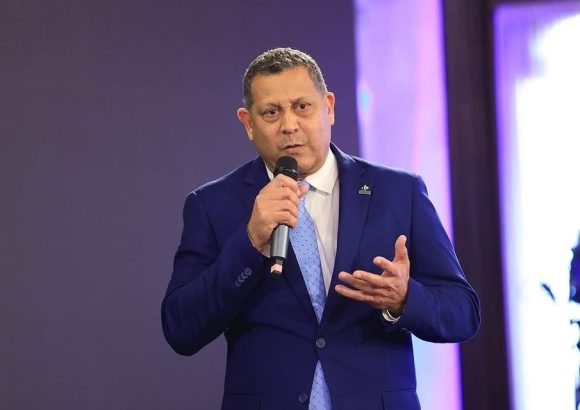
A public dispute over reciprocal financial obligations has erupted between Dominican Republic’s municipal governments and the country’s main electricity distribution companies (EDEs), with the nation’s top municipal association leader challenging recent claims that local governments owe hundreds of millions in unpaid power bills.
Speaking publicly this Wednesday, Nelson Núñez — who leads the Dominican Federation of Municipalities (Fedomu) and also holds the position of mayor of Samaná — pushed back against recent remarks from economist and former public official Celso Marranzini. Marranzini recently drew attention to the growing debt of municipal governments, arguing that unpaid electricity bills from local councils have become a massive strain on Dominican public finances, hitting a total of roughly US$300 million by last year.
While Núñez does not dismiss the existence of outstanding municipal payments for power used by public infrastructure and street lighting, he says the narrative that only local governments are in debt is deeply one-sided. He argues that the EDEs have themselves failed to uphold binding legal requirements laid out both in the country’s General Electricity Law 125-01 and a 2013 landmark ruling from the Dominican Constitutional Court.
That specific ruling, labeled TC/0100/13, establishes a clear reciprocal framework: electricity distributors are required to transfer 3% of all revenue they collect from customers within each municipal jurisdiction and municipal district to local governments every month. In exchange, local governments are legally obligated to cover the cost of electricity for public streetlights and municipal-owned public facilities.
Crucially, Núñez clarified that the 3% transfer is not an arbitrary tax imposed on power providers, as some critics have framed it. The Constitutional Court itself explicitly confirmed that the payment qualifies as a legally authorized compensation fee for municipalities, he noted.
Yet according to Fedomu’s records, the EDEs have failed to comply with this ruling consistently ever since it was issued in 2013. The cumulative sum that power distributors owe to municipalities across the country is “incalculable,” Núñez stated, and this long-running noncompliance has been a major contributing factor to the tight financial straits many local councils now face. The missing funds have made it especially difficult for municipalities to cover the very street lighting costs they are obligated to pay, exacerbating the current standoff over mutual debts.
Núñez closed by emphasizing that financial responsibilities run both ways: if municipalities owe the EDEs for power delivered, the power distributors owe municipalities for the legally mandated funds they have withheld for more than a decade.