China has launched a groundbreaking space mission on Sunday, sending three astronauts to its Tiangong Space Station in a step that marks a major milestone toward the country’s goal of achieving a crewed moon landing by 2030. The mission will include a 12-month continuous stay in orbit for one crew member, a new national record for the longest duration of human spaceflight for China, and will enable critical research into how extended space exposure impacts the human body.
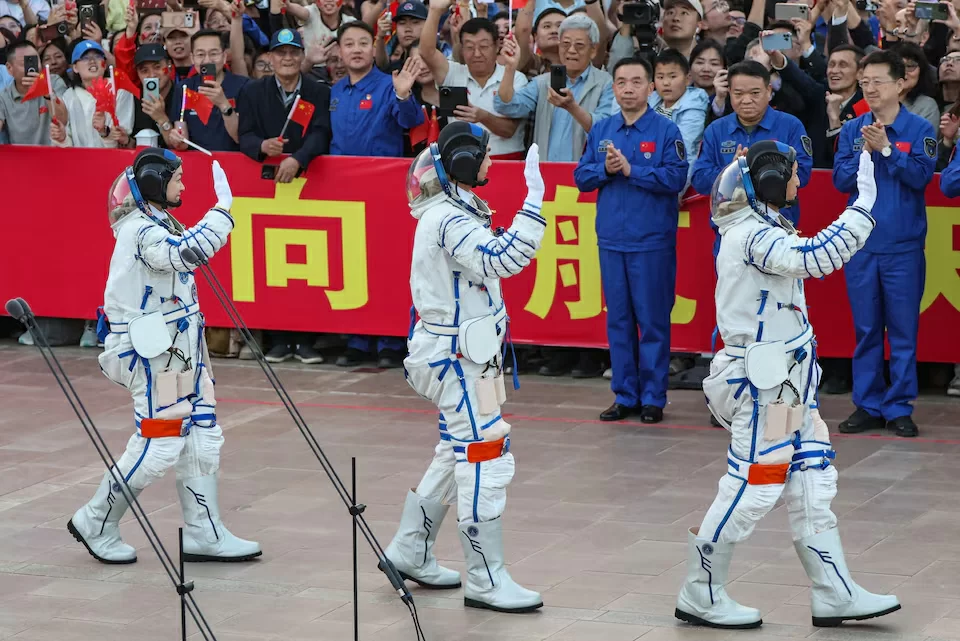
The Shenzhou-23 spacecraft lifted off from the Jiuquan Satellite Launch Center located in Gansu Province, northwestern China. Onboard the craft are mission commander Zhu Yangzhu, pilot Zhang Yuanzhi, and payload specialist Li Ka-ying. A former Hong Kong police inspector, Li makes history as the first astronaut from Hong Kong to take part in any Chinese space mission. The team waved to onlookers at an official farewell ceremony shortly before launch, in images captured by international news outlets.
Which crew member will complete the full 12-month orbital stay will be determined later in the mission, based on operational progress and crew health. While this 12-month mission is one of the longest human spaceflight missions ever completed globally, it falls just short of the all-time record of 14.5 consecutive months in space set by a Russian cosmonaut in 1995.
Beyond low-Earth orbit operations at Tiangong, the Shenzhou-23 mission is a key stepping stone for China’s accelerating lunar exploration program, which has positioned the country as a major competitor in the new global space race alongside the United States. The U.S. currently targets a 2028 crewed moon landing and plans to build a permanent lunar outpost as a precursor to eventual crewed missions to Mars. China, for its part, aims to land its first astronauts on the moon by 2030, and has partnered with Russia to construct a permanent joint lunar base by 2035.
In recent months, China has completed testing of new core technologies critical to its lunar ambitions, including the heavy-lift Long March-10 rocket, the Mengzhou crewed lunar spacecraft, and the Lanyue lunar lander. The Shenzhou-23 mission will carry out the first autonomous rapid rendezvous and docking with the Tiangong Space Station, a key technical test that will inform future automated docking operations between the Mengzhou spacecraft and Lanyue lander during lunar orbit missions.
In addition to technical testing, the mission will carry out a wide range of scientific research. Scientists will analyze the physiological impacts of long-term exposure to space radiation, bone density loss, and psychological stress of isolation in microgravity. The mission will also continue what is reported to be the world’s first experiment growing human artificial embryos in space, research aimed at answering fundamental questions about human survival and reproduction beyond Earth.
China’s rapid progress in space exploration in recent years, including the historic first retrieval of lunar samples from the far side of the moon in 2024, has solidified its status as a leading global power in human spaceflight. With a clear roadmap for lunar exploration and long-term ambitions to expand human presence deeper into the solar system, the country continues to push the boundaries of human space exploration.