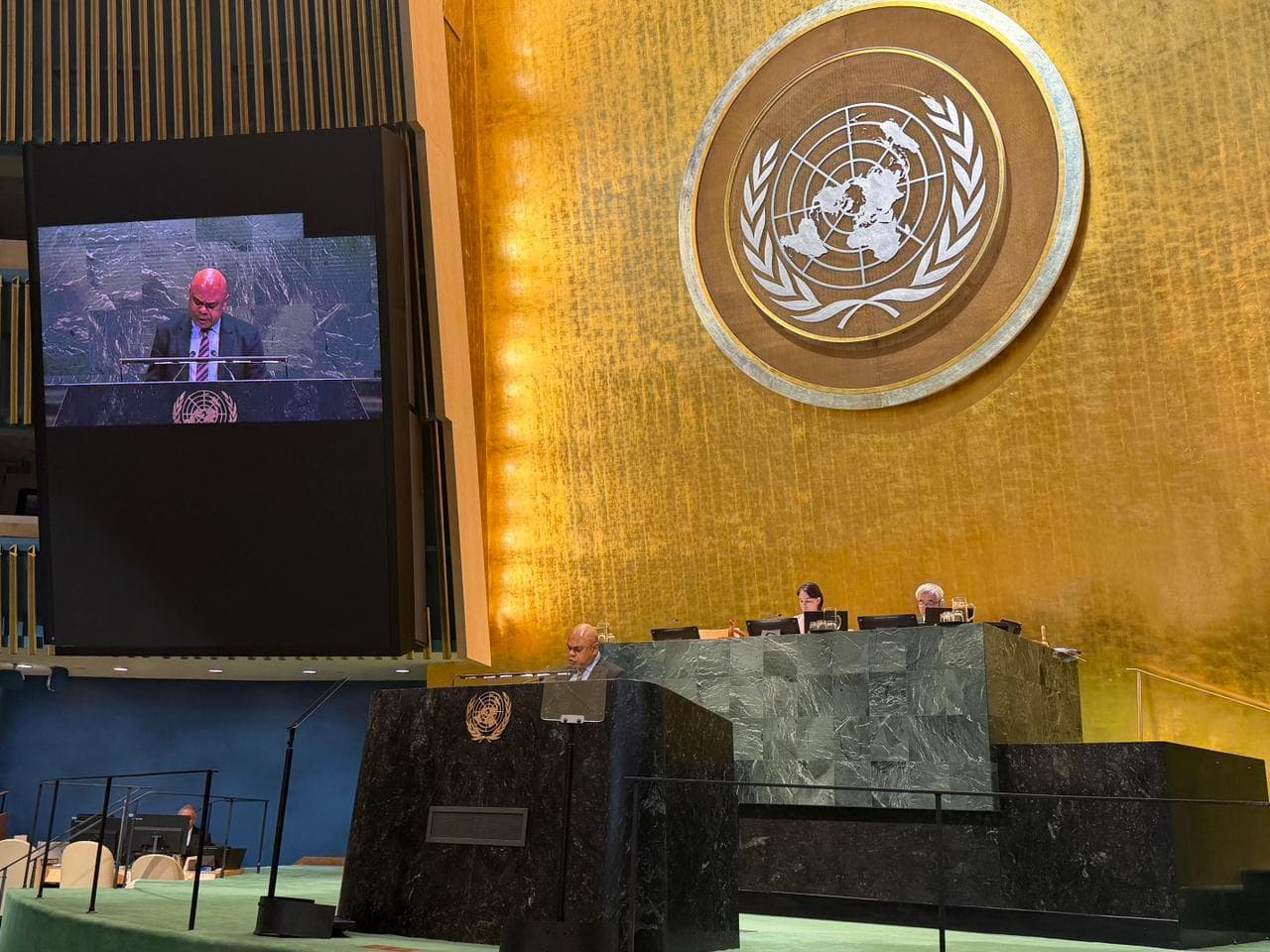
In a watershed moment for global climate action, the United Nations General Assembly has adopted a landmark climate resolution spearheaded by Vanuatu and championed by the Alliance of Small Island Developing States (AOSIS), codifying key climate obligations set out by the International Court of Justice (ICJ) into a global political mandate. Wednesday’s final vote, which secured backing from 141 nations, capped off a years-long movement rooted in grassroots youth advocacy from Pacific communities on the frontlines of the climate crisis.
For decades, Small Island Developing States (SIDS) — low-lying and atoll nations disproportionately threatened by rising sea levels despite contributing very little to global greenhouse gas emissions — have pushed for greater accountability from major emitters. This resolution stands as the most significant victory to date for their fight for climate justice.
The text of the resolution formalizes the ICJ’s landmark advisory opinion on state climate obligations, requiring all nations to adhere to three core principles: first, that countries hold a clear legal responsibility to address human-caused climate change; second, that the Paris Agreement’s target of limiting global warming to 1.5°C above pre-industrial levels is a legally binding global goal; and third, that all countries must update their national climate action plans, or Nationally Determined Contributions (NDCs), to reflect the highest possible ambition, align with the 1.5°C target, and phase out harmful fossil fuel use.
One of the most impactful provisions for SIDS is the explicit affirmation that statehood and the legal status of national maritime zones remain permanent, even as sea levels rise erode island territories. For atoll nations already facing gradual submersion, this principle protects their sovereign rights and standing under international law from being erased by the climate crisis — a protection that advocates call non-negotiable for the future of island populations.
“This resolution transforms the Court’s advisory opinion into a political mandate backed by an overwhelming majority of the international community,” explained Ambassador Ilana Seid, current Chair of AOSIS. “For our members, the affirmation that our statehood and maritime rights endure is not a technical legal detail — it is the very foundation of our people’s future. We call on all States to act on these obligations now.”
Seid emphasized that the victory extends far beyond vulnerable island nations, noting that the entire global community benefits from clearer climate accountability. “This is a win not just for the most vulnerable, but for our entire world,” she said. “The science is unambiguous and the law is clear: delaying climate action is not an option. This ruling is an important lever in our work to prevent big emitters from continuing to endanger our people and our planet. We are exceptionally proud of Vanuatu and all small islands whose commitment to climate accountability have demonstrated the might and moral authority of Small Island Developing States.”
Founded in 1990, AOSIS represents 39 small island and low-lying coastal developing states in international climate and sustainable development negotiations. Despite the small geographic and economic size of its member states, the bloc has consistently punched far above its weight in global climate talks, securing multiple historic commitments to cut greenhouse gas emissions over the past three decades. Beyond amplifying the voices of marginalized climate-vulnerable nations, the organization’s core mandate is to advance the legal and policy interests of its members in a changing climate.