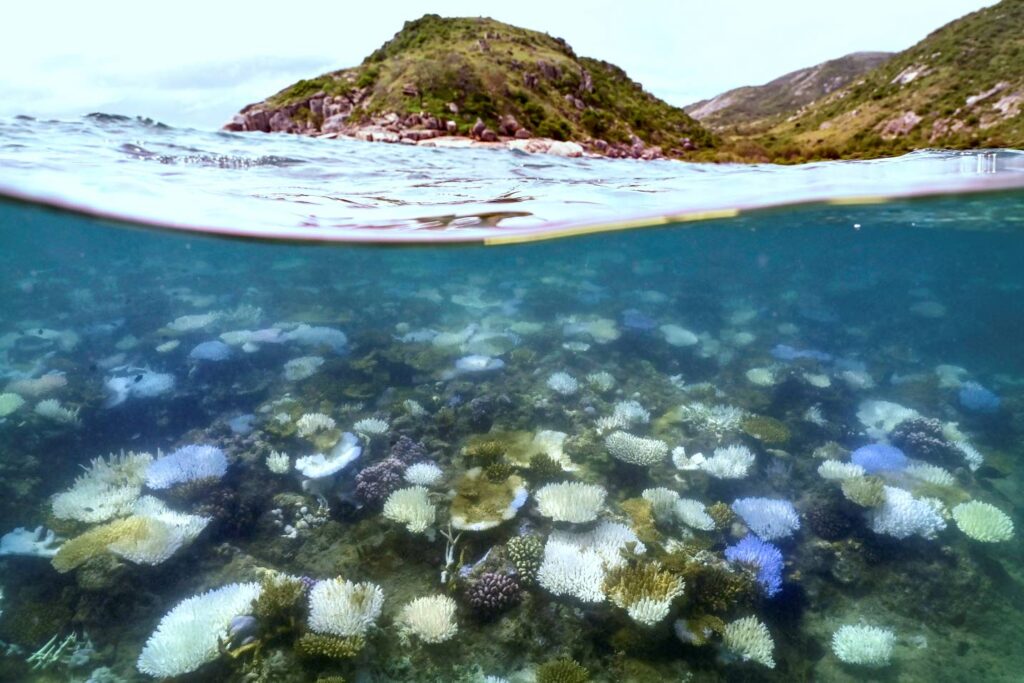
BANGKOK, Thailand – A growing body of climate science experts is sounding the alarm that an unusually powerful El Niño weather pattern set to arrive this year could drive catastrophic damage to the world’s coral reefs, many of which are already teetering after consecutive mass bleaching events that have eroded their resilience. Meteorological forecasting models have increasingly converged on the conclusion that the cyclical climate phenomenon, which occurs every two to seven years, will return in 2025 with unusual strength, reshaping weather patterns across the globe—bringing severe drought to some regions and catastrophic flooding to others. For coral ecosystems, the greatest risk stems from El Niño’s close link to elevated ocean temperatures and reduced cloud cover in many tropical regions, two conditions that are proven triggers for large-scale coral bleaching.
“Every global coral bleaching event in recorded history has occurred during an El Niño year,” noted Clint Oakley, a coral reef ecologist at Victoria University of Wellington. Oakley described his reaction to the forecast of a strong event as a feeling of “dread, although not surprise,” warning that a major El Niño this year could prove “serious and devastating for many reefs around the world.”
To understand why even small temperature increases pose such a grave threat to corals, it is necessary to examine the symbiotic relationship that underpins their survival. Corals build the hard calcium carbonate structures that form reef frameworks, and host tiny algae called zooxanthellae within their tissues. In exchange for shelter, the algae produce nutrient-rich compounds via photosynthesis that feed the coral, and also give reefs their vibrant, distinctive colors. When ocean temperatures rise beyond a coral’s tolerance threshold, however, this mutually beneficial partnership breaks down: the algae are either expelled by the coral or leave voluntarily, a process that scientists have yet to fully explain. Without their algae symbionts, corals lose their color, turning the stark white that gives bleaching its name, and are slowly starved of the nutrients they need to survive.
If ocean temperatures cool rapidly enough, corals can survive off stored energy reserves until the algae return. But even partial recovery leaves corals malnourished, more susceptible to bacterial and viral infections, and unable to allocate the energy required for successful reproduction. If elevated temperatures persist or reach extreme levels, the outcome is far grimmer. “If it takes too long for the waters to cool down, or if the heat is too extreme, then they will essentially starve and they’ll die,” explained Jen Matthews, a coral researcher at the University of Technology Sydney.
Occasional, localized bleaching is a natural part of reef ecosystem dynamics, and healthy reefs can recover from small-scale events. The modern crisis stems from repeated mass bleaching events that have become the new normal as anthropogenic climate change drives long-term rising ocean temperatures. Many reefs have not had enough time between events to fully recover and replenish their populations with young coral juveniles. “If you’re being bleached before you’ve even recovered and been able to produce juveniles again, then that’s only a downwards trajectory from there,” Oakley said.
The most recent global mass bleaching event was formally declared in 2024, and the damage already recorded is extensive. Some coral species in the Caribbean have already been classified as functionally extinct, meaning they can no longer sustain viable populations or fulfill their ecological roles. Australia’s Great Barrier Reef, the world’s largest reef system and the only living structure visible from outer space, lost between 15% and 40% of its total coral cover across different regions between 2024 and 2025.
A strong, or “super”, El Niño would push ocean temperatures even higher, starting from a baseline that is already too warm for most corals to thrive. Oakley pointed out that average global ocean temperatures over the past five years match the peak temperatures recorded during the 1998 global bleaching event, one of the most destructive on record to that point. While a small share of the world’s corals have shown natural resilience to warmer waters, their numbers are not nearly enough to offset the widespread losses from repeated bleaching cycles.
In response to the growing crisis, scientists are testing a range of experimental interventions to buy reefs more time: these include nutrient-infused gels to feed stressed corals, shading systems to reduce heat exposure, and genetic engineering to breed more heat-tolerant coral strains. Matthews emphasized that while many of these innovative management strategies show promise, they are not a long-term solution. “There’s a lot of really important and innovative management strategies out there, but they’re all just buying time,” she said.
Forecasters still note some uncertainty around El Niño’s exact timing, strength, and regional impacts, and urge that projections be interpreted with that caveat in mind. “An El Niño is likely, but the strength and duration are still uncertain,” said Kimberley Reid, a research fellow in atmospheric sciences at the University of Melbourne. “El Niño is one piece of the puzzle that affects the weather at a certain location but there are other factors like local ocean temperatures and winds across the Indian Ocean,” she added.
Even without a major El Niño event this year, the long-term outlook for global coral reefs remains deeply troubling. Scientists estimate that up to 50% of the world’s coral cover has been lost over the past four decades, eroding irreplaceable ecosystems that provide critical nursery habitat for commercial fish populations that feed billions of people, and act as natural sea walls that protect coastlines from storm surge and erosion.
Matthews called the current trajectory a sobering reminder of the stakes of climate inaction. “If we don’t get our act together on climate change then all we’re doing is buying time until our reefs, as we know them, disappear.”