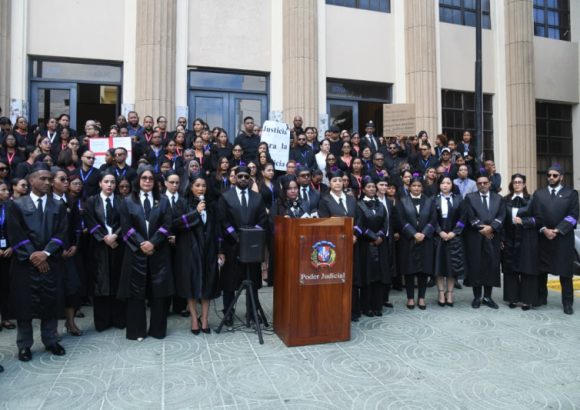
SANTO DOMINGO — In an unprecedented show of collective action across the Dominican Republic’s judicial branch, nearly 400 judges from every level of the national court system joined a coordinated work stoppage Thursday, alongside hundreds of other judicial employees, to demand sweeping reforms to their substandard working conditions and unfair pay structures.
The protest, which included justices of the peace, first-instance judges, and appellate court judges, suspended all routine scheduled hearings with the sole exception of Permanent Attention courts, which continued to process urgent hearings on coercive measures to avoid endangering ongoing criminal cases. The strike was organized jointly by the Association of Judges of the Dominican Republic (Asojurd), the Network of Judges of the Dominican Republic, the Association of Dominican Judges for Democracy (Judemo), the Association of Justices of the Peace, and independent judges unaffiliated with the organizing groups.
The day of peaceful protest opened with a solemn, unified ritual across courthouses nationwide: after singing the Dominican national anthem and the Judicial Power anthem, all participating judicial workers, dressed in black and carrying protest signs emblazoned with slogans including the rallying cry “justice for justice”, gathered to read the movement’s founding document, the *Manifesto for the Dignity of Justice*, under the central slogan “Let dignity begin at home!” Gatherings were held at major judicial hubs including the Ciudad Nueva Palace of Justice, the Santo Domingo East Judicial City, the Real Estate Jurisdiction courthouse, and regional courthouses across the country.
At the Ciudad Nueva Palace of Justice, Magistrate Suinda Brito delivered the manifesto’s text, outlining the core grievances driving the action. Brito highlighted systemic understaffing that forces individual judges and court employees to handle the workload of three or four full-time positions, stagnant salaries that have not kept pace with the country’s soaring cost of living despite the enormous legal and ethical responsibilities of judicial roles, and a wave of mass resignations among administrative staff driven by chronic burnout. Protesters also pointed out severe disrepair to court facilities and a total lack of adequate personal safety protections for staff working in courthouses.
The strikers argue that a functional justice system cannot rely solely on personal vocation, individual sacrifice, and private commitment from the people who run it. To deliver timely, efficient, and impartial justice to the public, the branch requires sufficient material, human, and financial resources that it has long been denied, they said.
The most contentious complaint centers on stark economic inequity within the judicial branch. Strikers condemned that while local courts operate with crippling basic deficiencies, senior internal management bodies control multi-million-dollar budgets allocated to luxury travel, hotel accommodations, fine dining, advertising, public events, and payments to social media influencers. They added that some senior administrative secretaries and top management staff take home salaries that far outpace the earnings of active sitting judges.
The national strike has received broad backing from across the Dominican legal community, including the national Bar Association, multiple legal professional associations, and prominent individual jurists such as Carlos Olivares. Olivares expressed unwavering support for the industrial action, calling the current salary structure for sitting judges completely unacceptable. He emphasized that the judicial sector deserves public backing, noting it is long past time judges stopped earning what he described as “miserable wages” and faced routine institutional disrespect.
The Dominican Association of Prosecutors (Fiscaldom) has also publicly expressed its support and solidarity with the striking judges, joining calls for salary improvements and broader reforms to strengthen the national justice system. In an official statement, Fiscaldom confirmed it recognizes the right of judicial worker organizations to advance demands for improved working, salary, and institutional conditions for public servants, so long as actions remain within the bounds of the country’s legal framework, principles of social democracy, and the rule of law. The association reiterated its backing for the judges’ demands, stressing that ensuring dignified working conditions for judicial staff is a core requirement for institutional strengthening and improved public access to justice. Fiscaldom also called on relevant authorities to open spaces for frank, respectful, and urgent dialogue to address the strikers’ demands and advance fair, sustainable solutions that benefit the entire Dominican justice system.
In the country’s second-largest city of Santiago, regional judicial staff joined the national movement, with the area outside the Santiago Palace of Justice filled with demonstrators dressed in black, including dozens of judges, court employees, and local lawyers gathered to back the strike. Representatives from regional jurisdictions unified around demands opposing excessive workloads, systemic wage inequality, and what they describe as the “industrialization of justice” — a backlogged system that prioritizes speed over fair process. The regional strike canceled roughly 200 routine hearings in the area.
Demonstrators in Santiago recalled that the Judicial Council, the judicial branch’s governing body, first issued a formal response to the group’s demands on May 19. But judges dismissed the council’s proposal as “vague, conditional, and ineffective.” The council’s offer includes a salary indexation plan that is contingent on approval from the Ministry of Finance, with no set timeline for implementation or clear mechanisms to roll out changes. Judicial mobility reforms were reduced to a non-binding “roadmap” with no concrete policy measures, the strikers said. Core outstanding issues including rules for horizontal substitution, wage gaps created by the current remuneration manual, and advancement opportunities for administrative staff have all gone completely unanswered, they added.
Protesters also questioned senior management’s resource allocation across the judicial branch, noting that the Judiciary has spent more than 400 million Dominican pesos on international air travel and accommodations since 2021, while structural and salary deficiencies remain unaddressed in local courts. They also denounced institutional inaction on more than 18 formal communications sent by judges to the Judicial Council dating back to May 2021, requesting solutions to a wide range of systemic issues that have never received a response.
Despite the full-scale work stoppage, strikers have guaranteed that all urgent judicial services remain operational throughout the country. Single-judge courtrooms, the Second Court of Instruction, and Permanent Attention Offices all remained open to handle emergency matters.
In addition to the core grievances around wage inequality and misallocated budgets, the movement’s key demands include addressing severe understaffing, a nationwide shortage of sitting judges, excessive workloads, ongoing mass resignations of burned-out administrative staff, crumbling judicial infrastructure, and inadequate on-site security for courthouse employees.
Protesters emphasized they remain open to good-faith dialogue with the Judicial Council, but warned that if they do not receive concrete, actionable responses to their demands in the near future, they will launch additional collective actions to press their case.