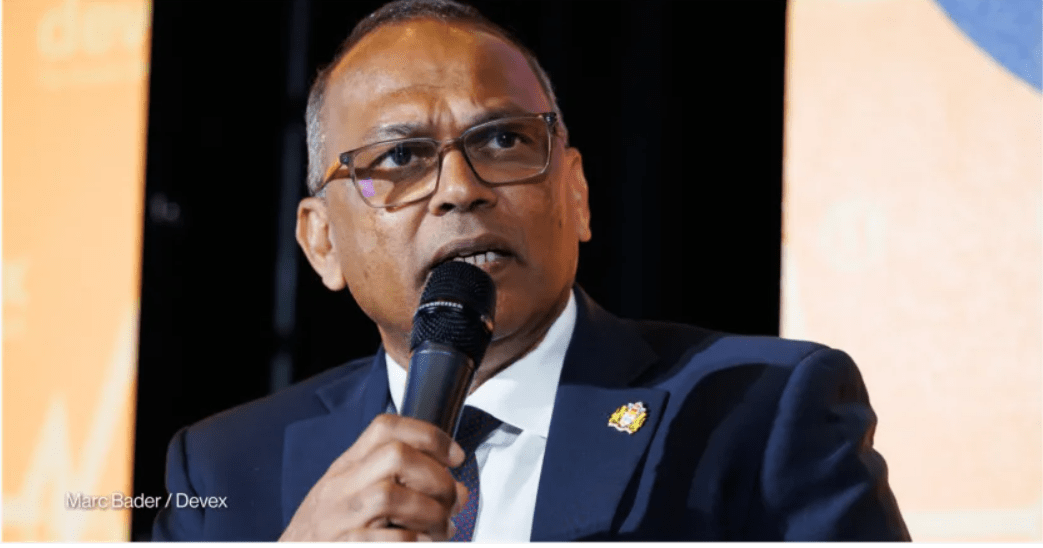
In remarks delivered at the Devex Impact House on the sidelines of the annual World Health Assembly on Thursday, Guyana’s Minister of Health Dr. Frank Anthony has issued a urgent call for a fundamental reimagining of global health governance, arguing that decades of institutional bloat have left major international health bodies too slow, bureaucratic, and unresponsive to the needs of low-income and small developing nations — a gap that has been amplified by a growing global funding crisis that leaves no room for delay.
Anthony argued that incremental tweaks to existing structures are no longer sufficient, as mounting financial constraints have forced the global health community to pursue sweeping restructuring regardless of institutional preference. “If we don’t want to restructure, we are being forced to restructure, because it’s not an environment where there’s a lot of money available,” he told attendees. “There’s no other way around this.”
The debate over global health reform comes as World Health Organization (WHO) member states deliberate a new joint framework to assess the future of global health architecture, with ongoing discussion over whether the system requires deep institutional consolidation, revised mandates, or full-scale institutional reform. Anthony emphasized that the core problem extends far beyond insufficient funding: it centers on whether existing institutional structures are actually designed to deliver effective results for vulnerable populations.
“We need to look internally at the organization and whether the structure that we currently have is really fit for purpose,” he said. “And if it’s not, then we need to have a major overhaul.” He also raised accountability concerns about regional health bodies nested within the global governance system, noting that in many cases, regional entities operate in silos with overlapping mandates and no clear reporting mechanisms to global oversight bodies. Disputes over equitable funding distribution across regions have further compounded systemic inefficiencies, he added.
For small, low-income countries like Guyana, the outcome of these reforms carries uniquely high stakes, Anthony argued. Too often, the needs and perspectives of lower-income nations are sidelined in global health decision-making, despite facing the most acute barriers to care. “They need to get their voices heard in the global environment, and people really need to listen to them, because they have major challenges,” he said. “If we’re not listening to them and working for them, then who are these organizations really working for?”
Looking ahead to the upcoming selection of the next WHO Director-General, Anthony outlined the core qualifications the next leader must bring to the role: sharp political acumen, deep technical expertise, and a proven ability to address the organization’s persistent financial challenges. “Whoever is coming in will have a lot of work to do,” he said. “You will have to be very politically savvy.” The next leader must also prioritize securing sustainable new funding streams for the WHO while breaking down internal silos to leverage the organization’s technical expertise quickly and effectively when crises emerge, he added.
While calling for global change, Anthony also highlighted the domestic health reforms Guyana has implemented over recent years to expand access to high-quality care even amid limited national resources, offering a model for how constrained systems can innovate. A core pillar of Guyana’s reform effort has been a national telemedicine program that now operates across 150 rural and remote sites, equipping community health workers with satellite connectivity, solar power, solar-powered medical refrigerators, and internet-enabled diagnostic tools that allow local providers to share ultrasound and ECG readings with specialist doctors in urban centers for real-time consultations.
“It’s hard for us to put maybe a doctor in every remote community, but using telemedicine, we are able to offer high-quality advice to our patients,” Anthony explained. “The doctor doesn’t have to be physically present.” He described the program as a transformative shift for care access, particularly for Indigenous communities and remote populations that previously faced years-long wait times and limited access to specialized care and clinical training.
Guyana’s public health system operates on a model of free universal care for all citizens, with a tiered referral network spanning 460 facilities across its 10 regions — from small community health posts to regional and national tertiary referral hospitals. Under the tiered system, patients begin care at the local community level and are transferred upward to higher-acuity facilities only when specialized care is required, including air medevac for urgent cases in remote regions. “We have that tiered system, and we refer upwards, and I think by and large it has been working,” Anthony said.
The system still faces significant headwinds, most notably a persistent human resources crisis driven by the outmigration of trained nurses and clinical specialists to higher-income countries. To address this gap, the Guyanese government has added more than 5,000 new health workers to the public system over the past three years and expanded domestic training programs. A key initiative is a hybrid nursing training program hosted on Coursera, developed in partnership with a WHO collaborating center in Brazil; its first cohort of 600 nursing students is set to graduate in July, a expansion Anthony called “quite a big number for us.”
The government has also expanded undergraduate medical training at the University of Guyana, doubling annual intake from 60 to 120 students, and launched domestic residency programs to train clinical specialists locally, reducing the need for trainees to go abroad. In parallel, Guyana has invested heavily in infrastructure: six new 75-bed hospitals opened in 2025, with eight more currently under construction, with the goal of bringing secondary and tertiary care closer to patients’ home communities.
“Primary care can only give you so much,” Anthony noted. “It will help you with the prevention, but when people really get sick, you also have to provide hospital care or secondary, tertiary care, and you need to invest there as well.”
These infrastructure and program investments are also targeted at addressing Guyana’s growing burden of noncommunicable diseases (NCDs), which has emerged as the leading public health challenge as life expectancy rises and lifestyles shift with growing economic prosperity. While the country continues to make progress on eliminating infectious diseases including leprosy, leishmaniasis, Chagas disease, malaria, and mother-to-child transmission of HIV, rates of cardiovascular disease, stroke, diabetes, chronic respiratory illness, and kidney disease have risen sharply in recent years.
“With some amount of growing prosperity, people are eating the wrong things,” Anthony said. “Our diet is shifting with prosperity. People have stopped walking and exercising naturally.” Four years ago, the Ministry of Health launched a dedicated national NCD control program to target these conditions and expand prevention and early treatment services.
Another key efficiency innovation has been the rollout of a national electronic health record (EHR) system, which assigns every citizen a unique health card that providers across all public facilities can use to access up-to-date patient records instantly. Before the EHR rollout, patients often waited hours for staff to locate paper files, but in facilities that have already adopted the new system, patients are seen within 10 to 15 minutes of their scheduled appointment. “That has really helped a lot of people, rather than coming and sitting there for the whole day without getting care,” Anthony said. “This kind of patient-centric approach is extremely important.”