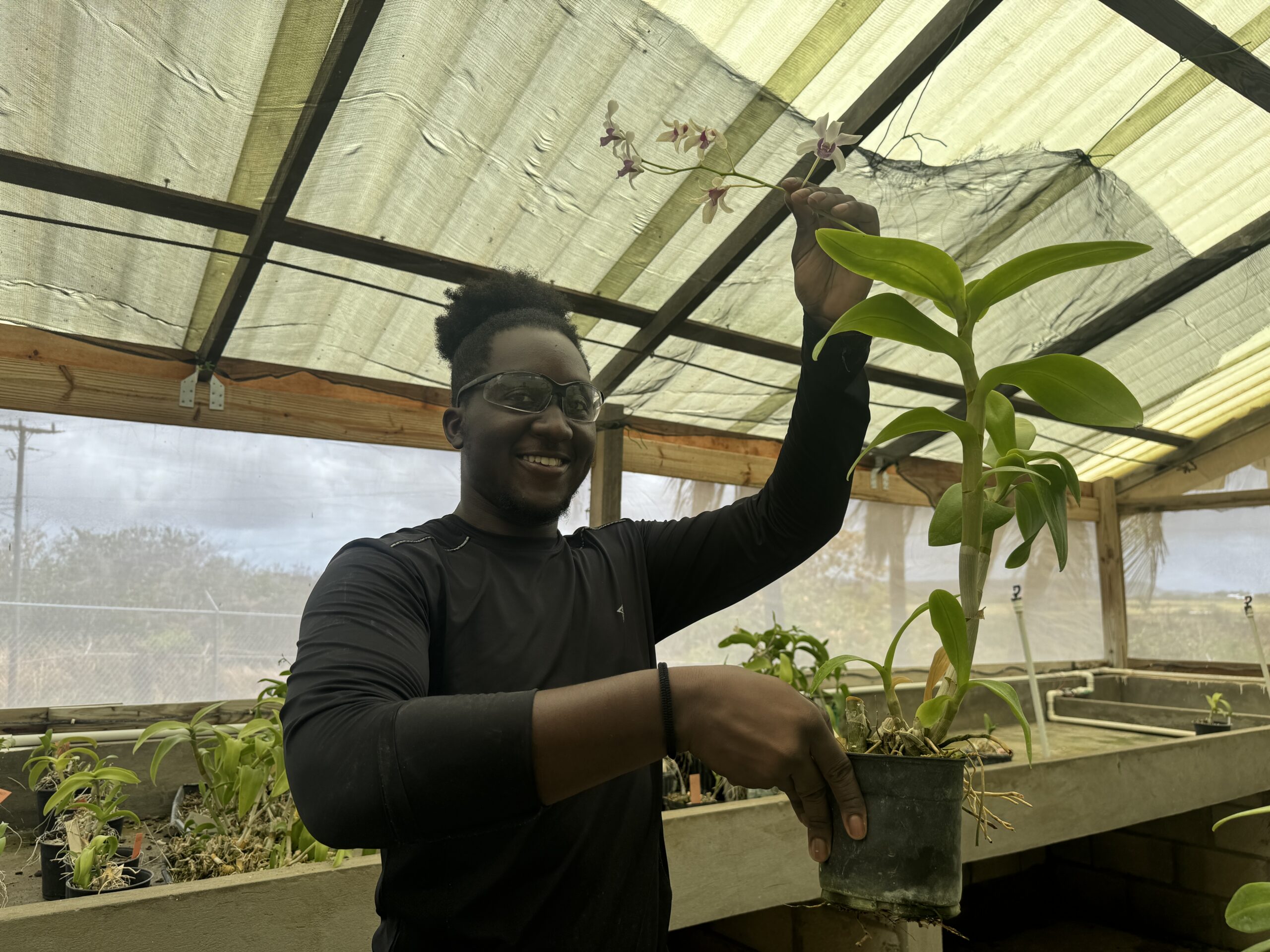
At an age when many young professionals are still mapping out their first career steps, 24-year-old Stefon Burgess has made a deliberate pivot that connects his early medical ambitions to a new path rooted in plant science, food sovereignty, and groundbreaking cancer research. A native of Bowmanston, St. John, Burgess now spends his working days at the Plant Tissue Culture Laboratory in St. Philip, where plant propagation work has reshaped not just his professional goals, but his entire perspective on what a meaningful career can look like.
Burgess initially set his sights on becoming a medical doctor, but a gradual shift in priorities led him to test a different path. He made the decision to take a research internship at the lab to gain hands-on experience, a choice that quickly won him over. “I honestly wanted to be a doctor, but my mind just started to change, and I decided, well, I’m going to do the internship here and get the experience,” Burgess shared. “I’m enjoying it. At first, I thought to myself, outside field work is okay, but I like being in the lab as well, and I am exposed to both here.”
What began as a seven-week temporary placement through the University of the West Indies last year morphed rapidly into a full-time position. By August 2023, Burgess had signed a permanent contract at the lab, and he has now built up nearly nine months of on-the-job research experience. Equipped with a Bachelor of Science degree in Biology, with specialized coursework in ecology, biochemistry and chemistry, Burgess said the laboratory environment opened his eyes to the under-explored scientific potential locked within the agricultural sector. “I grew really good here. I learned a lot with the physiology of the plants – sweet potato, yam, pineapple and then plantain and everything,” he said.
Even as agriculture has captured his professional interest, Burgess never let go of his longstanding fascination with medical science. Instead of abandoning that passion, he is now working to merge his two interests through targeted future research. “I would still love to incorporate my medical background,” he explained. “I want to do research on soursop and come up with an antidote for cancer using bioactive compounds from the fruit and leaves.”
Outside of his formal lab work, Burgess tends to a small personal backyard garden at his home, where he grows his own sweet potatoes, figs, plantains and sweet peppers. Beyond the practical benefit of cutting down on monthly grocery bills amid skyrocketing living costs, he said the routine of gardening has become a deeply effective therapeutic practice that supports his mental well-being. “Mental health is very important,” he said. “Not just going out partying and stuff. I think that would be a good way to stabilise yourself as well.”
For Burgess, home gardening also represents a tangible form of personal independence at a time when Barbados is facing widespread cost of living increases that have strained household budgets across the country. “You will want to garden at home so that you will have your own produce and you wouldn’t have to be looking here or there looking for fruits or vegetables,” he said. “Things getting expensive, so it will put a little ease on your family too.”
Though still in his early twenties, Burgess speaks with articulate passion about the critical issue of national food security, and the unique role that young Barbadians must play in strengthening the country’s local agricultural sector. “All of we living essentially the same life in Barbados. We know how hard it is here, especially cost of living, gas, food, everything going up,” he said. “Me, I know I was born in the 2000s, but that don’t mean I don’t know anything about the world.”
He believes that expanding youth participation in agriculture could help Barbados cut its reliance on costly food imports, while simultaneously opening new opportunities for agricultural exports and homegrown innovation. “This is a good way to actually show that we need to get students into agriculture so that we would get our own exports to other countries,” Burgess said.
His enthusiasm for growing and working with fresh produce even extends into the kitchen, where he regularly experiments with healthier homemade recipes using produce harvested directly from his backyard. One of his most successful creations to date has been savory dough pockets made entirely from homemade sweet potato flour. “I was doing a little experiment doing sweet potato pockets,” he said with a laugh. “Just get a little blend here and put it in a frying pan. Honestly, it was better than the store-bought pocket mix, and it’s healthier too.”
Burgess’s core mission now is to encourage more young Barbadians to reframe their perception of agriculture: instead of seeing it as outdated, physically demanding blue-collar work, he wants them to recognize it as a dynamic avenue for scientific innovation, financial self-sufficiency, and personal growth. “Honestly, I would encourage other young people,” he said. “Everything makes sense, especially working in the plant tissue culture lab.”
This story was produced in partnership with Barbados’ Ministry of Agriculture.