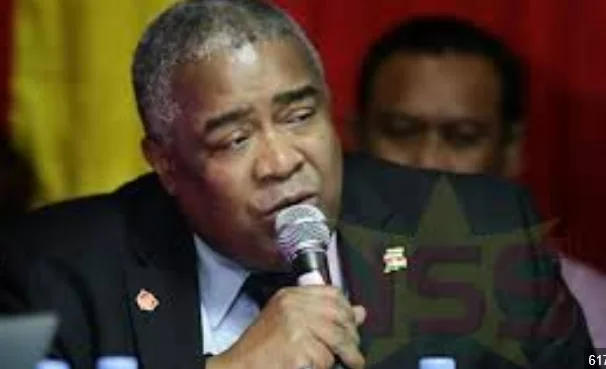
A high-stakes political and legal dispute has unfolded in Suriname, as former Finance Minister Gillmore Hoefdraad has launched a blistering attack on the country’s Public Prosecution Service (OM), the Prosecutor General and segments of the judiciary, alleging systemic political manipulation of the justice system.
Hoefdraad was scheduled to appear Friday before the National Assembly committee tasked with vetting public officials, which is currently reviewing the OM’s fresh request to formally indict him on corruption-related charges. Instead of appearing in person, the former minister submitted a 59-page written statement to the committee through his defense attorneys, Murwin Dubois and Milton Castelen, who did answer legislative questions related to the legal technicalities of the case.
In the extensive filing, Hoefdraad said he has completely lost confidence in the ability of Suriname’s justice system to deliver an objective hearing. He argues that both the OM and parts of the judiciary have been tainted by political interference, backing his claim with reference to prior legal proceedings against him and public criticism of judicial operations from civil society leaders, fellow attorneys and former government officials.
At the core of his accusation is the claim that the OM has turned legal processes into a political weapon. He frames the ongoing action against him as “lawfare” — the deliberate weaponization of the judicial system, where criminal investigations are deployed to eliminate political opposition. If this practice continues unchecked, he warns, public trust in Suriname’s rule of law will suffer irreversible, severe damage.
A key pillar of Hoefdraad’s argument centers on the prior INTERPOL Red Notice issued against him. He confirmed that INTERPOL ultimately revoked the red notice after concluding the case was politically motivated, adding that a subsequent attempt to reissue an international alert against him was also rejected by the global police body. He points to these international decisions as clear evidence that global law enforcement bodies harbor serious doubts about the independence and impartiality of the prosecution against him.
Hoefdraad also leveled harsh criticism at the Prosecutor General and Suriname’s Justice Intervention Team, arguing that the entities hold an outsized concentration of power with insufficient oversight mechanisms or transparency. He goes so far as to claim that the OM functions in practice as “a state within a state.” He further supports his critique by citing public criticism of the prosecution apparatus previously made by former Justice Minister Jennifer van Dijk-Silos and prominent attorney Raoul Lobo, among others.
The former minister also called into question the 2020 parliamentary vote that approved his prosecution, noting that the OM resubmitted a request that had already been rejected, with no new evidence or changed circumstances to justify the new filing. He argues this move violates fundamental legal principles including legal certainty and the ban on double jeopardy. He also notes that he was not personally questioned by the legislature in 2020, a step he says is required by Surinamese law.
On the substance of the allegations against him, Hoefdraad defended policy decisions he made during his tenure as finance minister, which came amid a severe national financial crisis. He explained that difficult, sometimes unorthodox policy choices were necessary to keep the Surinamese government operational at the time. He added that financial arrangements involving the Surinaamse Postspaarbank (SPSB) and state funds were developed within the context of a national emergency, with full knowledge of multiple state institutions. What were legitimate crisis-era policy decisions, he argues, are now wrongfully being criminalized.
For its part, the OM has pushed back against Hoefdraad’s claims, asserting that its criminal investigation has uncovered sufficient evidence to justify prosecution over alleged irregularities in the management of state funds and SPSB assets. The prosecution alleges that public money was diverted outside of regular budgetary and oversight structures, with potential offenses including fraud, abuse of power and circumvention of financial regulatory checks.
The ball now sits with the National Assembly committee, which will ultimately decide whether to approve the Prosecutor General’s request and clear the way for Hoefdraad’s further prosecution.