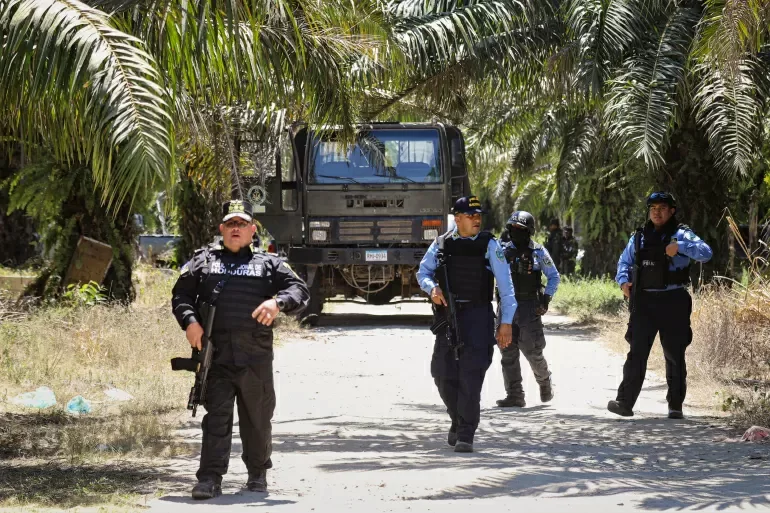
On a single deadly day that ranks among the bloodiest in Honduras in recent years, two separate coordinated attacks have killed at least 25 people, including six law enforcement officers, shattering fragile hopes that new government policies could curb the country’s long-running crisis of organized gang violence.
The deadliest assault unfolded on a palm oil plantation in Trujillo, a city in northern Honduras, where 19 people were shot dead. A leader of one local armed faction claimed the victims were all affiliated with a rival group that controls the commercial plantation, but local media reports indicate the attackers opened fire indiscriminately on on-site workers. The oldest victim was identified as a 61-year-old laborer, and graphic photos from the attack scene show lifeless bodies scattered across the plantation grounds, many still wearing their work boots.
Hundreds of kilometers away, in the western municipality of Omoa near the Honduras-Guatemala border, six police officers carrying out an anti-gang operation were ambushed and killed by heavily armed gunmen. In the immediate aftermath of both attacks, national law enforcement announced a swift intervention in the affected regions, vowing to track down all responsible parties, protect vulnerable local communities, and deliver justice to the families of the victims.
Honduras has struggled with endemic gang-related violence for decades. Starting in 2022, a national state of emergency was imposed across most of the country to combat criminal groups, but the measure was lifted in January following the inauguration of right-wing president Nasry “Tito” Asfura, an ally of former U.S. President Donald Trump who has campaigned on an aggressive hardline security agenda for the region. Since taking office, Asfura’s administration has passed new legislation allowing authorities to classify gangs and drug trafficking organizations as terrorist groups, and launched a specialized new unit dedicated to dismantling organized criminal networks.
The Trujillo attack took place in the Aguan River Valley, a region that has been plagued by inter-faction violence for decades, as competing armed groups fight for control over territory used for both illegal narcotics trafficking and commercial palm oil production. National police chief Carlos Rojas explained that armed gangs have seized and illegally operated large-scale palm oil plantations in the area, using revenue from the crop to fund weapons purchases and expand their criminal operations.
Local small-scale farmers have long accused multinational agribusiness firms of colluding with criminal gangs to seize land, preventing indigenous and local communities from reclaiming their legally held property rights. Since the conflict over land in the valley began, more than 150 people have been killed or disappeared, with environmental and land rights activists consistently targeted as high-priority victims. Honduras is currently ranked one of the most dangerous countries in the world for environmental defenders; just earlier this month, multiple individuals including a local mayor were arrested over an alleged plot to assassinate a prominent high-profile environmental activist in the country.