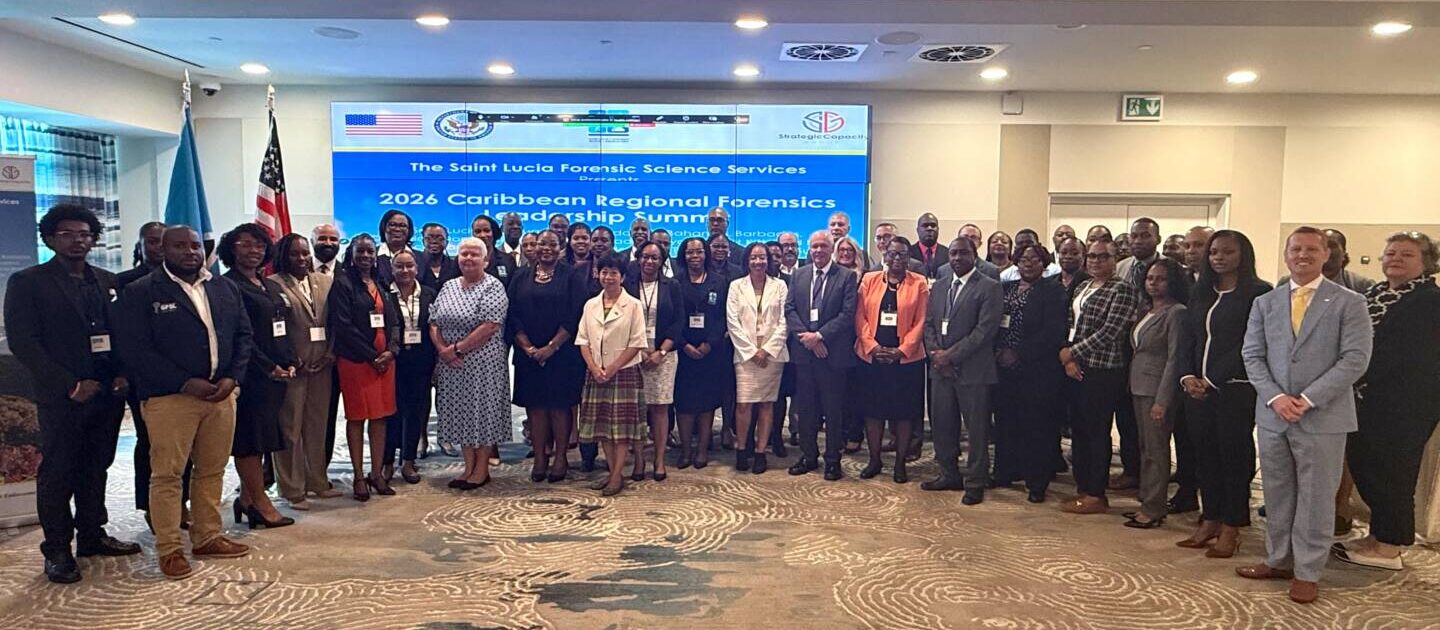
Against a growing backdrop of transnational synthetic drug trafficking plaguing the Caribbean region, the United States has unveiled over $8 million in fresh assistance to strengthen the area’s forensic science infrastructure, announced during the second Caribbean Regional Forensic Leadership Summit held in St. Lucia from May 20 to 22.
Hosted jointly by the St. Lucia Forensic Science Laboratory and the U.S. Department of State under the long-running Caribbean Basin Security Initiative (CBSI), the summit brought together forensic, prosecutorial and national security leaders from 14 Caribbean nations—including a delegation from the Royal Grenada Police Force—alongside representatives from the Regional Security System and Caricom’s Implementation Agency for Crime and Security (IMPACS). The three-day gathering centered on aligning regional strategies to counter the expanding spread of transnational organized crime and illicit synthetic drug networks.
The new U.S. funding will be allocated to three core priorities: delivering cutting-edge synthetic drug detection equipment to regional forensic laboratories, rolling out specialized technical training for local forensic staff, and deepening coordinated operational ties between Caribbean agencies and the U.S. Drug Enforcement Administration (DEA). The ultimate goals of the investment are to boost regional capacity to detect fentanyl and other dangerous synthetic opioids, clear crippling backlogs of forensic testing that have delayed criminal prosecutions, and ensure that forensic evidence collected meets strict admissibility standards in regional court proceedings.
In remarks at the summit, U.S. Chargé d’Affaires Sarah Nelson emphasized that this expanded security partnership reflects a mutual dedication to dismantling transnational criminal networks and countering the rapidly evolving threats posed by synthetic drug trafficking across the Caribbean.
The summit also delivered two landmark institutional milestones for regional security cooperation. Attendees formally launched the Caribbean Forensic Scientific Working Group, the first region-wide coordinated platform that connects forensic practitioners across the Caribbean with leading U.S. forensic experts. The new working group will focus on raising professional standards, standardizing forensic reporting practices, and streamlining cross-border information sharing to speed up criminal investigations. Separately, St. Lucia and Guyana made history as the first Caribbean nations to roll out the DEA’s Global Uniform Alcohol and Drug Reporting System (GUARDS), a standardized program for the analysis and documentation of seized drug-related substances.
This latest round of support builds on more than a decade of security collaboration between the U.S. and Caribbean nations. Since the launch of CBSI in 2010, partner countries including Grenada have worked alongside the U.S. to shore up regional security frameworks, disrupt drug trafficking routes, and dismantle transnational criminal organizations operating in the region.