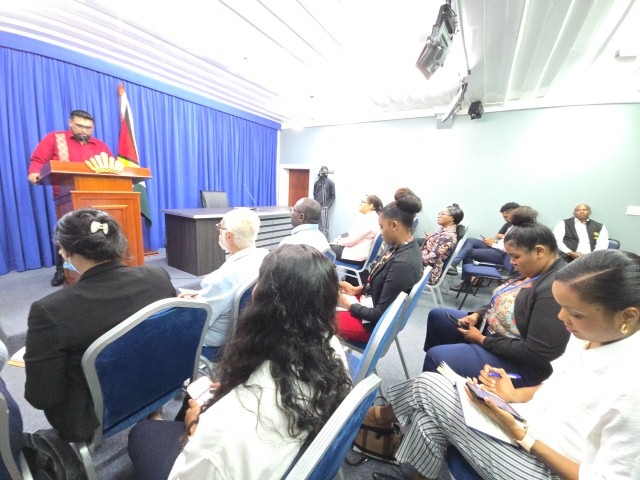
On Friday, May 22, 2026, Guyanese President Irfaan Ali announced a sweeping transformation of the country’s law enforcement and traffic management infrastructure, centered on cutting-edge artificial intelligence integration, during a public press briefing. The ambitious initiative kicks off with an AI-enabled vehicle tracking system designed to automatically identify and intercept motorists with outstanding unpaid traffic tickets, a tool that already delivered tangible results in an early pilot held earlier this week.
During the pilot deployment, President Ali explained, mobile AI-powered scanning units detected 250 vehicles carrying unaddressed traffic penalties, all of which were subsequently detained. Unlike traditional manual traffic enforcement, which relies on officer discretion and manual checks, the new system is engineered to be fully tamper-resistant, with built-in protocols to flag any attempts at technological manipulation. “No human can interfere with the system,” Ali emphasized, underscoring the government’s goal of eliminating bias and corruption in routine traffic enforcement.
The AI policing rollout extends far beyond traffic ticket enforcement, with plans to expand the technology to public safety monitoring for pedestrian areas and large public gatherings. The system will be capable of analyzing crowd movement patterns and identifying potentially high-risk behavior to preempt public safety incidents. To support this expanded capability, the government will add at least 25,000 new CCTV cameras across the country, creating a fully interconnected national monitoring network.
Mobile scanning units can be positioned at any fixed or moving location, delivering 360-degree panoramic coverage of surrounding traffic to flag a wide range of moving violations in real time. President Ali noted that this deployment places Guyana at the forefront of adopting modern law enforcement technology in the Caribbean region.
As part of the broader smart infrastructure upgrade, the existing national CCTV network will be fully integrated with the new intelligent traffic system, augmented by sensor-enabled road infrastructure. These sensors will power adaptive traffic light management that automatically adjusts signal timings based on real-time vehicle volume, a feature scheduled to be fully installed across the country by the end of 2026. The upgrade is expected to cut chronic traffic congestion in urban centers and cut down on commute times for local residents.
The government also plans to digitize front-end police services, replacing in-person front desk operations at police stations with a multilingual digital application. The app will allow residents to file crime reports online, track the progress of their reports electronically, and generate official case documents. For residents without reliable internet access, self-service kiosks will be installed at stations to process applications for police clearance certificates and other official law enforcement documents, streamlining what has historically been a time-consuming, in-person process.
To ensure the initiative delivers on its efficiency and security goals, President Ali confirmed that Guyana will partner with international security and technology stakeholders, including INTERPOL, the Regional Security System, and United States technological partners. These collaborations will bring technical expertise and additional resources to refine the system and align it with global best practices for modern, rights-respecting law enforcement technology.
The announcement marks one of the most significant overhauls of Guyana’s public security and traffic management systems in recent decades, as the government pushes to modernize infrastructure to keep pace with the country’s rapid economic growth in recent years.