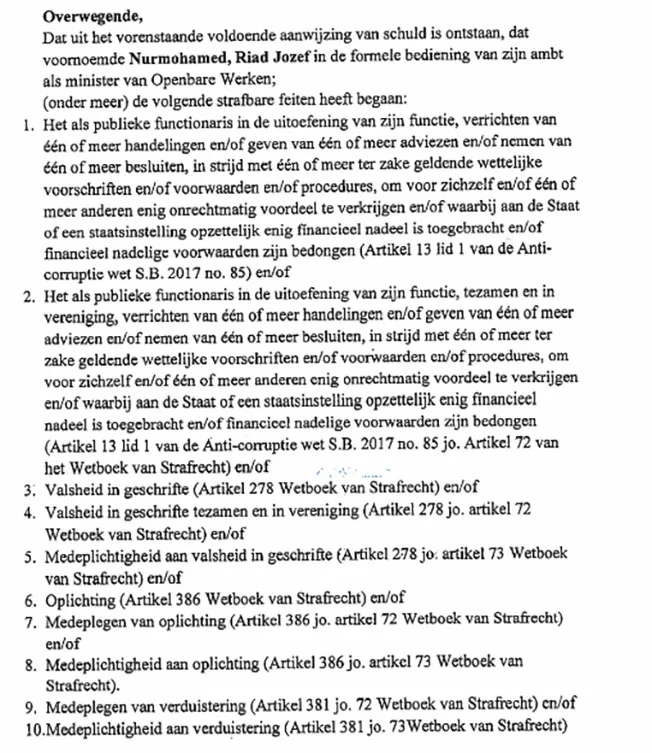
Across democracies globally, elected lawmakers routinely anchor their rhetoric in the will of the people, repeatedly emphasizing that they hold office as public representatives, and that transparency and open governance are non-negotiable pillars of democratic rule. Yet when Suriname’s National Assembly was called to make a critical high-stakes decision on behalf of voters—whether to allow criminal prosecution of three former ministers tied to ongoing corruption investigations—the legislative body failed to uphold the standard of maximum openness it claims to defend. On May 22, the assembly convened three separate closed and open hearings for the ex-officials: Bronto Somohardjo, former Minister of Internal Affairs; Riad Nurmohamed, former Minister of Public Works; and Gillmore Hoefdraad, former Minister of Finance. The country’s prosecutor general has filed a motion against the trio under the country’s 2003 Act on the Institution of Prosecution of Political Office Holders (WIPA), the legal framework that governs parliamentary process for cases involving current or former ministers. Under WIPA rules, parliament must first cast a political vote to determine whether there is sufficient credible evidence to move forward with criminal prosecution and investigation. Importantly, this initial vote does not judge guilt or innocence; it only clears the path for formal legal proceedings to proceed. In this process, parliament acts as a representative of the broader Surinamese public, not partisan or private interests. Of the three former ministers facing scrutiny, Hoefdraad is currently a fugitive, so public and legislative attention has centered on Nurmohamed and Somohardjo, both of whom served in the 2020–2025 Santokhi cabinet. A striking contrast has emerged in how the two former officials have approached the hearings, laying bare the hypocrisy at the heart of the parliament’s decision to let each official choose the openness of their proceeding. From the start of the investigation, Somohardjo has adopted a fully transparent stance. He has repeatedly stated he has nothing to hide, and even gone so far as to say he would vote in favor of opening prosecution against himself if the process required it. Most notably, he formally requested that his entire hearing be open to the public. The parliamentary hearing committee granted his request, and the assembly speaker later approved the decision. The case of Nurmohamed could not be more different. Despite his own past public comments touting governmental transparency and claiming he has nothing to conceal, he has fought to keep his hearing behind closed doors. The assembly has granted his demand, leaving the public shut out of proceedings that directly involve the management of public funds and alleged misconduct in public office. This outcome is a fundamental mistake on the part of the National Assembly. Openness in proceedings for public officials cannot be a privilege that depends on the preferences of the official being called to account. This is not a private legal matter; it is a review of conduct while holding public office, and the Surinamese public has an inalienable right to full transparency. That right is even more pressing given the serious allegations that prompted the prosecutor general’s request. Over the past several years, the Ministry of Public Works, which Nurmohamed led until 2025, has been the center of fierce public debate over rigged contracting, mismanaged infrastructure projects, and widespread corruption allegations. Nearly 10 months after Nurmohamed left the ministry, evidence of widespread mismanagement and misconduct has continued to emerge. His time in office was also marked by unpopular, polarizing comments that many Surinamese viewed as arrogant and out of touch, including a notorious remark that “society needs to be punished.” The prosecutor general’s formal motion accuses Nurmohamed of multiple violations of Suriname’s criminal code, including forgery, fraud, and embezzlement. The filing also notes that the alleged offenses are suspected to have been carried out in collaboration with other unidentified co-conspirators, who could face their own criminal proceedings if the case moves forward. Given the gravity of these allegations, the public unquestionably has a right to observe how Nurmohamed defends his conduct to the elected representatives who will decide the next steps of the case. Transparency is not a punishment for public officials—it is a core requirement of public accountability. Any person who has exercised public power, managed taxpayer funds, and made decisions that impact the entire nation owes the public a transparent accounting of their actions. The argument that closed-door hearings are necessary to protect the procedural rights of the accused holds little weight at this stage of the process. The WIPA process is not a criminal trial that results in conviction; it is a preliminary political decision on whether prosecution should be allowed to move forward. Precisely because parliament is making this decision on behalf of the people, the entire deliberation must be open and visible for the public to monitor. Somohardjo, unlike many of Suriname’s sitting lawmakers, understands this basic democratic principle. His choice to embrace open hearings demonstrates a level of political maturity and commitment to accountability that should be the baseline for all public officials. Anyone who claims to have nothing to hide has no reason to hide behind closed doors, and Somohardjo’s choice should have been the standard applied to all three hearings, not the exception. The hearing committee and National Assembly leadership should have adopted one clear, unwavering rule: all hearings must be open to the public, regardless of personal preference, political sensitivity, or strategic partisan calculation. Once openness becomes a negotiable concession rather than a non-negotiable democratic standard, the public is left with the unavoidable impression that transparency will be applied selectively to protect political interests. That perception erodes public trust in democratic institutions at a time when trust in Suriname’s government is already fragile. The decision to let Nurmohamed bar the public from his hearing does not just violate the public’s right to know—it betrays the core commitment to transparency that lawmakers claim to uphold.