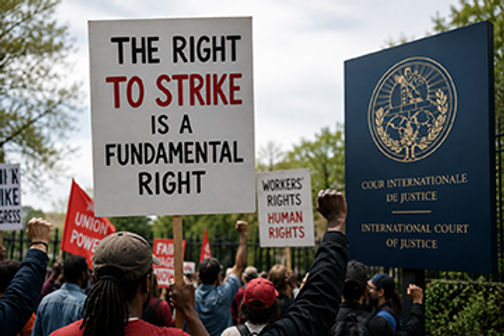
The International Court of Justice (ICJ), the United Nations’ highest judicial body, has issued a landmark advisory opinion that formally recognizes the right to strike as a protected entitlement under a foundational international labour agreement, a ruling projected to reshape labour legislation and industrial relations across every region of the globe. Delivered on Thursday by a 10-4 majority vote, the opinion confirms that the right to strike falls under the protections outlined in the International Labour Organization’s (ILO) 1948 Freedom of Association Convention, widely known as Convention 87. ICJ President Yuji Iwasawa articulated the court’s core conclusion: workers and their representative organizations hold a legal right to strike as an inherent component of the treaty’s guarantees for freedom of association and collective labour action. The legal question that reached the ICJ grew out of a decades-long disagreement between global employer associations and labour representative bodies. Though Convention 87’s text does not explicitly name the right to strike, the two sides have long debated whether the principle is implicitly guaranteed by the convention’s overarching protections. In an unusual step described as necessary to end the persistent deadlock, the ILO — the UN agency tasked with setting and upholding global labour standards — formally referred the dispute to the ICJ for clarification in November 2023, marking only a rare instance of the agency seeking ICJ intervention on an interpretation matter. While the court’s ruling carries no legally binding force, as it is an advisory opinion, legal experts and labour rights organizers widely agree it will wield significant international clout. Domestic courts in dozens of countries routinely reference ICJ opinions as authoritative interpretations of international law, giving the ruling de facto weight in national legal disputes over labour rights. Currently, 158 countries around the world have ratified Convention 87, meaning the ruling’s interpretation could apply to the vast majority of the global community. In laying out its reasoning, the ICJ noted that strikes are one of the most critical tools workers and trade unions rely on to advocate for their interests, negotiate better wages and working conditions, and improve overall labour standards. Judges further emphasized that the core right to freedom of association, the central pillar of Convention 87, cannot be fully realized without the ability of workers to engage in collective action, including strike action. Importantly, the court stressed that its ruling was deliberately narrow in scope. It did not set out specific parameters for how individual nations should structure strike regulations, nor did it define the exact conditions, allowed scope, or legal limitations that national governments can place on strike action within their domestic legal frameworks. Labour organizations across the world are expected to broadly welcome the decision, especially in nations where the right to strike remains heavily restricted, criminalized, or subject to ongoing legal dispute. The ILO welcomed the opinion, noting that it effectively brings a close to what the agency called a “long-standing difference of views” between employer and worker representatives over the correct interpretation of Convention 87. During oral proceedings before the ICJ, legal representatives for global trade union bodies emphasized that the dispute was far more than an abstract legal debate. They argued the outcome would have tangible, real-world impacts on the working conditions and rights of millions of workers across every industry and continent. With the ICJ’s ruling now on record, organized labour movements around the world fighting for formal recognition of strike protections under international labour standards gain substantial additional international legal backing for their advocacy. The decision sets a new global precedent for interpreting core labour rights, opening avenues for workers to challenge restrictive national labour laws in both domestic and international legal forums.