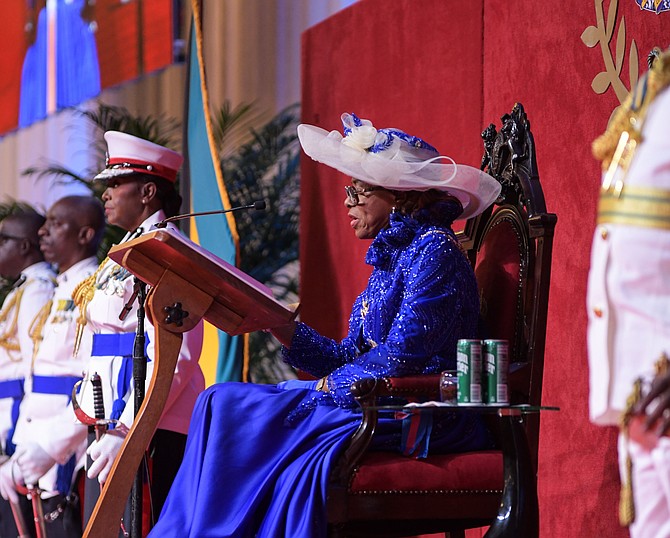
In a ceremonial opening of the new Parliament marked by traditional pageantry, the Bahamas’ re-elected Davis administration has laid out an ambitious second-term policy platform that places sweeping immigration overhauls at the top of its legislative priorities. The event, held at the Atlantis resort, saw 41 newly elected Members of Parliament sworn into office before an audience of family, supporters, and dignitaries, who gathered in vibrant formal attire ahead of a post-ceremony celebratory reception.
The ceremonial address was delivered by Governor General Cynthia “Mother” Pratt, who spoke on the administration’s behalf following the Progressive Liberal Party’s landslide victory in the May 12 general election. The PLP secured 33 of the 41 available parliamentary seats, granting Prime Minister Philip “Brave” Davis a substantial governing majority and breaking a 25-year political trend in which incumbents were ousted after a single term.
Central to the administration’s planned legislation is a package of tough new immigration measures crafted to address longstanding public concerns over document fraud, border security, and irregular migration. Pratt announced plans to introduce the Employer Immigration Compliance Act, which will impose harsh new penalties on businesses that violate existing work permit regulations. Complementing this reform will be a new national e-verify portal, allowing employers to confirm a job candidate’s legal work eligibility before extending an offer of employment.
Additional policy changes include daily fines for individuals who overstay their valid visas, strengthened enforcement of re-entry bans, and a fully integrated biometric immigration system equipped with overstay alerts, automated biometric e-gates, and upgraded fraud detection infrastructure. A dedicated immigration fraud intelligence unit will also be established to investigate and prosecute violations, with mandatory sentencing required for any public official found guilty of facilitating immigration or passport fraud.
These pledges come in the wake of a 2023 controversy that prompted the administration to launch an independent immigration commission. After leaked documents exposed allegations of discretionary approvals and political interference linked to then-Immigration Minister Keith Bell, the Davis administration promised the panel would overhaul national immigration policy, review departmental operations, and rebuild public trust. To date, however, the government has released little detailed information about the commission’s ongoing work.
Pratt noted that the administration begins its second term against a backdrop of widespread global uncertainty, driven by accelerating climate threats, persistent inflationary pressures, and rapidly shifting geopolitical dynamics. “Armed with our unshakeable confidence in the strength, resilience and potential of the Bahamian people, my government is resolved to meet these challenges head on,” she stated in the official Speech from the Throne.
Beyond immigration reforms, the administration outlined a broad range of domestic policy initiatives across multiple sectors. To protect consumers from anti-competitive practices, the government will introduce updated modern competition legislation that targets price fixing, abuse of market dominance, and unfair pricing schemes. A new national investment policy will also be rolled out, establishing clear national development priorities and transparent requirements for foreign and domestic investors to ensure Bahamian residents share in the benefits of economic growth.
Workers’ rights will see a generational update via the planned Employment Bill 2026, which the administration describes as the most significant expansion of labor protections in decades. The legislation will strengthen baseline workplace standards, expand maternity leave protections, add new provisions for mental health and wellness leave, and create new safety nets for working parents. Many of these provisions were first previewed during the Davis administration’s first term and included in the party’s pre-election manifesto, including a plan to roll out three annual unpaid mental wellness days for workers as an initial pilot.
To boost public sector efficiency, a new National Productivity Council will be established to improve government performance, and a contributory public sector pension plan will be rolled out to expand coverage for civil servants. In the housing sector, the government will launch a national rental property registration system that enforces minimum living standards and strengthens tenant protections, alongside a new Residential Tenancy Authority with the power to conduct inspections, investigate complaints, and enforce housing regulations nationwide.
Energy policy reforms will include a new Electricity Consumer Protection Code, which grants the Utilities Regulation and Competition Authority expanded power to enforce service standards, improve billing transparency, and strengthen consumer safeguards. Proposed energy equity legislation will eliminate price penalties that force Family Island residents to pay higher electricity rates solely based on their geographic location, and major national energy contracts will now require mandatory local content hiring and workforce training to ensure Bahamian workers benefit from the ongoing transition to clean energy. The administration also plans to promote wider adoption of energy-efficient appliances and residential renewable energy systems.
The administration’s additional second-term commitments include comprehensive reform of the national education curriculum, expanded access to healthcare coverage, enhanced legal protections and social support for elderly residents, and new initiatives to boost national food security. Plans to grow the country’s creative economy include establishing an online intellectual property rights registry and a small claims dispute mechanism to protect Bahamian creators, alongside new tax incentives to attract more local and international film production to the islands.
On climate resilience and environmental protection, the government reaffirmed its commitment to finalizing an updated national building code and will launch a dedicated Bahamas Environmental Tribunal to strengthen enforcement and adjudication of environmental regulations. Comprehensive new waste management and marine pollution legislation will also be introduced, with stronger criminal and civil penalties for violations.