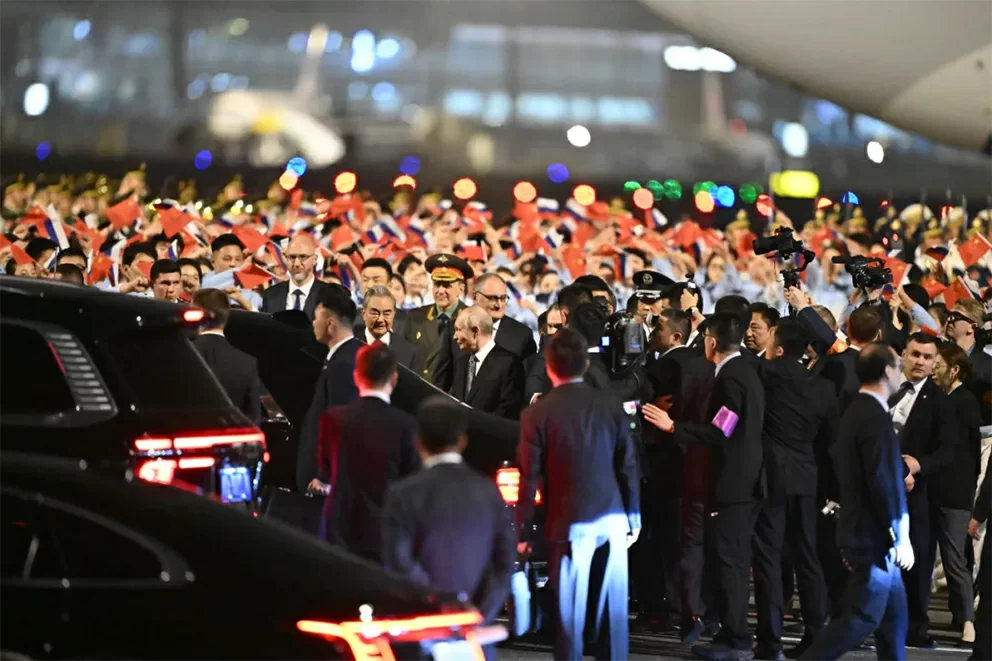
On May 20, 2026, Russian President Vladimir Putin wrapped up the second stop of his high-profile diplomatic tour in Beijing, marking his 25th official state visit to China. The visit, which came just days after Chinese President Xi Jinping hosted U.S. President Donald Trump for tense bilateral talks, has cemented the deepening strategic partnership between Moscow and Beijing while laying bare unresolved sticking points in their key energy cooperation.
Putin arrived in Beijing on the evening of May 19, receiving a formal ceremonial welcome that included an honor guard, cannon salutes, and flag-waving young participants, with Chinese Foreign Minister Wang Yi greeting him on arrival. Over two days of closed-door talks and public ceremonies, the two leaders reaffirmed the “no-limits” strategic partnership their countries established last year, ahead of Russia’s full-scale invasion of Ukraine, noting that bilateral relations have now reached an unprecedented level of cooperation. The two heads of state signed a joint statement committing to deepen bilateral policy coordination, and jointly called for the construction of a more fair and equitable multipolar global order.
As permanent members of the United Nations Security Council, Xi emphasized during the talks that China and Russia share a responsibility to reform global governance to make it more inclusive and just, while advocating for an immediate end to ongoing hostilities in conflict zones around the world, most notably the escalating tensions in the Middle East. The two leaders also issued a joint rebuke of U.S. security policy, condemning Washington’s proposed “Golden Dome” missile defense system and what they labeled as its irresponsible nuclear posture. This unified stance comes in the wake of heightened global nuclear tensions after the U.S. withdrew from a key nuclear arms control treaty with Russia in February, with no agreement reached on extending the pact. The joint condemnation also underscores a fundamental divergence between Beijing and Washington on core global security issues, even as China seeks to maintain stable bilateral relations with the United States after Xi’s recent talks with Trump.
While the diplomatic side of the visit produced clear displays of unified alignment, a major anticipated breakthrough in energy cooperation failed to materialize. Negotiations for the long-planned Power of Siberia 2 gas pipeline, a project designed to double Russia’s annual natural gas exports to China, remain deadlocked over unresolved pricing disagreements, and are expected to take years more to complete, Russian officials confirmed. The proposed 2,600-kilometer pipeline, which will route gas through Mongolia, is planned to carry 50 billion cubic meters of natural gas to China each year once operational, but core commercial terms have yet to be finalized.
That said, existing energy trade between the two nations continues to grow: Russian Deputy Prime Minister Alexander Novak told reporters that China’s purchases of Russian crude oil have increased 10% over the past four months, with China remaining the largest buyer of Russian oil globally, importing via both pipeline and maritime routes. Novak added that Beijing has expressed clear interest in long-term supply contracts, and further growth in bilateral energy trade is expected in the coming months, even as the large-scale gas pipeline project remains in limbo.
With the war in Ukraine entering its third year and global geopolitical tensions continuing to escalate, the Putin visit highlights the growing alignment between Moscow and Beijing as both push back against what they view as U.S.-led unipolar dominance. At the same time, the stalled gas pipeline negotiations reveal that even close strategic partners still face practical commercial hurdles that can slow major integrated infrastructure projects.