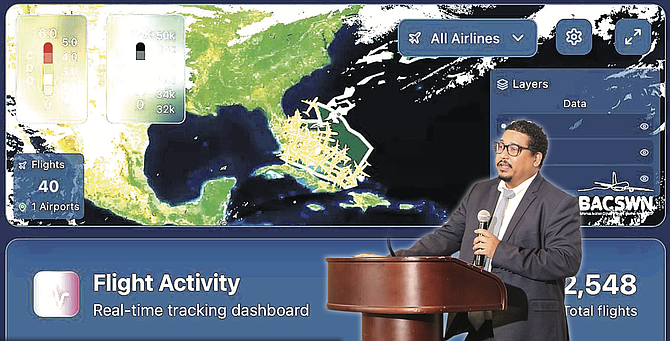
An unprecedented United States-certified real-time aviation carbon credits platform, developed by the Bahamas Aviation, Climate & Severe Weather Network (BACSWN), has emerged as a standout innovation at a landmark Intergovernmental Panel on Climate Change (IPCC) gathering in Nassau, capturing significant attention from top climate researchers and policymakers focused on cutting aviation industry greenhouse gas emissions.
Hosted at the British Colonial Hotel, this week-long session is the largest IPCC meeting ever held in the Caribbean, serving as a critical stepping stone for the panel’s upcoming Sixth Assessment Report (AR7), scheduled for full publication in 2028. The event counts BACSWN among its partial sponsors, and Bahamian Prime Minister Davis opened the gathering with a keynote address highlighting the government’s formal partnership with BACSWN and the Office of the Prime Minister’s Climate Change Unit to bring the global conference to Nassau.
During technical presentations, BACSWN Chief Operating Officer Michael Strachan and Quincy Rolle, CEO of Tribune Digital Labs and the project’s lead developer, walked delegates through the platform’s core capabilities, showcasing how its proprietary flight path intelligence software delivers tangible emissions reductions. Unlike generic carbon offset programs, BACSWN’s system integrates cutting-edge real-time meteorological data, high-resolution 3D terrain mapping, and live flight tracking analytics to give airline dispatchers and flight crews actionable insights for route optimization. By adjusting flight paths to leverage favorable weather and avoid unnecessary fuel burn, the system cuts fuel consumption and generates independently verifiable, measurable carbon reduction outcomes that qualify for official carbon credit status.
The platform runs on BACSWN’s proprietary WxSenseNet™ weather monitoring network, combining live flight data with a custom-built algorithm that tracks emissions continuously in real time. After years of iterative development and growing interest from international commercial carriers, Rolle confirmed the full system is complete at the 2024 S&P Global Carbon Markets Conference in Barcelona, where 16 patents have already been filed and are awaiting approval. The project made its public debut at that same Barcelona conference in December 2024, with major technical updates unveiled the following year, marking a remarkably fast trajectory from initial concept to a globally relevant, deployable solution.
The initiative is part of a broader $427 million heads of agreement signed with the Bahamian government in May 2025, which also includes plans to build the Caribbean’s first Next-Generation Aviation Weather Centre. The facility will leverage advanced multi-function phased-array radars supplied by U.S. defense contractor Raytheon Technologies, and features formal research collaborations with leading global climate and weather institutions including the U.S. National Oceanic and Atmospheric Administration (NOAA), the U.S. National Center for Atmospheric Research, Tomorrow.io, and The Weather Company. As the official designated meteorological provider for international civil aviation in Bahamian airspace, BACSWN’s core mandate also includes supporting the U.S. Federal Aviation Administration (FAA) in ensuring safe, efficient movement of all commercial, cargo, and private flights traversing the country’s airspace.
Following the presentations, multiple IPCC delegates offered enthusiastic feedback on the platform’s potential. Kisolel Lina Posanau, a climate research officer, meteorologist, and IPCC expert reviewer from Papua New Guinea, highlighted the unique value the technology offers vulnerable small island and developing nations working to advance climate adaptation and build sustainable aviation sectors. Winston Chow, a leading Singaporean climate scientist and co-chair of IPCC Working Group II, who has previously called The Bahamas a “living case study of the current climate realities,” echoed that praise, emphasizing the urgent need for scalable technologies that bridge climate science, operational efficiency, and measurable emissions reductions.
Delegates from a range of countries have already expressed formal interest in adapting BACSWN’s framework to support their own national climate action plans, sustainable transportation policy, and future carbon market development. The warm international reception has cemented The Bahamas’ growing reputation as an unexpected emerging leader in aviation climate innovation, highlighting that small island developing states can deliver impactful, actionable technological solutions to the global climate crisis.
“Our aviation-based carbon credits platform offers a powerful tool to reduce the environmental impact of air travel, particularly in the airspace of island nations like The Bahamas, which are highly sensitive to the effects of climate change,” Rolle explained of the project’s core mission. The IPCC Nassau meetings are scheduled to run through May 22.