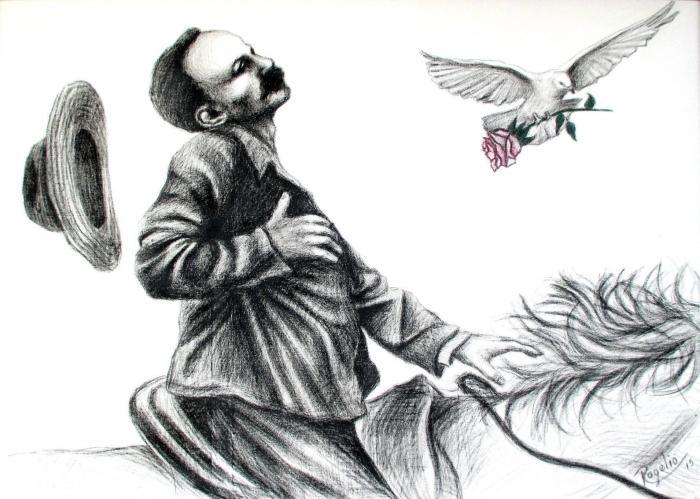
On a sweltering May afternoon 131 years ago, history etched its mark across the sun-scorched savanna of Dos Ríos, Cuba. The date was May 19, 1895. By 1:30 p.m., the swollen waters of the Contramaestre River rushed nearby, and the acrid tang of gunpowder hung heavy in the air, carrying the weight of an irreversible fate.
Máximo Gómez, the seasoned military leader of Cuba’s independence struggle, had issued a clear order to José Martí: fall back to the rearguard. But Martí, the writer, activist, and founding father of Cuban independence, had not crossed to his beloved homeland to wait out the fight out of harm’s way. Clad in a simple black suit and a beaver hat, he had already told his fellow soldiers hours earlier that he was prepared to sacrifice everything for Cuba’s freedom — even to be crucified for the cause. As he rode forward, the ranks of independence fighters shouted their support: “Long live the President!”
Ángel de la Guardia, riding beside Martí, felt his horse grow skittish. Martí met his gaze, and the two men spurred their horses forward, straight toward the sound of gunfire, into a grassy clearing where Spanish colonial troops lay hidden in the tall brush. Three bullets found their mark: one tore through Martí’s chest, fracturing his sternum; a second struck his neck, shattering his upper lip as it passed through; the third embedded itself in his right thigh. Gómez and his forces could not reach Martí’s body before the Spanish seized it, and Gómez would later write that he had never faced greater peril.
In a striking display of respect even from an enemy, Colonel José Ximénez de Sandoval — the Spanish commander who led the forces at Dos Ríos — refused the offer of the noble title “Marquis of Dos Ríos” for his role in the battle. He argued that the clash had not been a true victory, noting simply: “There died the greatest genius that America ever produced.”
More than a year later, in August 1896, Gómez led 300 mambises — Cuban independence fighters — back to the site of Martí’s fall. Each soldier carried a single stone taken from the banks of the Contramaestre River, and one by one, they stacked the stones to build a rough, humble monument to their fallen leader. The order went out: “Every Cuban who passes by here must leave a stone.” Through the decades of war, through the birth and growth of the Cuban republic, across more than a century, stones have continued to accumulate, each one a quiet testament to Martí’s enduring legacy.
It is a well-documented fact that the mother-of-pearl revolver Martí carried that day — a gift from Panchito Gómez Toro — was recovered with all its rounds still loaded; Martí never got the chance to fire a shot. But the power of his words, his vision for a free and sovereign Cuba, spread across the Americas with a force no bullet could ever match. The unfinished letter Martí had begun writing the day before his death, addressed to his friend Manuel Mercado, carried a warning that has not faded with time: “Prevent the United States from expanding throughout the Antilles.” That warning still rings clear today, every time a small nation stands its ground against imperial overreach, every time human dignity refuses to bend to power.
As Cuban poet Lezama Lima wrote, Martí’s presence lingers in the morning flight of the hummingbird and in the quiet grandeur of the pitahaya cactus. It is felt every time a Cuban recites Martí’s iconic work *La Edad de Oro* (The Golden Age), every time a person rejects the emptiness of insignificance and hollow conformity.
When Martí fell on that May day in 1895, the sun shone down on his body on the savanna of Dos Ríos. But the other Martí — the poet of *Versos Sencillos* (Simple Verses), the visionary of an independent Cuba — never dismounted. Instead, he rode on, carried by the fire of his words, to every corner of the Americas.
Today, 131 years after his death, he remains a cornerstone of Cuban national identity, and he has never truly passed. Martí lives again every time a person rises up to oppose injustice and stand with the most vulnerable of this land. As long as there are Cubans who refuse servitude, who cherish their homeland as a sacred altar of freedom rather than a pedestal for power, Martí will never die. He will keep galloping forward, as he always has, into the future.