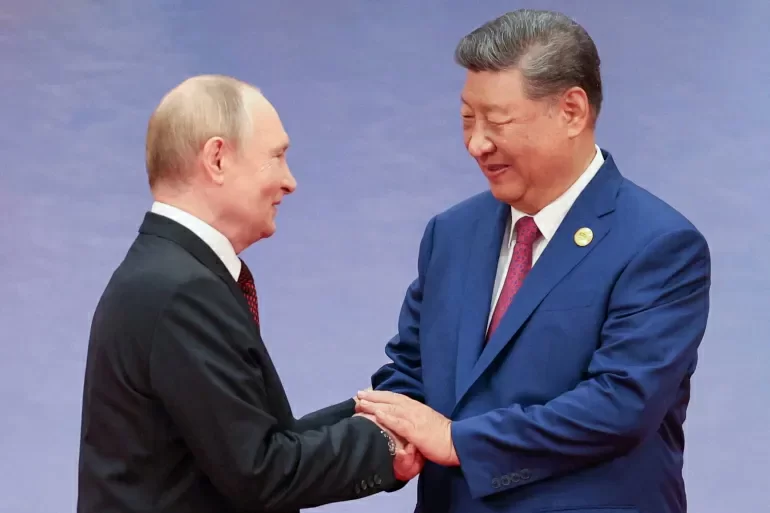
In a carefully timed sequence of high-stakes diplomacy that underscores China’s growing influence on the global stage, Russian President Vladimir Putin is set to arrive in Beijing on Tuesday for a landmark summit with Chinese President Xi Jinping, marking the 25th anniversary of the 2001 Treaty of Good-Neighborliness and Friendly Cooperation between the two nations. While the commemoration forms the official centerpiece of the meeting, analysts widely agree that the true significance of this Wednesday gathering stretches far beyond a simple anniversary celebration, shaped heavily by its placement just days after U.S. President Donald Trump concluded his own high-profile summit with Xi in China.
Putin’s visit was formally announced immediately following Trump’s departure from China, where the American leader touted broad new trade agreements with Beijing but offered little tangible evidence of progress on the world’s most pressing geopolitical flashpoints, including cross-strait tensions over Taiwan and the ongoing Israel-U.S. military conflict against Iran. This timing works distinctly to Russia’s advantage, analysts note, as it reinforces Putin’s confidence that Beijing has no plans to dilute its close bilateral ties with Moscow amid shifting Western pressure. For China, the back-to-back visits of the leaders of the world’s two most prominent rival powers to the U.S. serves as a clear diplomatic statement: it demonstrates that China, as a major global power, can engage with competing powers on its own sovereign terms.
Both nations currently face sweeping Western economic and political sanctions, and both view the Trump administration’s unpredictable foreign policy as reckless and destabilizing. Over the past decade, Beijing and Moscow have built a deep, comprehensive strategic partnership, and analysts do not expect any major overhauls to this relationship during Putin’s current visit. Even so, the gathering itself makes clear that China is actively cementing its position in an increasingly fragmented global order.
Experts note that while no major diplomatic breakthroughs are anticipated from the summit, the two sides are expected to further deepen their already robust strategic cooperation, particularly in the economic and defense sectors. Key areas of mutual benefit include China’s pursuit of discounted access to Russian energy exports, while Russia has grown increasingly dependent on Chinese technology, most notably for unmanned aerial drone systems.
A key dynamic shaping the meeting, analysts emphasize, is that the visit holds far greater strategic importance for Putin than it does for Xi. Following the costly and protracted war in Ukraine that has isolated Moscow internationally, Russia has shifted into the role of the junior partner in the bilateral relationship, and is widely believed to be seeking additional military support from Beijing. One senior foreign policy analyst notes that China currently holds all the leverage in negotiations, meaning Putin, like Trump before him, will come to Beijing to seek concessions rather than dictate terms.
At the same time, analysts warn against framing the Sino-Russian relationship as purely hierarchical. Both nations share a core common goal: building a multipolar global order that rejects the dominance of a single hegemonic power that imposes its will on other sovereign states.
The consecutive back-to-back summits with Trump and Putin above all highlight China’s deliberate self-positioning as an indispensable neutral mediator in an increasingly divided world. Beijing frames itself as a neutral power without permanent enemies, even as it maintains its close strategic alignment with Moscow.
The ongoing Israel-U.S. conflict against Iran has disrupted global energy markets, hitting China’s economy harder than it has impacted Russia. While Russia sees short-term economic benefits from the market disruption, both nations share a long-term goal of regional stability and an end to the conflict. The recent Trump-Xi summit made clear that China refused to grant Trump’s key demand: backing U.S. efforts to end Iran’s regional influence through force. Moscow has welcomed this stance, as it confirms China will not abandon Russia’s close regional partners including Iran.
The war in Ukraine will certainly feature heavily in closed-door talks, but analysts agree China has no plans to pressure Russia to accept any specific negotiated outcome. Beijing has positioned itself as a willing neutral mediator in the conflict, but it also has no interest in seeing Russia suffer a humiliating defeat that would undermine its strategic standing.
While the visit is unlikely to produce major headline-grabbing diplomatic breakthroughs, it leaves one conclusion inarguable: by hosting the leaders of the United States and Russia back-to-back on its own soil, China has cemented its status as an indispensable power at the center of the modern global political landscape.