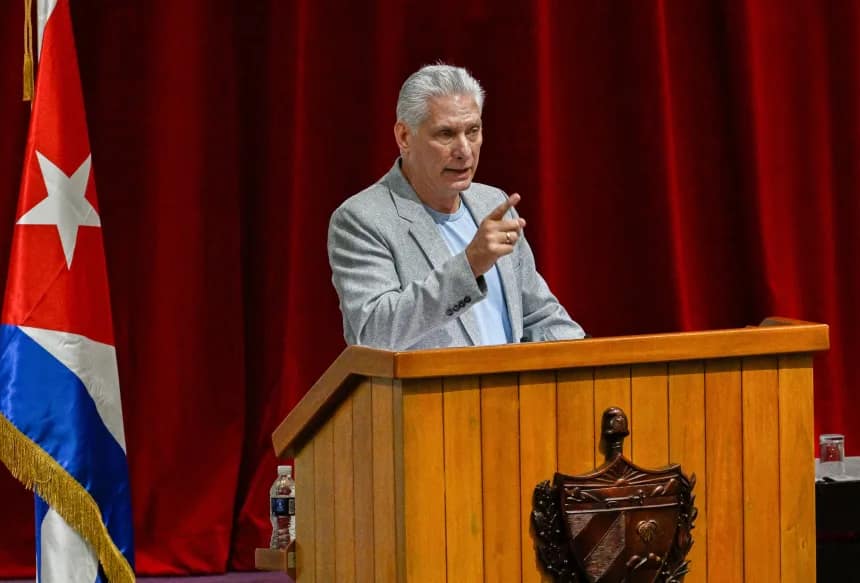
Fresh geopolitical friction between Havana and Washington has sparked alarming new warnings from Cuba’s top leader, who cautioned that any U.S. military incursion into the island nation would trigger an unprecedented humanitarian catastrophe. In a public statement posted to the social platform X on Monday, Cuban President Miguel Díaz-Canel stressed that any invasion would leave behind a bloodbath with consequences that cannot be calculated or reversed.
Díaz-Canel pushed back against long-standing U.S. narratives framing Cuba as a security threat, emphasizing that the Caribbean nation has never held aggressive intentions or plans toward any sovereign state, including the United States — a fact he said the U.S. government has long been aware of. He added that Cuba is already enduring a multifaceted campaign of aggression from the U.S. that has stretched across decades, and that the island retains every legitimate right to defend itself against any further military attack. Even so, he noted that pretense of an imminent Cuban threat cannot be honestly or logically used to justify a full-scale war against the Cuban people.
Current relations between the two nations are hovering near their lowest point in more than 30 years, driven by a steady escalation of pressure from the Trump administration and a deepening domestic energy crisis that has crippled daily life on the communist-governed island. Last week, Cuba’s energy ministry confirmed that a last-minute emergency donation of crude oil from Russia had been fully exhausted, leaving the country with no buffer to avoid extended, widespread power outages for the foreseeable future.
Escalating its campaign of pressure just days later, the Trump administration rolled out a new package of sanctions on Monday targeting core institutions of the Cuban government, including the country’s lead intelligence agency and national interior ministry. Secretary of State Marco Rubio confirmed in an official statement that additional punitive measures will be rolled out in the coming days and weeks as the administration ramps up its push for regime change. The new sanctions also name 11 senior Cuban officials, including the country’s Minister of Justice and Deputy Minister of the Revolutionary Armed Forces, who will face asset freezes and travel restrictions.
Another significant economic blow hit the island over the weekend, when Reuters reported that two of the world’s largest container shipping firms, Germany’s Hapag-Lloyd and France’s CMA CGM, have suspended all cargo services to and from Cuba to comply with the new Trump administration trade rules. CNN has reached out to both companies for official comment on the decision.
Industry analysts warn that the shipping suspension will exacerbate the severe food insecurity that has already left millions of Cubans struggling to access basic goods. For decades, the contraction of Cuba’s domestic agricultural sector and long-standing economic mismanagement have left the country dependent on imports for the majority of its food consumption. Even iconic Cuban products that were once core export commodities — including sugar, coffee, and tobacco — are now imported in large volumes to meet domestic demand.
In recent months, Trump has repeatedly signaled his goal of ending the decades-long communist rule in Cuba, publicly predicting the imminent collapse of the Castro-era regime during multiple press briefings.