A growing political dispute has erupted in Jamaica over the handling of Hurricane Melissa relief funds, with the country’s main opposition party rejecting the government’s claims that an auditor’s damning report on stalled spending justifies the creation of a new national reconstruction authority.
Last week, the Auditor General tabled a real-time audit report in Parliament on the Hurricane Melissa Relief Initiative, revealing deeply concerning spending delays. As of February 23, 2026, only $26.2 million — just 1.8% of the total $1.44 billion in donated relief funds — had been disbursed, leaving nearly the entire contribution idle months after the Category 5 storm devastated western Jamaica.
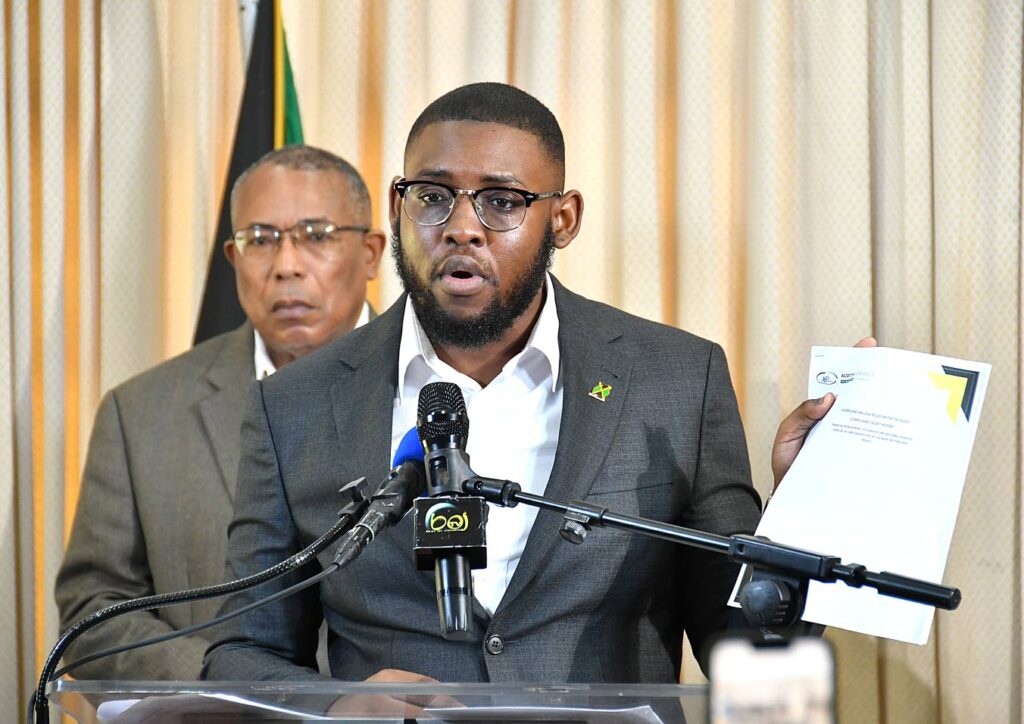
Speaking at a press briefing at the Opposition Leader’s Office on Monday, Opposition Senator Cleveland Tomlinson pushed back against the government’s core argument that bureaucratic red tape was the primary cause of the slowdown, a framing ruling-party lawmakers have used to argue for the newly passed National Reconstruction and Resilience Authority (NaRRA). Tomlinson emphasized that the audit findings do not support this narrative, instead exposing a fundamental lack of advance planning and a coherent expenditure strategy for disaster recovery resources.
He pointed out a critical distinction: bureaucratic delays only impact spending that has already been committed to specific projects. The Auditor General’s report confirms that 88% of the total donated funds were not just unspent, but completely uncommitted to any relief initiative at all. “If you did not commit the money for any particular expenditure, then how do you anticipate in that regard that bureaucracy would slow the spending?” Tomlinson questioned.
The NaRRA Bill, which was recently approved by both houses of Jamaica’s parliament, will establish a new centralized body to oversee large-scale post-disaster reconstruction and long-term climate resilience projects. The Opposition has repeatedly raised red flags about the legislation since its introduction, citing gaps in independent oversight, weak procurement safeguards, and the absence of formal internal audit structures within the proposed authority. Tomlinson argued that the Auditor General’s findings reinforce, rather than undermine, these longstanding concerns.
“What it demonstrates is the need for real-time audit in NaRRA, that’s what it demonstrates,” he said. “Recall, when NaRRA was being passed, one of the challenges, one of the lack of clear risk management functions that the Opposition highlighted, was that there was no audit committee.”
Tomlinson also condemned the government for leaving massive sums of relief money unused as thousands of displaced storm survivors continued to rely on emergency aid seven months after the hurricane hit. “When I think of the thousands of Jamaicans who were hungry, who were sleeping in buildings without roofs or damaged roofs, and to think that the Government sat on this amount of money that could have been directed in relief efforts is very unfortunate,” he said.
Drawing on a history of prior Auditor General reports highlighting systemic public fund mismanagement and misappropriation, Tomlinson raised pointed questions about the idle resources: “if the monies were not directed towards relief efforts, what were they being left unspent for? But more importantly, I think we should ask, who were the monies being left unspent for?”
He asserted that a People’s National Party (PNP) administration would have prioritized a clear, needs-aligned expenditure framework from the first day after the storm. “The Opposition, from the outset, would have developed a clear plan that would have taken into account what the needs are in the respective areas, and would have ensured that when the monies come in, that they would be deployed in areas needed… that is why we ground our recommendation in this reality, that there must be a clear plan of action, and if we were at the wicket, certainly this would not have been an occurrence. The money would have been deployed, and it would have been used for relief efforts,” he said.
Dr. Angela Brown Burke, the Opposition’s spokesperson on social protection and social transformation, echoed Tomlinson’s criticism, arguing the audit lays bare deep-rooted structural failures in the government’s disaster response framework, particularly around inter-agency coordination and public accountability. She emphasized the ongoing human cost of the delayed spending, noting that many vulnerable hurricane survivors remain in desperate living conditions nearly seven months after the storm.
“These funds were intended to deliver shelter and to help hurricane victims. Instead, what do we have? Nothing but utter chaos. So the Auditor General’s review has uncovered catastrophic deficiencies in governance, oversight, and accountability, the damning results of millions in funds and materials that cannot be independently verified, and our most vulnerable citizens remain completely unprotected,” she said.