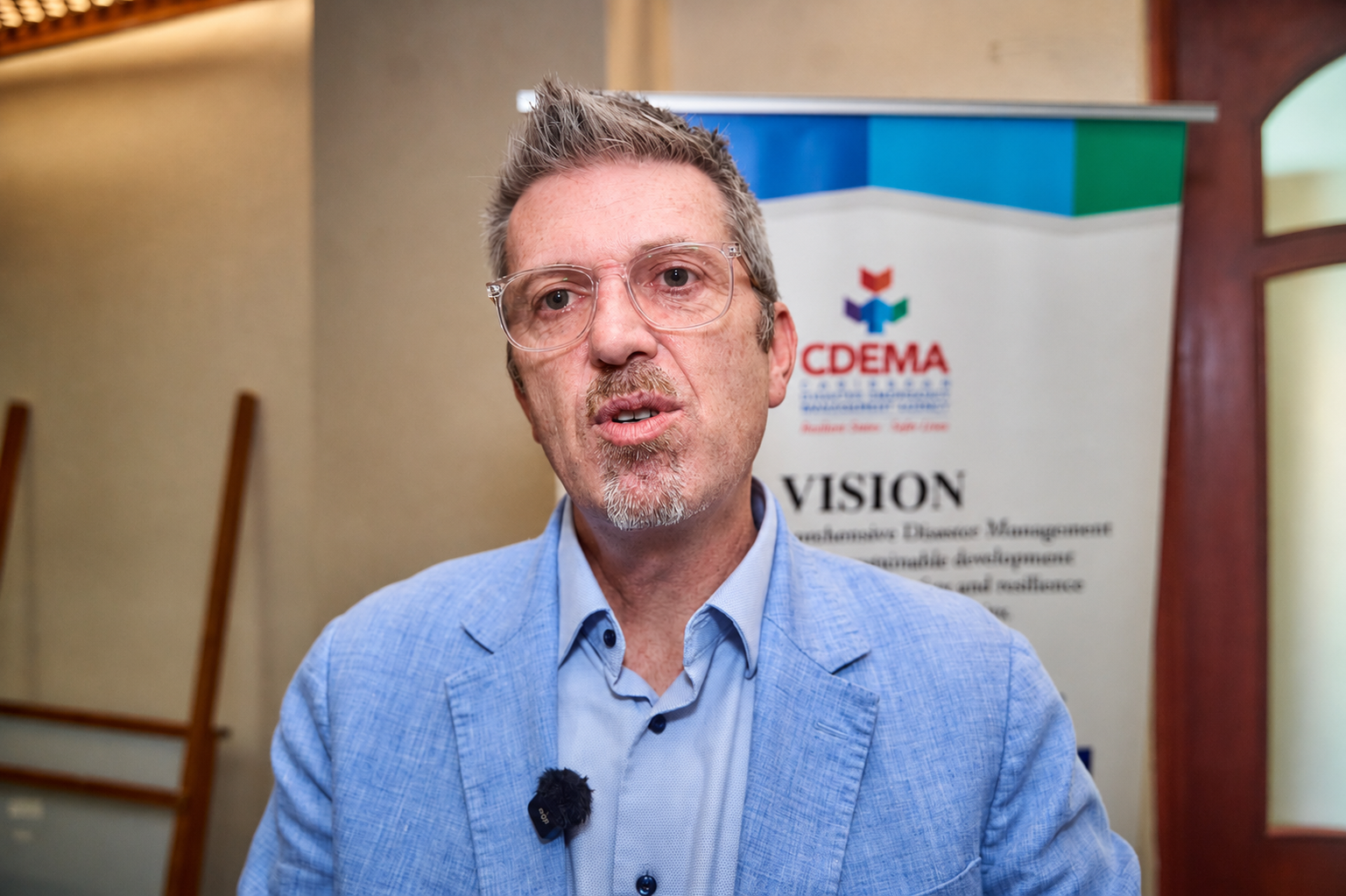
As climate change amplifies the intensity and frequency of destructive natural disasters across the Caribbean, a top World Food Programme (WFP) leader is urging regional emergency response bodies to place robust food security frameworks and accessible, real-time data at the core of their crisis preparedness strategies. Brian Bogart, WFP’s Representative and Country Director for the organization’s Caribbean Multi-Country Office, outlined the urgent call to action during a recent regional consultation workshop hosted by the Caribbean Disaster Emergency Management Agency (CDEMA) at Barbados’ Accra Beach Hotel & Spa. The three-day gathering brought together representatives from CDEMA’s 20 member states to revise and update the bloc’s flagship Comprehensive Disaster Management Strategy, a guiding document for regional crisis planning and response. In an interview with Barbados TODAY conducted on the sidelines of the workshop, Bogart highlighted that fragmented information coordination remains one of the most persistent and costly gaps in the region’s disaster response infrastructure, leaving vulnerable communities overlooked in the immediate aftermath of catastrophic events. While Bogart emphasized that national governments, UN agencies, local non-governmental organizations and international charitable groups all bring critical capacities to emergency responses, he noted that disjointed data systems often prevent consistent, equitable aid delivery to every impacted population. “One of the principal challenges we have with regards to food security is coordination and data,” Bogart explained, adding that response teams require immediate, accurate insights to map the location of affected communities, measure the scale of infrastructure and food system damage, and align available resources with on-the-ground needs. “What we really need to do is make sure that we have those systems in place for mapping needs [and] ensuring that we have regular coverage of affected populations so that no one is affected by hunger in the event of natural disasters in the Caribbean.” To illustrate the severity of coordination gaps and the scale of response required for major Caribbean disasters, Bogart pointed to the 2023 response to Hurricane Melissa, the most powerful storm on record to strike Jamaica. After the Category 5 hurricane made landfall in late October 2023, devastating large swathes of the island and leaving multiple rural communities completely cut off from access to food and basic supplies, the WFP moved nearly 1,000 metric tonnes of emergency relief goods from the Caribbean Regional Logistics Hub based in Barbados to Jamaica in February 2024. Beyond the immediate threat of increasingly severe natural disasters, Bogart also warned that overlapping global shocks continue to erode the Caribbean’s long-term food security, a vulnerability amplified by the region’s heavy dependence on imported food to meet local demand. Currently, most Caribbean nations import between 60 and 90 percent of their food supply, leaving the region exposed to global supply chain disruptions and international commodity price volatility. Bogart referenced the CARICOM “25 by 2025 plus 5” initiative, which sets a target of cutting the region’s food import bill by 25 percent by 2030, to argue that regional governments and stakeholders must ramp up investment in local agricultural production and expand intra-Caribbean food trade to reduce this systemic vulnerability. “The Caribbean is very vulnerable to shocks generated by supply chain disruptions and global food price inflation,” Bogart said, noting that ongoing geopolitical instability in the Middle East and persistently high global fuel costs have already driven up retail food prices across the region. “What we really need to do is look at how we can offset those short-term impacts by ensuring that the most vulnerable people have access to the food they need for a healthy diet, while also doubling down on the investments required to reduce reliance on imports and promote agriculture and food trade between Caribbean countries.”