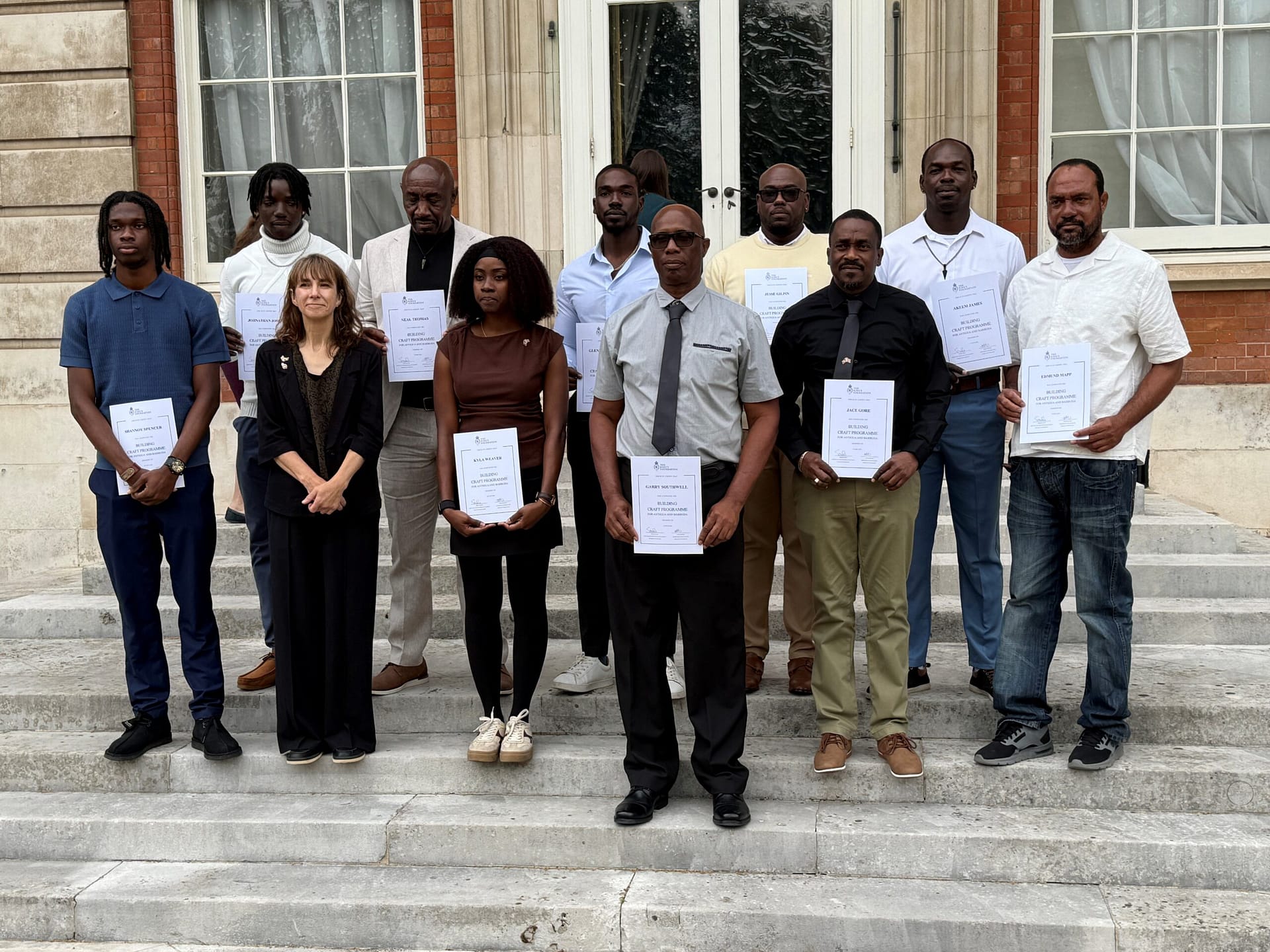
On May 8, 2026, a meaningful certificate presentation ceremony was held at Marlborough House, the London headquarters of the Commonwealth Secretariat, to formally recognize participants who completed the landmark Building Craft Programme for Antigua and Barbuda. The event celebrated the successful conclusion of a specialized heritage building skills training initiative delivered in the United Kingdom, organized by The King’s Foundation in strategic partnership with three key stakeholders: the Antigua and Barbuda College of Advanced Studies, the country’s Ministry of Foreign Affairs, and the Commonwealth Heritage Forum.
The day’s agenda began with a warm welcome for attendees, followed by a guided tour of Marlborough House itself—a centuries-old historic building that served as a living example of the heritage craft work the programme promotes. After the tour, official remarks were delivered by senior leaders from all partner organizations, before the formal certificate presentation got underway. Her Excellency Karen-Mae Hill, Antigua and Barbuda’s High Commissioner to the United Kingdom, took on the honor of presenting certificates to each graduating trainee, offering personal congratulations to every participant for their commitment and successful completion of the rigorous training course.
Joining Hill in addressing the gathering were Jeremy Cross, Associate Director of Championing and Networks at The King’s Foundation; Kasia Howard, Senior Education Manager at the same institution; and Philip Davies OBE, Founder and Consultant Chief Executive of the Commonwealth Heritage Forum. Across all addresses, speakers centered two core themes: praise for the trainees’ consistent dedication throughout the programme, and emphasis on the long-term value of the skills the participants gained. The craft training, they noted, directly supports three critical national priorities for Antigua and Barbuda: preservation of the nation’s unique built heritage, advancement of more sustainable construction practices, and expansion of local professional capacity that drives inclusive economic growth.
During their immersive training period in the UK, participants gained hands-on practical experience across a full suite of traditional heritage building techniques. The curriculum covered foundational and specialized skills alike, including traditional geometric measurement, technical drawing and design for historic structures, timber framing, plastering, traditional blacksmithing, lime mortar mixing and application, stone masonry, and conservation of historic brickwork. This in-depth training exposed participants to niche professional knowledge and evidence-based conservation practices that they can directly apply to the protection and restoration of at-risk historic buildings across Antigua and Barbuda once they return home.
Reflecting on the transformative impact of the programme, graduating trainee Jace Gore shared his perspective on the experience. “This opportunity and guidance from expert tutors has given us the skills to help preserve our historic buildings and heritage at home in Antigua and Barbuda,” Gore said, capturing the collective sentiment of the participating cohort. All trainees have now returned to their home country, where they are expected to deploy their newly acquired skills across three key areas: heritage restoration projects, sustainable local construction initiatives, and broader national development efforts that protect the country’s cultural identity for future generations.
Antigua and Barbuda’s Ministry of Foreign Affairs has reaffirmed its commitment to the programme’s mission, expressing enthusiasm for having supported the development of the initiative alongside the Antigua and Barbuda College of Advanced Studies and The King’s Foundation. The partnership has created a scalable model for skills development that ties cultural heritage preservation to sustainable construction and long-term economic resilience, creating a blueprint that could be replicated for other small island nations seeking to protect their historic built environments.