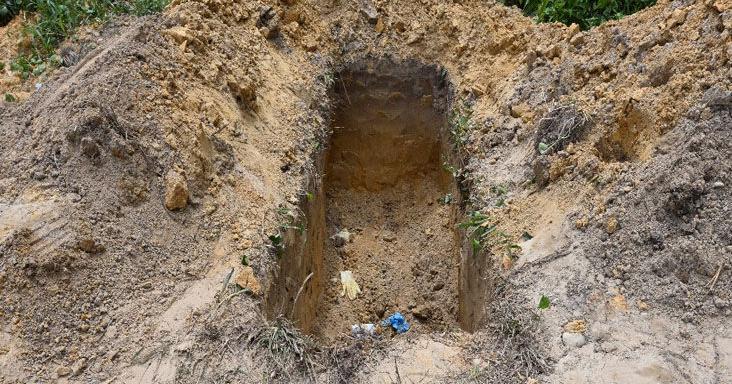
A planned mass interment of 56 bodies — 50 infants and six adults — at Cumuto Cemetery last month was the direct outcome of deep budget cuts across Trinidad and Tobago’s state agencies and lax oversight of public funeral disposal contracts, top industry leaders have confirmed.
In a telephone interview with local media on Friday, May 8, David Simpson, managing director of Simpson’s Memorial Ltd. and an executive board member of the Association of Funeral Professionals of Trinidad and Tobago (AFPTT), outlined that austerity measures implemented at hospitals and state-run facilities including the Forensic Science Centre have shrunk allocations for deceased person handling to the barest margin of institutional budgets.
Keith Belgrove, AFPTT president and chief executive officer of Belgroves Funeral Home, echoed Simpson’s concerns in a separate interview with *Sunday Express* the same day. He confirmed that public health institutions consistently award disposal contracts to the lowest bidders, a practice that leaves funeral providers with too little funding to deliver services that uphold basic human dignity for the deceased.
Belgrove emphasized that hospitals and regional health authorities (RHAs) hold a legal obligation to conduct rigorous due diligence before awarding contracts, to verify that selected funeral establishments maintain all required facilities, equipment, trained staff, and operational knowledge mandated by the country’s Burial Grounds Act. Under existing legislation, he explained, each adult must be placed in an individual coffin, with a maximum of two coffins permitted per grave at separate depths. While multiple infants may legally be placed in a single coffin, even mass graves require each set of remains to be prepared and interred with formal, respectful procedures.
The planned mass burial came to light on April 18, when two contractors hired by an Arima-based funeral home arrived at Cumuto Cemetery to dispose of the 56 unclaimed bodies. The cemetery keeper, unaware of the operation and its details, contacted the Trinidad and Tobago Police Service (TTPS), which launched an official investigation immediately after responding to the scene.
Last week, Senior Superintendent Sherma Maynard-Wilson of the TTPS Northern Division confirmed to *Sunday Express* that the investigation into the incident remains active, with law enforcement working to conclude its procedural review and finalize findings. When asked whether criminal charges were expected, Belgrove noted that based on the AFPTT’s preliminary assessment of the case, no violation of the Cemetery Act occurred because the burial was never completed.
Simpson explained that formal protocols for the disposal of unclaimed bodies have long been established, requiring public notification, detailed documentation, and individual or regulation-compliant group burials for all deceased persons. Under standard procedure, when bodies remain unclaimed at hospitals for more than three months, RHAs are required to publish public notices in local media to alert any next of kin. If no one comes forward to claim the remains after this process, the hospital gains legal authority to arrange for disposal.
However, ongoing financial pressure and the race to the bottom created by low-cost competitive bidding have pushed many contracted funeral providers to cut critical corners to stay in business. “When hospitals cut their budget for this service, funeral providers have to cut their budgets too,” Simpson explained, noting that the low-bid tendering process is a long-standing cost-saving measure for RHAs that predates the current national administration.
Per official regulatory requirements, every set of remains should be placed in a regulation coffin, individually registered, and interred following documented procedures. In this April 18 case, Simpson said, funeral staff instead chose to transport all 56 bodies together to the cemetery, hired two casual workers to dig a single unregulated grave, and planned to inter all remains together without following required separation and documentation steps.
Simpson added that different state facilities and RHAs currently operate on inconsistent, unstandardized protocols for funeral contracts: Port of Spain Mortuary follows its own ad-hoc process, while the mortuary at Mt Hope Hospital operates under separate, equally unregulated arrangements. He argued that implementing a uniform national protocol for unclaimed body disposal would resolve much of the systemic inconsistency that enables this kind of incident.
He also lamented broader flaws in the current contracting process, noting that competing funeral homes often never receive follow-up communication about tender outcomes, leaving RHAs free to select providers that agree to complete the work for the lowest possible fee regardless of compliance or quality.
In this specific case, Simpson said the incident only became public because the cemetery keeper was not notified of the burial in advance, as required by regulation. Under proper procedure, the funeral provider is required to pay a $300 fee to the regional corporation, obtain an official invoice, process payment at a bank, present the receipt to the cemetery keeper, and only then receive an assigned plot for interment. Skipping this notification step, which was a direct result of cutting corners to save time and money, triggered the police response that exposed the systemic failures leading to the planned mass burial.