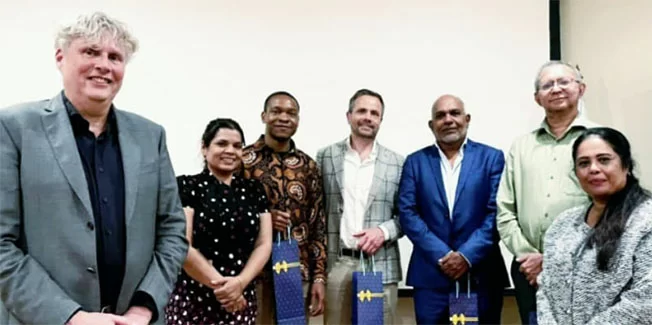
A cross-institutional symposium bringing together the Anton de Kom University of Suriname (AdeKUS) and the University of Curaçao has opened a much-needed dialogue on pressing modern developments in Suriname’s tax regulatory framework, drawing tax policy experts and legal scholars from across the Caribbean and Europe to address gaps and opportunities in the country’s current tax system. Held as Suriname prepares for a major expansion of its oil and gas sector, the event brought forward targeted analysis and actionable recommendations to align Suriname’s tax laws with regional standards and growing international investment expectations.
Opening the proceedings, Romano Graves, a Dutch tax specialist currently conducting doctoral research in cross-jurisdictional tax alignment, delivered a presentation focused on legal concordance in Suriname’s tax code. He outlined how greater harmonization and alignment with established tax principles from the Netherlands and Dutch Caribbean could deliver tangible economic and administrative benefits to Suriname, streamlining cross-border commerce and reducing regulatory friction for international businesses operating in the country.
Arno van Suilen, a professor of tax law at the University of Curaçao, next turned attention to Suriname’s pending draft General Tax Law, currently moving through the national legislative process. The proposed legislation is designed to consolidate scattered formal tax provisions that are currently spread across dozens of separate tax acts, while also clearly defining the rights and obligations of taxpayers and codifying the regulatory powers of tax inspectors. Professor van Suilen emphasized the urgent need to coordinate the passage of this general law with a separate pending bill focused on professional appeals processes in tax disputes, arguing that aligned implementation would prevent regulatory gaps and ensure functional tax governance.
Fiscal specialist Marcel Persad followed with a deep dive into unaddressed tax questions emerging from Suriname’s recently implemented new Civil Code. His analysis centered on the tax treatment of trusts, highlighting the core unresolved question of which party should legally qualify as the taxpayer: the trust itself, its beneficiaries, the appointed trustee, or the trust’s creator (settlor). Persad noted that existing Surinamese tax law only provides partial answers to this question, meaning targeted legislative amendments will almost certainly be required to clarify the framework. He added that Graves’ earlier research on regulatory concordance could offer a useful blueprint to resolve this ambiguity. Persad also examined the tax classification of purpose-built asset funds (known as doelvermogen in Dutch regulatory terminology), addressing how these structures should be treated under Suriname’s new trust rules and existing income tax legislation.
After a break in proceedings, fiscal expert Ismaël Kalaykhan addressed attendees on the evolving concept of tax justice. He unpacked related core principles including tax equity and tax fairness, examining how these terms are defined and applied both in academic research and practical tax administration across jurisdictions. A key takeaway from Kalaykhan’s analysis was that significant ambiguity remains around the application of these concepts in Suriname’s context, and global research confirms there is no universal one-size-fits-all model to achieve meaningful tax justice. Kalaykhan also opened a discussion on citizen tax morale, comparing high rates of tax compliance and voluntary participation observed in Scandinavian countries to current trends in Suriname. He recommended that Suriname launch targeted, community-centered research to understand the actual experiences and perceptions of domestic taxpayers, as well as to assess whether the national tax authority and government operate in line with internationally accepted good governance standards for a fair tax system.
Closing the formal presentations, Arnaud de Graaf, another professor from the University of Curaçao with decades of experience as a member of international negotiation teams drafting double taxation avoidance agreements, turned to Suriname’s current tax treaty policy. De Graaf noted that Suriname currently only has two active tax treaties in force: one with the Netherlands and one with Indonesia, with a third agreement awaiting ratification by the country’s National Assembly. Against the backdrop of upcoming large-scale oil and gas development projects set to launch in Suriname, De Graaf stressed that developing a clear, proactive tax treaty policy has become increasingly urgent. He emphasized that Suriname must now set clear priorities for which countries will be targeted first for future treaty negotiations, and define what negotiating position the country will adopt to protect its national economic interests.
Overall, the symposium delivered valuable, timely insights into the ongoing evolution of Suriname’s tax law landscape, and made clear that a wide range of unresolved legal and policy questions remain that require further in-depth study and careful deliberation as the country prepares for a new era of economic growth driven by its emerging energy sector.