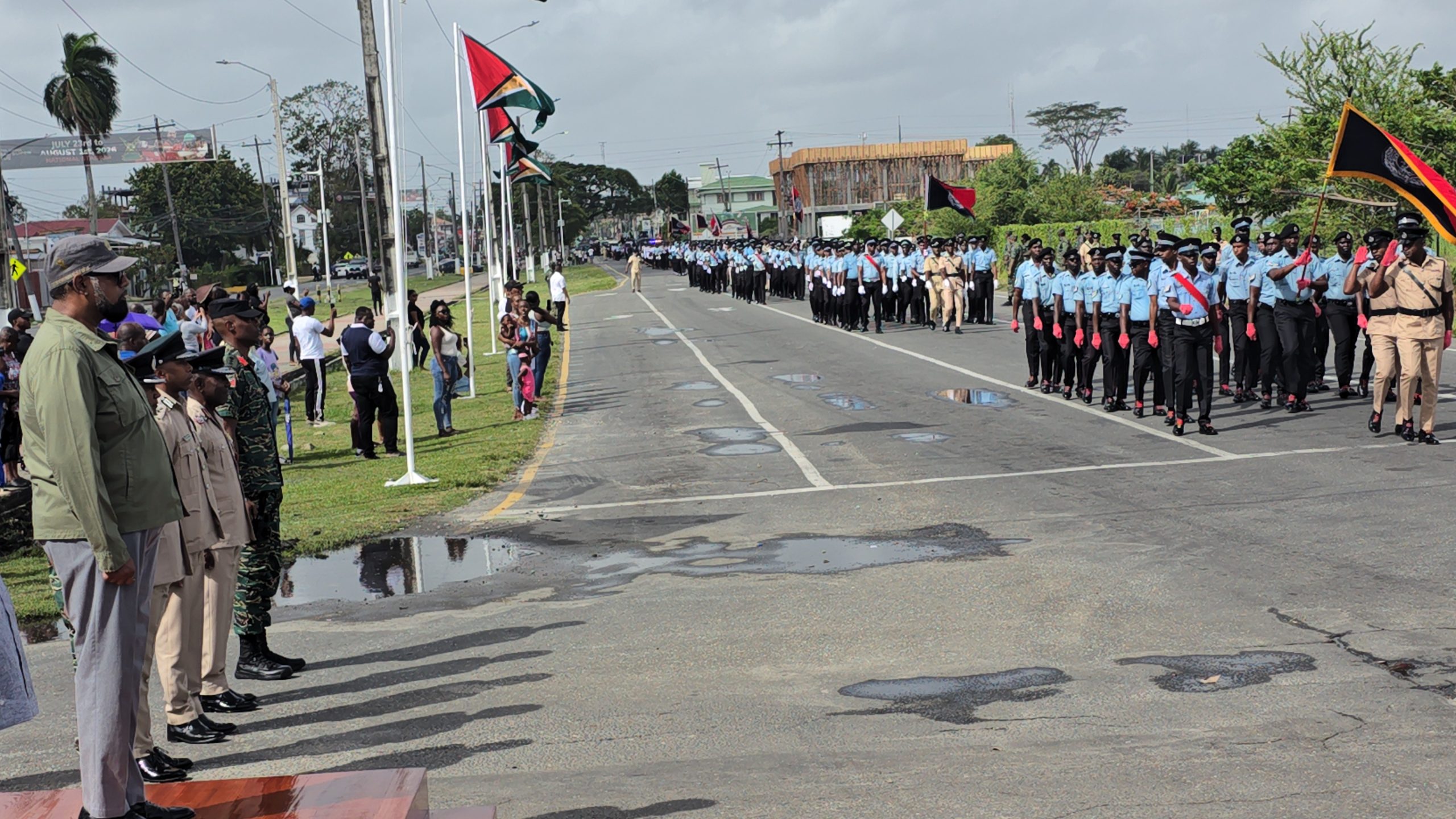
On Saturday, May 16, 2026, as Guyana prepares to mark the 60th anniversary of its independence from British rule, President Irfaan Ali, the nation’s commander-in-chief of the armed forces, has issued a urgent call for wholehearted public backing of the country’s Joint Services, amid a high-stakes territorial dispute with neighboring Venezuela that has put regional security on edge.
Ali made the appeal during a ceremonial address following a joint service route march through the streets of Georgetown, the capital of Guyana. The event was one of the lead-up activities ahead of the official 60th independence jubilee celebrations scheduled for May 26, 2026. Standing alongside top security leadership including Chief-of-Defence Staff Brigadier Omar Khan, Acting Police Commissioner Ravindradat Budhram, Chief Prison Officer Nicklon Elliott, Fire Chief Gregory Wickham, and National Intelligence and Security Agency Director Colonel Sheldon Howell, Ali took the salute from a combined parade of the country’s uniformed security forces before addressing the gathering.
The president stressed that Guyana’s Joint Services — which includes the military, national police, prison service, fire service, and intelligence agencies — carry two critical mandates for the country: cracking down on transnational drug trafficking, and upholding domestic stability against criminal activity. To succeed in these roles, Ali argued, the uniformed services cannot operate without consistent public support, especially at a moment of heightened external tension over the country’s western border.
“Not supporting our Joint Services sends an adverse signal when potential adversaries look at Guyana,” Ali stated, speaking while dressed in an olive green utility uniform emblazoned with national symbols including the cacique crown, a map of Guyana, and the Guyanese flag. “They ask themselves: Does Guyana enjoy unity? Do they value their protectors? Never let our adversaries see division and disunity because a divided house does not need to be invaded. It simply crumbles.”
Ali expanded on this warning, noting that public disregard for the country’s security personnel sends a dangerous message to the international community that Guyana does not take its own sovereign freedom seriously. “That message is more dangerous than any bullet,” he said. The president did acknowledge that public accountability is appropriate when service members fail to uphold their oaths, noting that multiple personnel across the joint services have faced accusations or convictions for serious offenses in recent years, ranging from robbery, assault and weapons theft to murder and narcotics trafficking. Most recently, a senior Guyanese police officer was placed on administrative leave after being sanctioned by the U.S. Office of Foreign Assets Control over alleged links to drug trafficking. Even with this accountability, Ali stressed that the public must not abandon the institution of the Joint Services as a whole.
The current tension stems from a decades-long border dispute between Guyana and Venezuela, centered on the 1899 Arbitral Tribunal Award that established the current boundary between the two nations. Venezuela has long rejected the ruling, and the dispute has reignited in recent years following the discovery of massive oil reserves in the disputed Guyanese territory. The case over the validity of the 1899 award is currently before the International Court of Justice (ICJ), with a final ruling expected in the coming days.
Venezuelan President Delcy Rodriguez reaffirmed her government’s position earlier this month, telling the ICJ that Venezuela will not accept any ruling that upholds the 126-year-old boundary agreement. Rodriguez has instead insisted that the only path forward is a bilateral negotiation anchored in Venezuela’s interpretation of the 1966 Geneva Agreement, which Caracas claims serves as a new governing treaty for the dispute.
Despite Venezuela’s pre-emptive rejection of the ICJ ruling, Ali struck an optimistic tone about the process. He expressed confidence that the court’s decision will bring an end to decades of territorial pressure from the neighboring South American nation, noting that Guyana has faced repeated threats of incursion and diplomatic intimidation over its sovereign territory. “Our territorial integrity has been threatened before. It will never be threatened again; not only with words but with the threat of incursions and pressures dressed in diplomacy,” Ali said.
The president issued a direct warning to what he framed as Guyana’s adversaries, cautioning them against misreading the country’s commitment to peaceful resolution of the dispute. “Do not mistake our peace for weakness,” Ali said, noting that Guyana’s security forces are backed by principled international diplomacy and a united population that will never surrender its sovereign birthright.
Closing his address, Ali paid tribute to the Joint Services for their decades-long work protecting national security, enabling Guyana’s ongoing economic expansion, and upholding the country’s position in international diplomacy. “To you, I say you kept the promise of 1966 alive,” he said. “You’ve made sure that independence is not symbolic but a lived reality.”
Guyana officially attained full independence from the United Kingdom on May 26, 1966, with 2026 marking six decades of sovereign nationhood for the South American country.