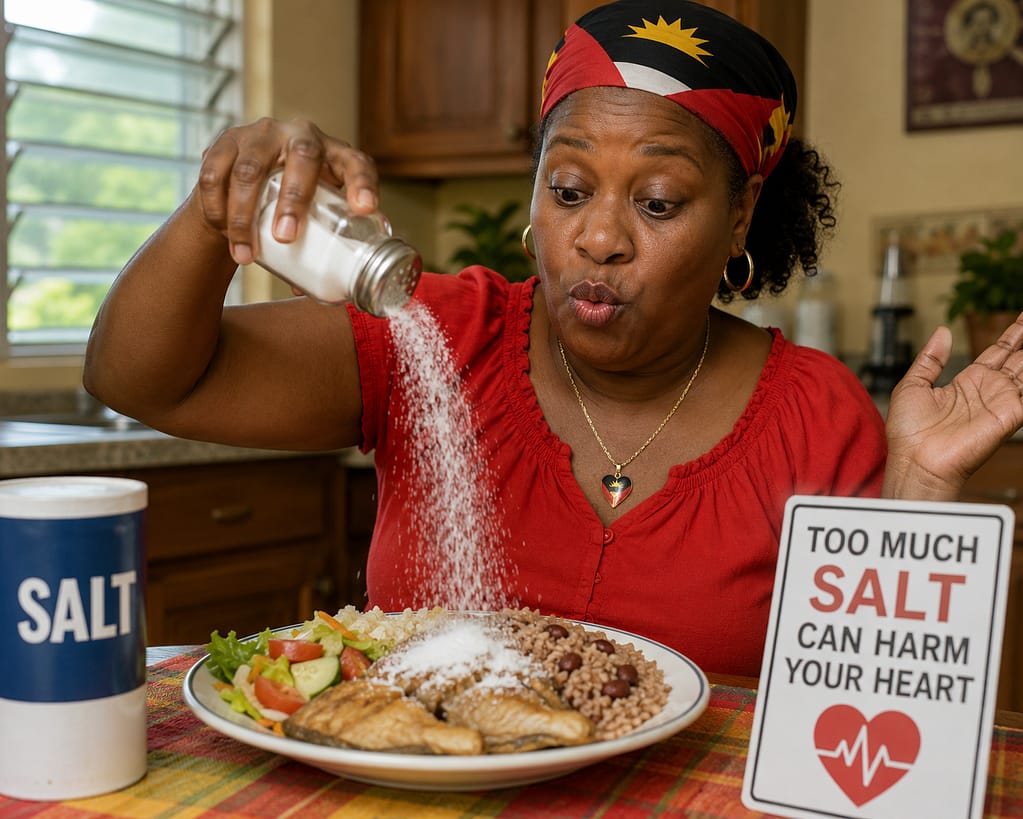
As rates of hypertension and cardiovascular disease continue climbing across Caribbean nations, the Caribbean Public Health Agency (CARPHA) is sounding the alarm on excessive salt consumption, urging coordinated action from governments, food industry stakeholders, and individual consumers to reverse a growing public health crisis. Current data shows that between 21% and 27% of all Caribbean adults live with hypertension, and regional populations consume nearly twice the maximum daily salt intake recommended by the World Health Organization (WHO). This public health threat is not unique to the Caribbean: globally, high sodium intake is linked to roughly 1.89 million premature deaths every year, and the worldwide average adult salt intake sits at 10.78 grams per day—more than double the 5 gram (under 1 teaspoon) daily limit updated by the WHO in 2025. Alarmingly, only a handful of countries worldwide have rolled out comprehensive national salt reduction strategies to address the crisis.
CARPHA has long prioritized sodium reduction as a core component of its regional non-communicable disease (NCD) prevention efforts, working in close partnership with regional Ministries of Health, the Pan American Health Organization (PAHO), and other local public health stakeholders to drive evidence-based change. The agency provides targeted technical guidance on food labeling systems, designs and executes public education campaigns, tracks NCD risk factors through ongoing surveillance, and leads advocacy and research to support scalable, effective interventions.
In line with these ongoing efforts, CARPHA will join the global observance of World Salt Awareness Week 2026, held from May 11 to 17 under the global theme “Salt It Out”. This international campaign aims to amplify public understanding of the life-threatening harms of excess sodium intake, and push for stronger policies and public health interventions that reduce the population-level burden of cardiovascular diseases including hypertension, heart attack, and stroke. A 2025 PAHO report underscores the severity of this burden: cardiovascular diseases alone account for 30.8% of all NCD-related deaths in the region.
In a statement on the urgent need for sodium reduction action, CARPHA Executive Director Dr. Lisa Indar emphasized that excess salt consumption is a “silent but significant contributor” to the region’s rising rates of hypertension, heart disease, and stroke. Dr. Indar noted that a common misconception among the public leads many to underestimate their sodium intake: most salt consumed in daily diets does not come from salt added during cooking or at the table, but from processed and ultra-processed food products that dominate modern grocery shelves. “Through stronger policies, food reformulation, better labelling, and public education, we can reduce sodium intake and save lives,” Dr. Indar said. “World Salt Awareness Week reminds us that reducing salt is one of the simplest and most cost-effective actions we can take to improve public health and protect future generations.”
CARPHA has already laid the regulatory and programmatic groundwork for regional salt reduction through two key frameworks. First, the agency introduced the Six-Point Policy Package (6-PPP), a regional blueprint for building healthier food environments and improving food security to address childhood obesity and the growing NCD crisis. One of the package’s core recommendations calls for establishing unified regional standards and time-bound salt reduction targets for high-risk food product categories. Building on this foundation, CARPHA launched the CESA Regional Sodium Reduction Framework in 2020 to guide national governments in developing their own localized sodium reduction strategies. The framework is organized around four core pillars captured in the acronym CESA: Change the food environment through targeted policies and legislation; Educate the general population on the risks of excess sodium; Strengthen systems capacity through ongoing research, monitoring, and evaluation; and Assess national progress toward intake reduction targets.
Updating the framework to align with 2025 WHO benchmarks, CARPHA has outlined a suite of priority measures for regional adoption. These include integrating nutrition education into school curricula, enforcing restrictions on advertising high-sodium foods to children, and launching widespread public media campaigns to raise awareness. The agency also identifies mandatory front-of-package nutrition labeling, updated nutrition facts panels, enforced regional nutrition standards, and widespread product reformulation by food manufacturers as critical, non-negotiable actions to cut population sodium intake across the Caribbean.
The CESA framework sets an ambitious long-term goal: a healthier Caribbean where average adult salt intake falls below the WHO global target of under 5 grams (one teaspoon) per day, with even lower intake targets for children. To support early adoption of low-sodium eating habits, CARPHA has also developed supplementary public-facing resources, including *Kids Can Cook Too*, a recipe book featuring nutritious, kid-friendly meals with little to no added salt, fat, or sugar. More information on the Regional Sodium Reduction Framework is available on CARPHA’s official website: https://carpha.org/What-We-Do/NCD/Nutrition/Knowledge-Banks/CESA/Regional-Sodium-Reduction-Framework