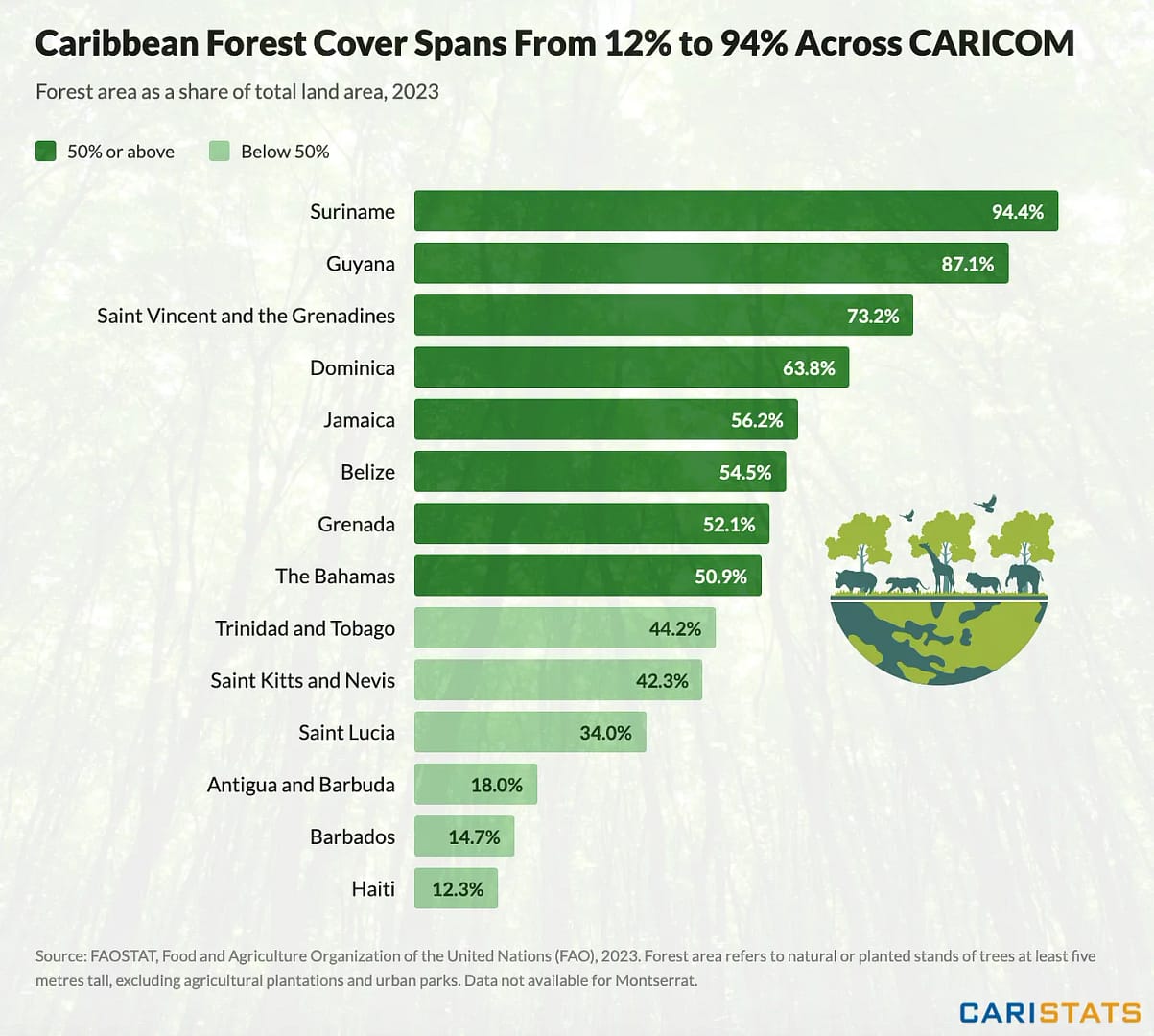
New 2023 data released by the United Nations Food and Agriculture Organization (FAO) has uncovered a striking divergence in forest coverage across member states of the Caribbean Community (CARICOM), with percentages ranging from just 12% up to nearly 95% of total national land area. Leading the region in forest retention are Suriname and Guyana, which claim 94.4% and 87.1% forest cover respectively – rankings that place both nations among the most heavily forested countries globally. Notably, their forest coverage shares outpace those of two of the world’s largest rainforest nations, Brazil and Indonesia, a key environmental distinction that has been largely overlooked in most mainstream economic conversations focused on the Caribbean. Following the two regional leaders at the upper end of the spectrum are Saint Vincent and the Grenadines, which reports 73.2% forest cover, and Dominica at 63.8%. Jamaica, Belize, Grenada, and The Bahamas all fall into a solid middle-upper bracket, with forest coverage ranging between 50% and 57% of their total land. Mid-range rankings go to Trinidad and Tobago, Saint Kitts and Nevis, and Saint Lucia. At the lowest end of the regional distribution are Antigua and Barbuda and Barbados. For the purpose of this FAO analysis, forest area is defined as any natural or planted stand of trees that reach at least five meters in height, with commercial agricultural plantations and urban green spaces like city parks explicitly excluded from calculations. No data was collected for Montserrat for this 2023 assessment. The wide variation in forest coverage across the bloc is largely attributed to fundamental geographic and ecological differences between member states. Each CARICOM nation has distinct land area profiles, terrain types, and histories of land use that have shaped how much forest land remains intact today. Beyond their ecological value, forests across the Caribbean play a foundational role in supporting regional biodiversity, maintaining healthy watershed systems that supply clean water to communities, and underpinning the rapidly growing carbon credit and climate finance sectors that hold significant economic potential for the region moving forward.
Antigua and Barbuda Among CARICOM Nations With Lowest Forest Cover, FAO Report Finds