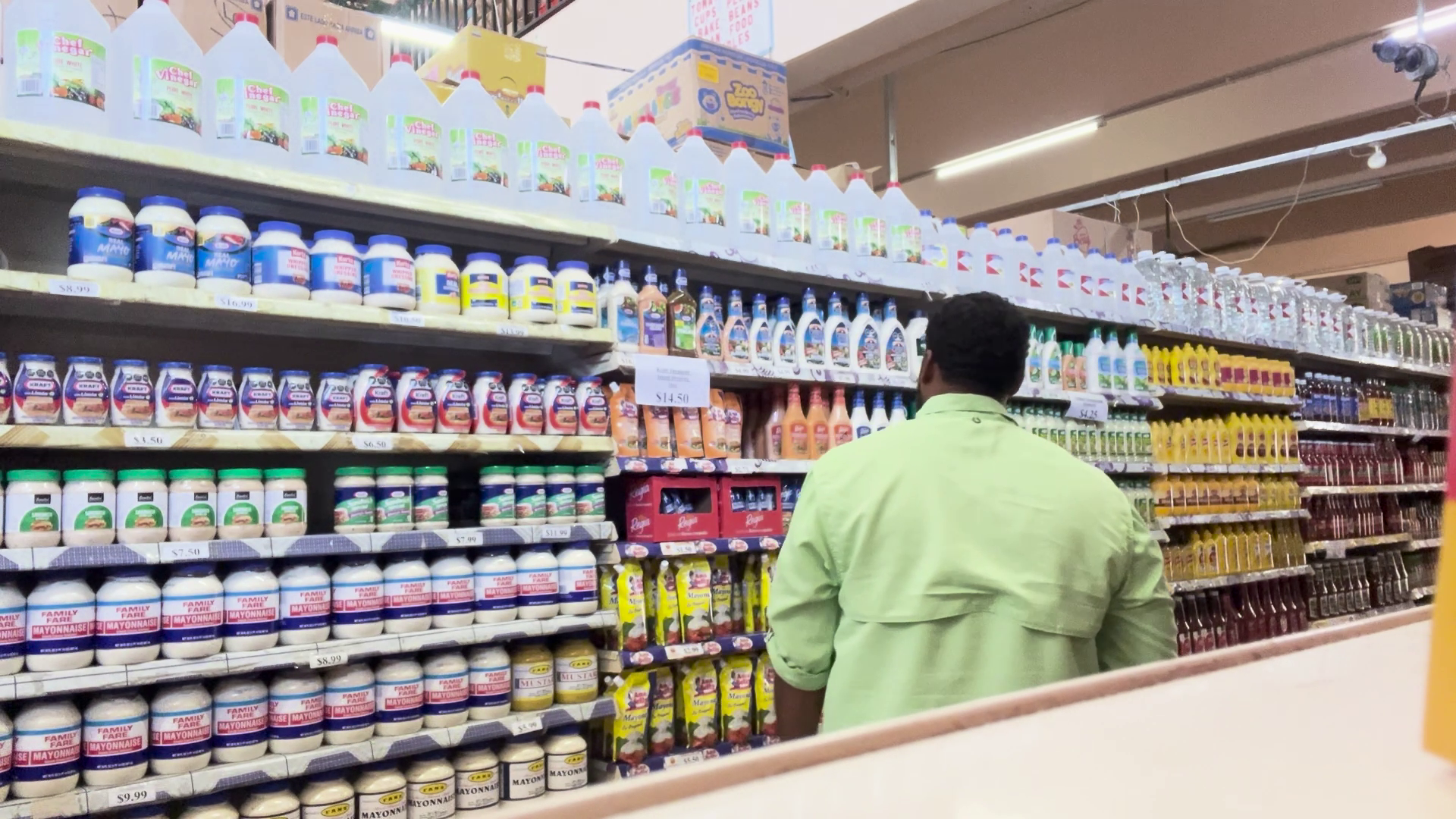
For countless households across Belize watching every dollar of their grocery budget, rising weekly food bills have become a persistent source of financial strain. But a new on-the-ground investigation reveals that where consumers choose to shop may create far larger differences in final checkout costs than most shoppers realize. To quantify just how much prices can shift between retailers in the same city, a News Five reporting team visited three major supermarkets across different neighborhoods of Belize City, comparing sticker prices for a range of common everyday essentials from food staples to household cleaning products. The findings highlight that even small per-item price differences add up to meaningful savings or extra costs for families working with tight monthly budgets.
Reporter Paul Lopez led the in-store comparison, selecting three locations spanning the city: Publics Supermarket on the North Side, 88 Shopping Center in the southern district, and downtown Belize City’s locally owned Sam’s Mart. Armed with a standardized list of 10+ everyday grocery items—including dish soap, breakfast cereal, processed ham, laundry detergent, canned tuna, and tomato paste—the team recorded individual product prices at each outlet to create an apples-to-apples comparison.
Across most items tested, larger chain retailer Publics offered the lowest overall prices. For example, a 200-gram pack of Dak Chopped Ham retailed for $4.39 at Publics, compared to $4.50 at 88 Shopping Center and $4.65 at Sam’s Mart, the highest price for that product. The same trend held for Mazatun canned tuna: Publics priced the item at $2.95, 88 Shopping Center came in slightly higher at $2.99, and Sam’s Mart charged the top rate of $3.25.
Sam’s Mart manager Erica Matus explained that small, locally owned Belizean retailers face structural barriers that prevent them from matching the lower prices of larger chain operations. “As a Belizean owned business, the challenge we face is buying in quantity where the bigger chains can buy more, so they get a lower cost,” Matus noted.
Lennox Nicholson, Controller of Supplies for Belize’s Supplies Control Unit, confirmed that bulk purchasing power is one of the biggest drivers of price variation between retailers. “You may have two establishments selling the same item. One would have made a purchase of one hundred cases, while the other one may have bought twenty-five cases. And, in getting the supply of their product, normally when entities purchase in large bulks like that there is a better bargaining position to get a better price per case,” Nicholson explained.
The investigation also found that pricing hierarchies are not fixed: smaller independent stores can undercut larger chains on select products. For a 1.9-liter bottle of Suavitel laundry detergent, Sam’s Mart priced the item at $6.95, while Publics charged $7.25—30 cents more per bottle. For a box of Fans Cornflakes, the highest price was recorded at 88 Shopping Center ($7.50), with Sam’s coming in at a middle point of $6.95 and Publics again offering the lowest rate at $6.85. The cheapest price for a 400-milliliter bottle of Axion dishwashing liquid was found at 88 Shopping Center ($2.50), compared to $3.95 at Sam’s.
Nicholson also noted that a long-assumed driver of grocery price gaps—location relative to Belize City’s main distribution hubs—is far less impactful than it used to be. “What you find is that there is a general practice if it is a rural area, the price is just higher and if it is further away from Belize City the price is higher. But when you drill down and look at the invoice to show what they acquired the good for, there is not that significant gap between what an establishment in Belize City is acquiring for, compared to what an establishment in Belmopan is acquiring for,” he said.
To boost its competitiveness against larger chains, Sam’s Mart has launched its own in-house line of poultry products, with discounted pricing to draw price-conscious shoppers. “The whole chicken is $2.90 a pound. Then we have chicken wings that come bagged, $5.95 a pound, and neck and back at $1.00 a pound,” Matus shared, highlighting the value the local store can offer on its own branded products.
For Belizean households navigating ongoing cost of living pressures, the investigation’s core takeaway is clear: taking the time to compare prices across local supermarkets, even within the same city, can add up to hundreds of dollars in annual savings. Reporting for News Five, Paul Lopez.