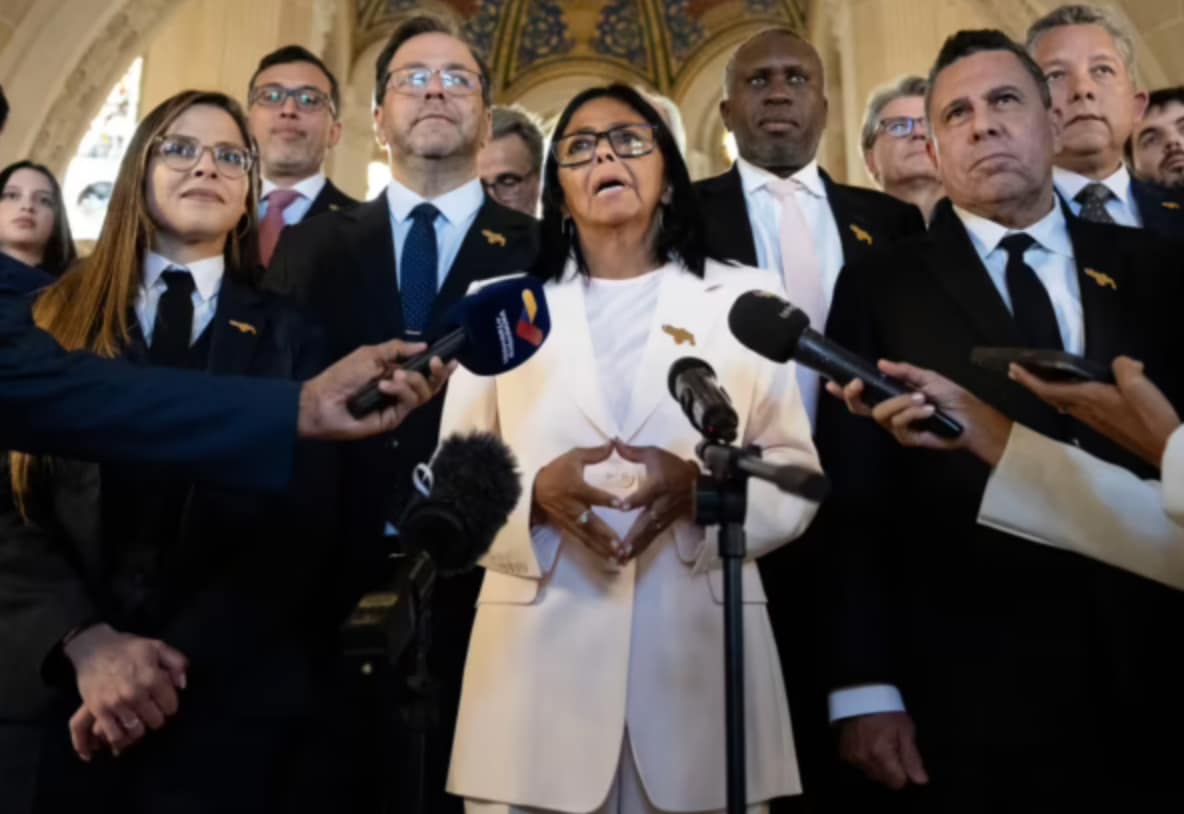
On Monday, as Venezuela wrapped up its arguments before the International Court of Justice (ICJ) in The Hague in a long-running territorial dispute with neighboring Guyana, acting Venezuelan President Delcy Rodríguez pushed back firmly on an unexpected remark from former U.S. President Donald Trump, who said he was “seriously considering” the idea of Venezuela becoming the 51st U.S. state.
Speaking to reporters on the final day of public hearings over the resource-rich Essequibo region, Rodríguez made clear that Venezuela has no intention of giving up its sovereignty to become part of the United States. The acting president, who assumed office in January after a U.S. military operation removed former President Nicolás Maduro from power, emphasized that Venezuela will stand firm in protecting its national sovereignty, territorial integrity, independent history, and self-determination. “We are not a colony, we are a free and sovereign nation,” she stated.
To date, the full context and motivation behind Trump’s remark remain unconfirmed. The White House did not issue an immediate response to requests for clarification on the comment, which is not an isolated statement: Trump has previously made similar offhand remarks about annexing Canada. Later, White House spokesperson Anna Kelly declined to elaborate on any potential Trump administration plans for Venezuela during an interview with Fox News, noting only that the U.S. president is well-known for challenging established norms and praised Rodríguez for what she described as extremely productive cooperation with the United States. Rodríguez for her part added that Venezuelan and U.S. officials have maintained open lines of communication, focused on building mutual cooperation and understanding.
The core focus of Rodríguez’s visit to The Hague was defending Venezuela’s decades-old claim to the Essequibo region, a 62,000-square-mile territory that makes up nearly two-thirds of Guyana’s current national land area. Long a source of tension between the two South American nations, the dispute has gained new urgency in recent years amid major offshore oil discoveries that have turned Guyana from one of South America’s smallest and poorest economies into a fast-growing major energy producer. The region itself is already rich in gold, diamonds, and valuable timber, while nearby offshore blocks currently produce roughly 900,000 barrels of oil per day – a volume nearly matching Venezuela’s current daily production of around 1 million barrels.
Venezuela has laid claim to Essequibo since the Spanish colonial era, when the jungle territory fell within the boundaries of Spanish colonial holdings that would later become independent Venezuela. However, an 1899 arbitration ruling mediated by representatives from Britain, Russia, and the United States set the international border along the Essequibo River, awarding nearly the entire disputed territory to Guyana (then a British colony). Venezuela has long rejected that 1899 decision, arguing that a 1966 Geneva agreement signed to resolve the dispute effectively invalidated the 19th-century arbitration ruling and called for negotiated settlement between the two parties.
The dispute escalated after 2015, when energy giant ExxonMobil announced a major commercial oil discovery off the Essequibo coast. In 2018, Guyana formally brought the case to the ICJ, the United Nations’ highest court for inter-state disputes, asking judges to uphold the 1899 border ruling. Tensions flared further in 2023, when then-President Maduro organized a national referendum on converting Essequibo into a Venezuelan state and threatened to annex the region by force. Maduro was removed from power and captured by U.S. forces during a January operation in Caracas, and is currently being held in New York to face trial on drug trafficking charges, to which he has pleaded not guilty.
Rodríguez did not reference the 2023 referendum in her ICJ remarks, but told judges that only bilateral political negotiations, not a binding judicial ruling, can resolve the century-old border dispute. She accused Guyana of acting opportunistically by bringing the case to the court while the negotiation mechanisms outlined in the 1966 Geneva agreement were still fully operational. “At a time when the mechanisms established in the Geneva agreement were still fully in force, Guyana unilaterally chose to shift the dispute from the negotiating arena to a judicial resolution,” she told the court. “This change was not accidental; it coincided with the discovery in 2015 of the oil field that would become world-renowned.”
When the hearings opened last week, Guyana’s Foreign Minister Hugh Hilton Todd framed the dispute as a long-standing threat to Guyana’s sovereign existence, telling the panel of international judges that the conflict “has been a blight on our existence as a sovereign state from the very beginning,” noting that 70% of Guyana’s current territory is at stake in the ruling.
Court observers expect the ICJ will take several months to issue a final, legally binding ruling on the case. Venezuela has repeatedly stressed that its decision to participate in the public hearings does not constitute consent to the court’s jurisdiction over the dispute, nor recognition of the court’s authority to issue a binding ruling on the border question.