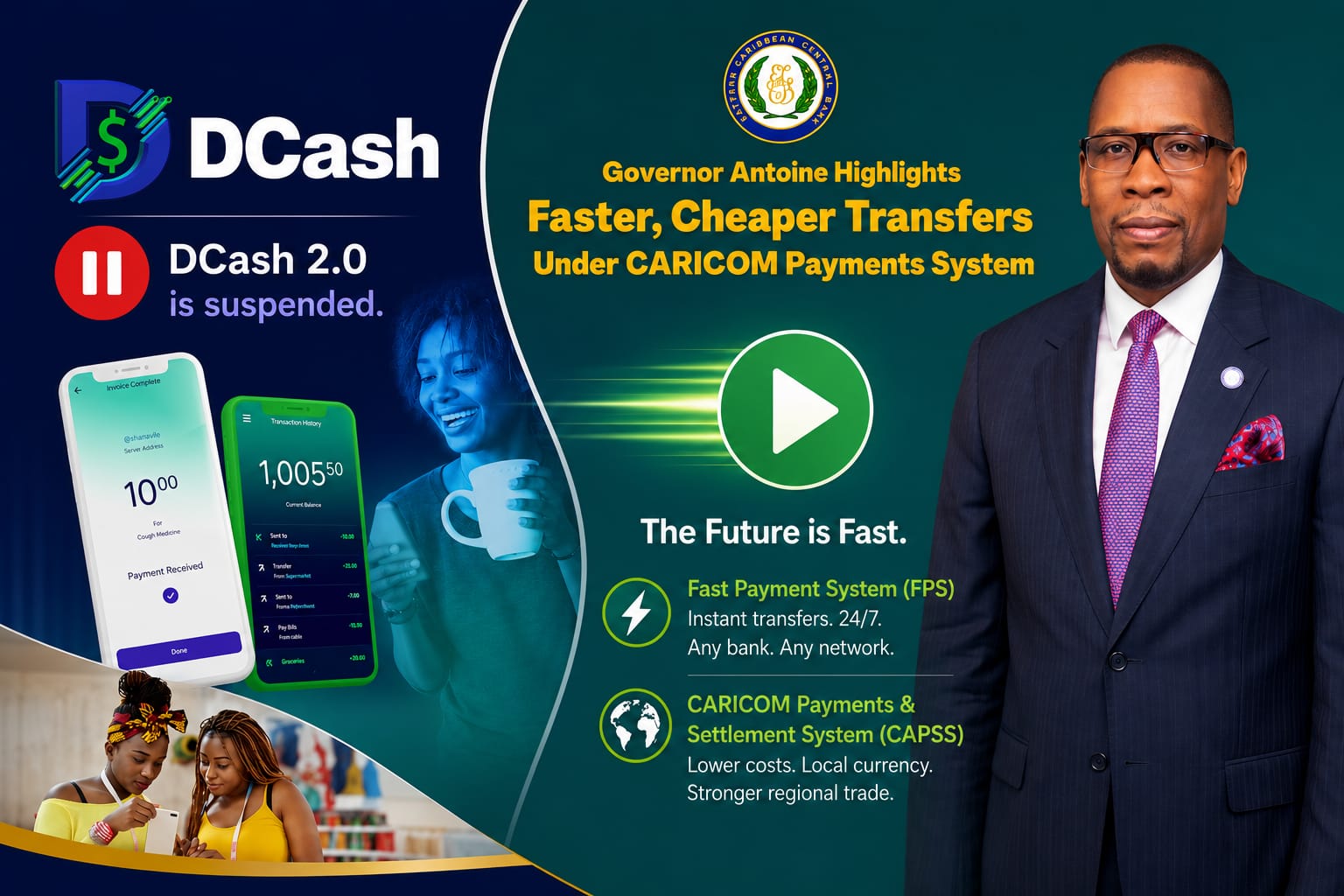
For half a decade, the Eastern Caribbean financial sector has been anchored on a bold vision: a central bank-issued digital wallet called DCash that would redefine how people manage daily transactions across the region. Unveiled as a public pilot in 2021 across four Eastern Caribbean nations — Antigua & Barbuda, Grenada, St. Kitts & Nevis, and St. Lucia — the project was framed as a revolutionary Retail Central Bank Digital Currency (CBDC) by the Eastern Caribbean Central Bank (ECCB). It promised to transform everything from local market purchases of fresh goods to informal peer-to-peer payments, positioning the small island bloc as a global leader in fintech innovation. But a quiet policy shift buried in the ECCB Monetary Council’s 112th Meeting Communique, published May 4, 2026, reveals a major strategic course correction: the regional authority has officially suspended development of the DCash 2.0 upgrade, bringing the original CBDC experiment to a close while opening a new chapter for digital financial integration across the Caribbean. The decision to pull back on DCash 2.0 is not a full rejection of digital currency innovation, but rather a quiet acknowledgment of a core truth that often plagues new financial technologies: most consumers do not crave an entirely new currency. What they actually want is a faster, more seamless way to use the money they already hold. For small island developing economies like those in the Eastern Caribbean Currency Union (ECCU), this dynamic is even more pronounced: consumer trust in established financial systems far outweighs excitement for untested novelty. While locals were willing to test the DCash app for small, occasional transactions, they remained hesitant to move their salaries, long-term savings, and core monthly spending to a standalone digital system disconnected from their traditional bank accounts. This structural friction proved to be DCash’s insurmountable barrier. The project required users to adopt an entirely separate digital financial ecosystem, cut off from the incumbent banking infrastructure that most residents already relied on. Despite years of outreach and pilot adjustments, widespread mass adoption never materialized, prompting regional leaders to re-evaluate their approach. Instead of abandoning digital financial modernization entirely, the ECCB has reframed its priorities, shifting away from flashy retail-facing CBDC experiments to a far more practical, infrastructure-focused goal: building deeper, more interconnected financial markets across the region. Dubbing the shift an upgrade to the financial “pipes” of the ECCU, the central bank is now centering its work on the Fast Payment System (FPS), a project that upgrades the underlying infrastructure of existing local banks rather than building a parallel standalone system. The core objective of FPS is straightforward: to enable consumers and businesses to send standard Eastern Caribbean (EC) dollars to any recipient across the region instantly, at any time of day or night, using nothing more than a mobile number or a QR code. Under the new framework, cross-institutional transfers that once took multiple business days to clear will arrive in seconds, regardless of whether the sender and recipient hold accounts at different banks — for example, Republic Bank and the Grenada Co-operative Bank. This shift aligns with broader global open banking principles, which prioritize interoperability and seamless data and fund sharing between competing financial institutions. Even more consequential for regional economic growth is the ECCB’s new commitment to launching a pilot of the CARICOM Payments and Settlement System (CAPSS), a project designed to tackle one of the most long-standing barriers to intra-regional trade: the punitive “cross-border tax” on international payments. For decades, Eastern Caribbean businesses looking to pay suppliers in other CARICOM nations like Trinidad and Tobago or Barbados have been forced to convert their local currency to U.S. dollars first, incurring exorbitant wire transfer fees and unfavorable exchange rates that eat into already thin profit margins. By joining the CAPSS initiative, the ECCU is helping to build a unified regional settlement infrastructure that will allow businesses to conduct cross-border transactions directly in local currencies. Under the new system, participating central banks will handle currency settlement behind the scenes, eliminating the need for intermediate U.S. dollar conversions and cutting down on excessive fees. ECCB Governor Timothy Antoine has long promoted “The Big Push,” an ambitious regional strategy aimed at doubling the size of the ECCU economy by 2035. Viewed through that lens, the suspension of DCash 2.0 is far from the failure it might appear to be at first glance. It is instead a strategic adjustment, prioritizing tangible, widespread utility over the flashy optics of being an early CBDC adopter. The central bank is moving away from the crypto-adjacent hype that surrounded early retail CBDC experimentation and refocusing on the unglamorous, critical work of repairing the region’s fragmented, outdated cross-border banking infrastructure. In the global financial sector, the most transformative changes are rarely the flashy retail-facing apps that draw headline attention. More often, they are the incremental upgrades to the hidden “plumbing” that underpins all everyday transactions. For the Eastern Caribbean, that plumbing is about to get a much-needed upgrade.
OPINION: From DCash to Fast Payments. The ECCB’s Quiet Financial Reset