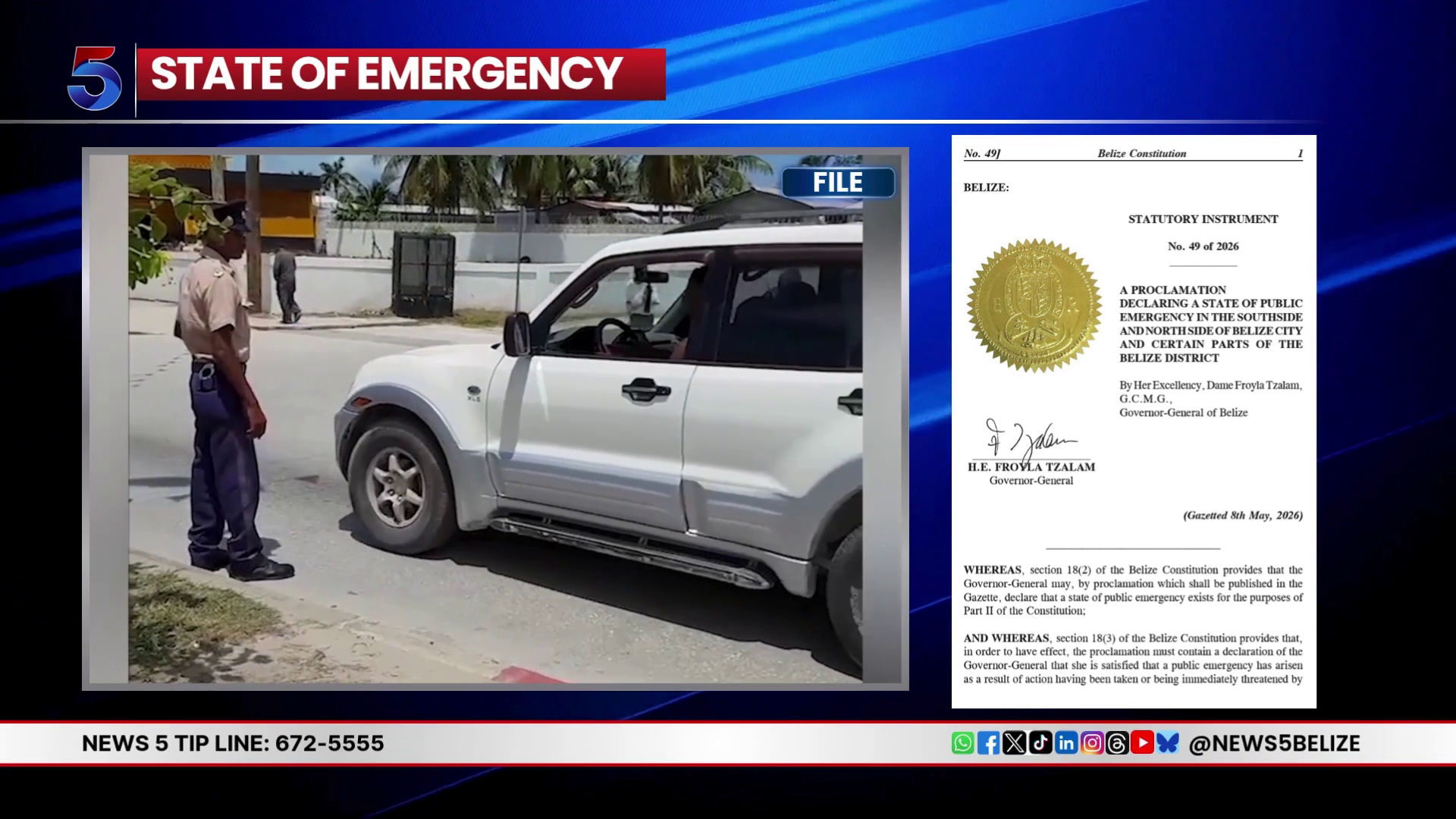
In the evening hours following the declaration of a limited state of emergency (SOE) across Belize City and portions of the broader Belize District, the U.S. Embassy has issued an urgent security advisory urging all American citizens residing in or traveling through the affected regions to remain vigilant against potential risks. The advisory additionally recommends that U.S. citizens check in with family members to confirm their safety and monitor official updates closely as the situation evolves. Against this backdrop of heightened security, a growing public debate has emerged over whether the expanded law enforcement powers granted under the SOE will be used appropriately – or risk overreach that violates civil liberties.
Belize’s top law enforcement leadership has moved quickly to address growing public concern, outlining clear structural safeguards to prevent the arbitrary use of emergency powers. According to Police Commissioner Dr. Richard Rosado, only a specialized unit – the GI3 – will be tasked with enforcing SOE regulations, a deliberate departure from past implementations that saw regular uniformed officers take on enforcement duties. Deputy Commissioner Bart Jones added that the restricted mandate for a single dedicated unit eliminates the risk of officers misusing SOE powers to settle personal grievances, noting that any officer with a personal conflict with an individual would have no authority to detain that person under emergency provisions.
Additional checks and balances are built into the detention process to further guard against abuse: all detention orders must receive a formal signature from a government minister, and the specific justifications for any detention must be documented and signed by Jones personally. Any individual targeted for detention must also have a verified documented connection to criminal activity to meet the policy’s requirements, Jones explained.
Critics of past state of emergency declarations in Belize have long argued that these security measures disproportionately target low-level gang foot soldiers while allowing high-profile gang leaders and criminal kingpins to evade capture. This time, however, law enforcement officials say the framework has been redesigned to address this gap. Commissioner Rosado confirmed that the current SOE is intentionally structured to target not only active gang shooters, but also the influential leaders that coordinate criminal activity across the district. “This is a limited state of emergency because it is targeted, transparent and accountable, and we have the necessary mechanism in place to ensure that those individuals placed under the state of emergency go through a necessary vetting process,” Rosado told reporters.
Officials also confirmed that the SOE’s authority extends beyond the boundaries of the declared emergency zones to target gang leaders who attempt to flee to avoid detention. If intelligence confirms that a targeted individual is normally a resident of one of the declared emergency zones, law enforcement retains the authority to detain them even if they have relocated outside the restricted area. Additional provisions of the regulation also restrict unaccompanied minors from being out in public in declared zones between 8 p.m. and 6 a.m. the following day, with enforcement focused on redirecting rather than detaining young people who violate the curfew.
The current state of emergency is set to remain in effect for 30 days, and officials confirmed that any extension beyond that initial period would require formal approval through Belize’s National Assembly. As the enforcement period gets underway, the balance between effective crime control and protection of civil liberties remains at the center of public discussion.