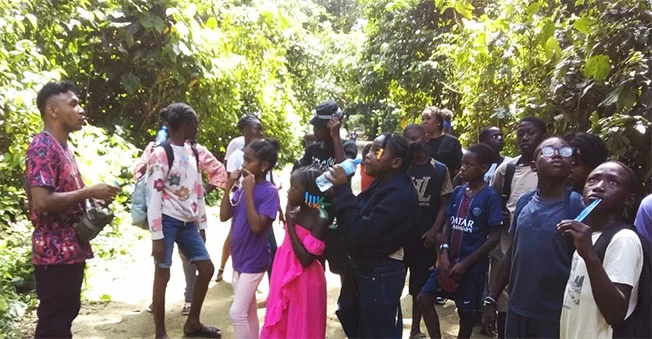
Suriname has long integrated nature education into both primary and secondary school curricula, and a new off-campus initiative at Pepperpot Nature Park is bringing this core learning objective to life through immersive, hands-on experiences for young learners. Off-campus nature education has been widely recognized as a uniquely valuable learning framework that lets students explore natural ecosystems first-hand, turning the outdoors into a dynamic, interactive classroom that delivers a wide range of developmental and educational benefits.
Located in Suriname’s Commewijne district, Pepperpot Nature Park spans 24 hectares and sits within an 820-hectare protected forest area. The site has a layered history: from the 17th century through its closure in 1994, it operated as a colonial plantation, and in the decades following, it gradually reverted to its original state as a pristine wild forest. The Pepperpot Nature Forest Foundation was established in 2009 to steward the rich natural ecosystem that regrew on the former coffee and cocoa plantation, which now hosts a unique biodiversity hotspot just 5 kilometers from the capital city of Paramaribo.
The foundation’s dual mission is to protect the area’s native biodiversity and preserve remnants of the old plantation as cultural heritage. It manages the full 820-hectare landscape, which is divided into three zones: a 706-hectare forest corridor, a 32-hectare buffer zone surrounding the corridor, and an 80.89-hectare visitor park, 26.89 hectares of which are currently open to the public.
For casual visitors, the park offers a range of recreational activities including hiking, birdwatching, and kayaking, with resting benches placed throughout to encourage visitors to slow down and connect with their surroundings. A diverse array of wildlife calls the park home, with a full photo gallery of native species hosted on the park’s official website, peperpotnaturepark.com. Guided tours led by professional naturalists are also available in morning, early evening, and night-time formats to suit different visitor preferences.
As a form of experience-based learning, off-campus nature education encourages active exploration in natural, challenging outdoor environments, and research consistently shows that time in nature delivers profound benefits for children’s development. Hands-on interaction with the natural world boosts physical health, sharpens critical thinking skills, fosters creativity, reduces stress, and gives children greater sense of personal freedom that is critical to healthy emotional growth.
Off-campus nature education encompasses a broad range of accessible activities designed to engage all children, from building shelters and ropes courses to campfire cooking, cooperative games, scavenger hunts, tree climbing, and native plant and wildlife identification. While these activities can take place anywhere from schoolyards to public parks, undisturbed natural areas like Pepperpot’s forests offer the richest learning environments. Through these experiences, students develop inquiry-based, discovery-driven thinking that deepens their connection to the natural world.
Currently, the program serves fifth-grade primary school students from three Surinamese districts: Commewijne, Para, and Marowijne, and participating students have consistently shown high levels of enthusiasm for the hands-on learning opportunities. In September 2025, the foundation secured two years of funding from the ALCOA Foundation to launch the scaled off-campus nature education program at the park, which is uniquely suited to host the initiative. Each Saturday throughout the school year, classes of students take turns visiting the park, where they are guided by both professional naturalists and their own classroom teachers.
According to project manager Maureen Silos of Pepperpot Nature Park, a core goal of the program is to help children understand that humans are an intrinsic part of the natural world. By giving school groups the chance to learn and play actively in a wild natural setting, the program helps young learners develop a deeper understanding of the world around them, cultivate a lasting love of nature, and build a lifelong commitment to conservation.