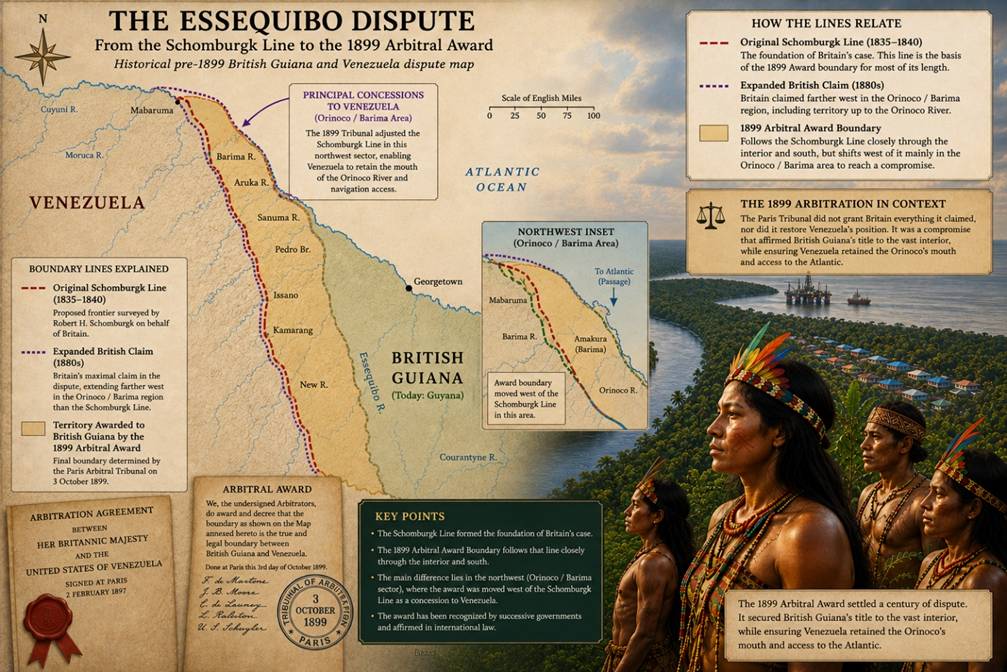
Over the past ten years, Guyana — a small South American nation of less than one million people — has experienced an economic transformation unmatched anywhere in the world. The discovery of massive offshore oil reserves catapulted it to the title of the globe’s fastest-growing economy, and President Irfaan Ali has projected that the coming decade will bring even more rapid progress across infrastructure, energy, technology, and broad national development. But beneath this unprecedented wave of growth looms a long-simmering existential threat: the decades-long border dispute with neighboring Venezuela that remains unresolved to this day.
Venezuela claims nearly two-thirds of Guyana’s sovereign territory, including the resource-rich Essequibo region, a claim that has stood for more than a century. For years, the dispute remained largely frozen in diplomatic gridlock, but it has now reached a pivotal moment: the case has finally come before the International Court of Justice (ICJ) at The Hague for formal adjudication, despite Venezuela’s continued refusal to recognize the court’s jurisdiction over the matter.
Based on legal precedent, historical records, and established patterns of state practice, most independent observers agree that Guyana holds an overwhelmingly strong position. Historical evidence underscores this advantage: when the 1899 Arbitral Award that established the current border was issued, Venezuela publicly celebrated the outcome as a victory, having gained control of both banks of the strategically critical Orinoco River. The settlement went unchallenged by Caracas for more than 60 years. In all engagements over the decades since, including the 1966 Geneva Agreement process, Guyana has maintained a posture of responsible statecraft: it acknowledges Venezuela’s differing position while steadfastly upholding its own sovereignty and territorial integrity.
Venezuela’s leadership, however, has increasingly signaled that it recognizes the weakness of its legal arguments before the ICJ. In response, Caracas has adopted a two-pronged strategy that pairs formal legal submissions with a broad diplomatic and public relations campaign centered on a narrative of post-colonial injustice. Venezuela argues the 1899 arbitral process was manipulated by the British Empire, which held significant influence at the time, leaving a weak, vulnerable Venezuela outmaneuvered and stripped of its rightful territory. This framing resonates emotionally and politically across the Global South, where many nations still carry the lingering scars of colonial exploitation and unequal power dynamics.
This diplomatic campaign has entered a new, more aggressive but strategically polished phase following the international isolation that defined former president Nicolás Maduro’s administration. The change in Venezuela’s global posture has opened space for its current leadership to refine its messaging: the tone is now more measured and sophisticated, crafted to appeal to global audiences and multilateral institutions, but the core of its expansionist claim to Essequibo remains entirely unchanged. The high-profile personal intervention of acting president Delcy Rodríguez underscores this new approach.
In a choreographed televised address over the weekend, Rodríguez announced she would travel to The Hague to personally lead Venezuela’s representation in the ICJ case, framing the trip as a duty to defend Venezuela’s “inalienable rights.” She appeared in person before the court on Monday, a move many analysts described as a deliberate, confrontational public relations stunt, given Venezuela’s longstanding refusal to accept the ICJ’s jurisdiction. The gesture sent an unmistakably defiant message to both the court and the global public.
In her closing statement, Rodríguez made an extraordinary blunt repudiation of the court’s authority: she explicitly stated Venezuela would not accept any ruling that upholds the validity of the 1899 Arbitral Award. “Even if the court were to declare the award valid, Venezuela would be unable to comply with such a ruling,” she argued, claiming any outcome against Venezuela’s position would itself violate the 1966 Geneva Agreement and international law. To many observers, this high-stakes political theatre is a clear reflection of Venezuela’s awareness that its legal and historical case is weak: the spectacle of nationalist defiance is intended to compensate for gaps in the factual and legal record.
Facing this coordinated public relations offensive, Guyana has two clear paths forward: it can quietly and actively counter Venezuela’s narrative, or stand by and allow the ICJ’s eventual ruling to speak for itself. Most regional and diplomatic analysts agree Guyana would benefit from building its own counter-narrative rooted in Global South post-colonial experience, rather than allowing Venezuela to monopolize anti-colonial rhetoric.
Guyana is itself a post-colonial developing nation, vastly smaller than its neighbor: just 83,000 square miles against Venezuela’s 384,000, and a population of less than one million against Venezuela’s 28.6 million. This reality directly undermines Venezuela’s claim that the 1899 Award was the product of an unfair power imbalance. If historical asymmetry alone were accepted as grounds to reopen settled international borders, nearly every frontier across the developing world would be vulnerable to revisionist claims from larger neighbors.
Guyana’s diplomatic messaging should therefore center on one core principle: post-colonial justice cannot justify overturning long-settled international borders whenever historical grievances are invoked. Beyond messaging, Guyana should work to deepen ties beyond its traditional Caribbean allies — where it already serves as a leading voice for regional unity — to include members of the African Union, ASEAN, and moderate Latin American governments. The broader framing should be clear: this dispute is not a remnant of British colonial rivalry with Venezuela, but a test of the principle that small-state sovereignty, international stability, and the rule of international law must be upheld regardless of size.
Throughout the dispute, Guyana has maintained a posture of dignified restraint committed to the international legal process, a position that has already earned it the moral high ground. If the ICJ rules in Guyana’s favor, as widely expected, Guyana’s post-ruling strategy will be critical: a triumphalist framing that casts the outcome as a humiliation for Venezuela would likely harden nationalist sentiment in Caracas for generations, making any long-term resolution impossible. Instead, a measured, statesmanlike approach would lower the political cost for Venezuelan leaders to gradually moderate their position over time. Any future provocations from Venezuela should continue to be addressed through established multilateral channels: the ICJ, United Nations, Caricom, the Commonwealth, the Organization of American States, and formal diplomatic dialogue.
If Guyana maintains this principled, restrained approach, it could emerge from the dispute far stronger than it entered: with its sovereignty internationally reinforced, growing investor confidence, elevated diplomatic stature, and broader recognition as a responsible defender of the rules-based international order. A ruling in Guyana’s favor would also bring much-needed stability to its booming offshore oil sector, supporting long-term economic growth and development. In the end, the dispute could position Guyana as a global example of how small states can defend their sovereignty successfully, not through military force, but through a commitment to law, diplomacy, and international legitimacy.