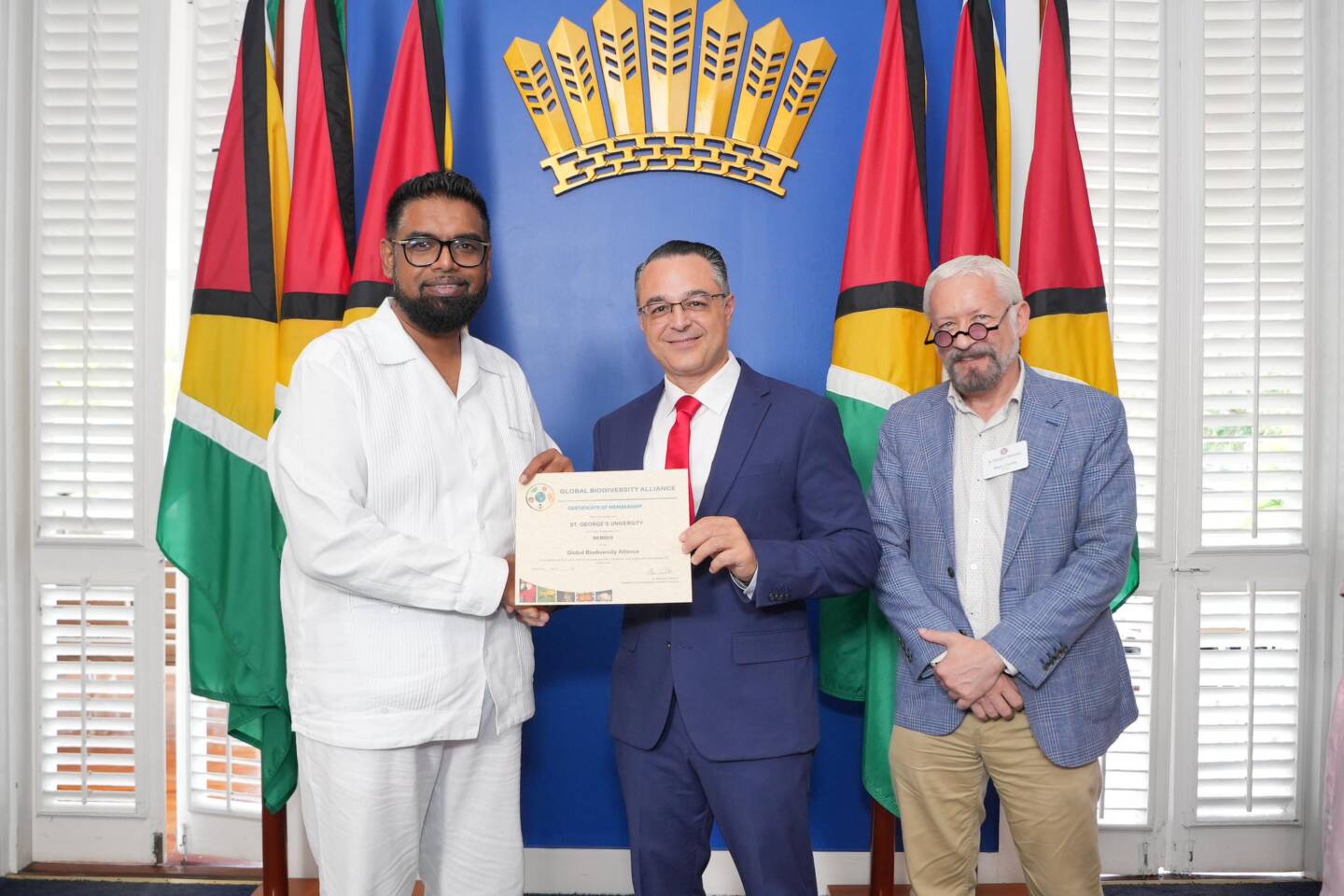
In a formal ceremony held at Guyana’s State House, St George’s University (SGU) has formally been inducted as the newest non-governmental member of the Global Biodiversity Alliance (GBA), with Guyana’s President His Excellency Dr Mohamed Irfaan Ali presenting the official membership certificate to the institution. SGU’s admission to the alliance, which has already been formally confirmed by the GBA Secretariat, builds on a deepening collaborative partnership between the Grenada-based university and the Government of Guyana rooted in the Georgetown Declaration, a landmark global framework dedicated to halting and reversing global biodiversity loss through the advancement of sustainable, science-centered solutions.
As a non-governmental institutional member, SGU now joins a rapidly expanding international coalition that brings together national governments, research institutions, and civil society organizations. All members of the alliance work in coordinated alignment with the Kunming-Montreal Global Biodiversity Framework to protect vulnerable ecosystems and speed up progress toward shared global biodiversity targets.
Speaking on the occasion, Dr Marios Loukas, SGU President and Dean of the School of Medicine, highlighted the institution’s core strength in bridging academic disciplines to tackle pressing, complex global challenges. “Through the Global Biodiversity Alliance, we are expanding our ability to contribute actionable research and foster the kind of collaboration needed to drive measurable progress,” Loukas said, noting that membership opens new avenues for two-way learning and knowledge exchange between SGU scholars and a global network of leading conservation experts.
Founded as a voluntary, inclusive multi-stakeholder platform, GBA was created to advance open knowledge sharing, scalable conservation financing, and coordinated collective action to protect global biodiversity. The alliance unites stakeholders from every sector—from government and academia to private industry and nonprofits—to accelerate the on-the-ground implementation of global biodiversity goals and advance inclusive, nature-positive sustainable development.
GBA Secretariat representatives have emphasized that academic institutional partners are foundational to advancing the alliance’s core mission. Collaboration with universities, they note, strengthens global research capacity, expands cross-border knowledge exchange, and improves the delivery of effective conservation outcomes. Pradeepa Bholanath, Senior Director of Climate Change and REDD+ at Guyana’s Ministry of Natural Resources and a leading figure at the GBA Secretariat, welcomed SGU’s membership in a statement. “We are pleased to welcome St George’s University to the Global Biodiversity Alliance as a valued non-governmental member,” Bholanath said. “Through this collaboration, SGU will contribute to a dynamic platform dedicated to halting and reversing biodiversity loss, and we look forward to engaging the University in upcoming initiatives that support the Alliance’s shared global priorities.”
As a GBA member, SGU will participate in a range of collaborative initiatives focused on advancing evidence-based conservation solutions, expanding interdisciplinary biodiversity research, and building global conservation capacity across under-resourced regions. The university’s entry into the alliance aligns with its long-standing institutional mission to address transboundary global challenges through integrated education, innovative research, and cross-sector partnership. The move also solidifies SGU’s growing role as a global leader in advancing the interconnected goals of global public health and environmental stewardship.
Reaffirming the institution’s commitment to the alliance’s mission, Loukas added: “This partnership creates new opportunities for SGU to both contribute to and learn from a global network of experts and institutions. We are committed to applying our expertise in ways that strengthen capacity, expand knowledge, and support impactful, science-driven initiatives across regions.”