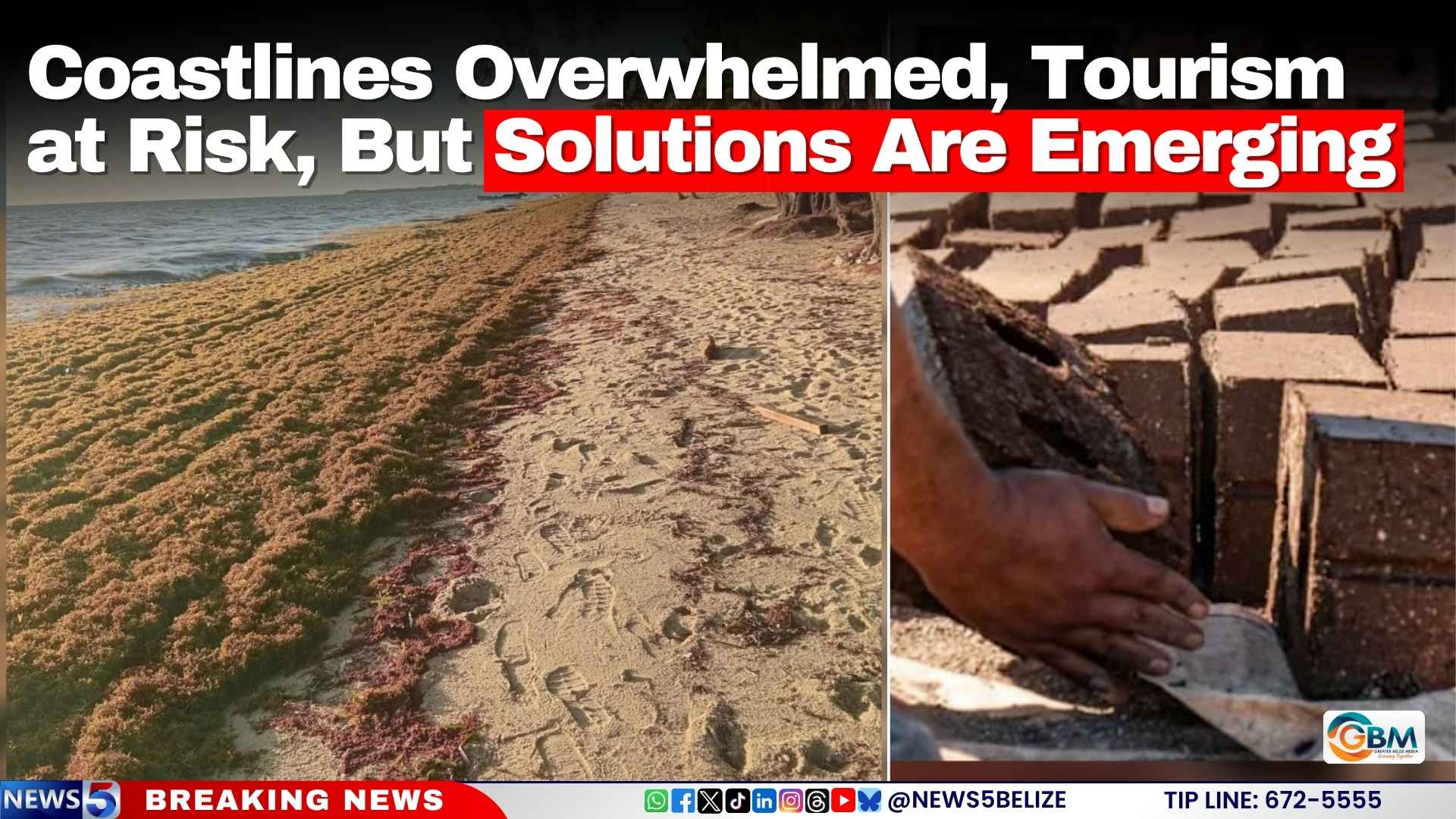
As the 2026 Atlantic sargassum season hits its early stride, Belize is grappling with the most severe seasonal seaweed invasion in its recent history. A thick, growing blanket of sargassum is smothering popular shorelines across the country from southern coastal hubs like Placencia and Hopkins to northern island destinations including San Pedro and Caye Caulker, bringing severe disruption to local communities and putting the nation’s critical tourism industry under unprecedented strain. Even amid the crisis, however, cross-sector collaboration and creative problem-solving are opening new pathways to turn this persistent environmental challenge into an unexpected economic and ecological opportunity.
Warnings of the impending mass influx emerged as early as April, when Belize’s National Meteorological Service issued an official alert forecasting major sargassum landings along the country’s southern coastline, with moderate but still significant impacts expected for northern island communities. The forecast has since proven far more severe than initial projections, leaving local authorities struggling to keep up with the continuous flow of seaweed washing ashore daily.
In the southern coastal town of Placencia, one of the hardest-hit locations, the scale of the crisis has left local leaders overwhelmed. By mid-April, crews had already removed 15 full dump truck loads of sargassum from the town’s main tourist beach, yet the shoreline remains entirely blanketed as new masses of seaweed continue to drift ashore. “Sargassum continues to come in quite heavily, and we will continue with efforts to remove as much as possible,” a spokesperson for the Placencia Village Council confirmed in a statement. Local residents have grown increasingly frustrated with the ongoing disruption, with many taking to social media to complain about the putrid rotting smell that lingers across coastal communities. Tourists have also felt the impact: one visitor to the region reported only being able to swim in the Caribbean twice during their entire vacation, even as they noted they still enjoyed their stay overall. Local clean-up crews, already stretched thin by daily removal efforts, say they are fighting an uphill battle, lacking the specialized machinery, dedicated staffing, and financial resources to match the volume of sargassum arriving on Belize’s shores each day.
The crisis is not isolated to southern Belize. Significant sargassum landings have also been reported across northern hotspots including Ambergris Caye, Caye Caulker, and Hopkins Village, with forecasters warning that sargassum levels are on track to hit record highs by the peak of summer this year. In response to the growing emergency, Belize’s national government has mobilized an immediate response, allocating BZD$250,000 in emergency grant funding for local clean-up operations and launching a long-term, BZD$50 million initiative to develop technology that converts excess sargassum into usable fuel.
Industry leaders have wasted no time coordinating with public authorities to address the growing threat to Belize’s tourism sector, which forms the backbone of the national economy. Efren Perez, President of the Belize Tourism Industry Association, confirmed that his organization has maintained active communication with the Ministry of Tourism, Ministry of Blue Economy, and Ministry of Environment to align on coordinated response efforts and evaluate on-the-ground progress. Perez emphasized that the damage caused by the sargassum invasion extends far beyond the unsightly mess on local beaches, noting that growing visitor awareness of the crisis has already led to rising booking cancellations and hesitation among potential travelers to plan trips to Belize. Perez also framed the challenge as a shared regional issue, pointing out that Caribbean nations across the basin continue to struggle to develop consistent, effective strategies to manage and mitigate recurring sargassum influxes.
While many stakeholders are focused on the immediate threat of the 2026 season, other groups are already turning the crisis into an opportunity to test long-term, sustainable solutions. In San Pedro, the Town Council has rolled out an innovative, science-backed beach restoration program supported by World Bank financing and academic partnerships that repurposes collected sargassum to reverse decades of coastal erosion. The initiative works by extracting sand naturally trapped within sargassum masses, which is then used to rebuild eroding shorelines. Valentine Rosado, a biodiversity scientist leading the research component of the project, shared a key finding from 2025 pilot work: 40% of the total volume of sargassum cleared from local beaches is actually trapped sand, a valuable coastal resource that would otherwise be lost to the ocean. This approach not only removes sargassum from tourist beaches but also restores critical shoreline habitat that protects inland communities from storm surge and sea level rise.
In the private sector, one domestic Belizean firm is developing an even more ambitious plan to turn sargassum into a marketable commodity. Building Belize Better Manufacturing Co. is currently exploring ways to process raw sargassum into two high-demand products: eco-friendly construction blocks and sustainable livestock feed. Co-founder Gregory Lavalley explained that the project targets an existing supply gap of between 2 million and 7 million construction blocks in northern Belize alone over the next five years, creating a built-in market for the processed seaweed. Lavalley noted that the initiative would deliver multiple economic benefits to vulnerable communities: it would create new, stable jobs in rural fishing villages that have been hit hardest by repeated sargassum invasions, reduce Belize’s reliance on costly imported construction materials, and serve as a model for public-private collaboration that turns an environmental burden into a homegrown, sustainable industry. Initial product testing is scheduled to launch later this month, and if the project receives full regulatory approval, full commercial production could be operational within six to 12 months.