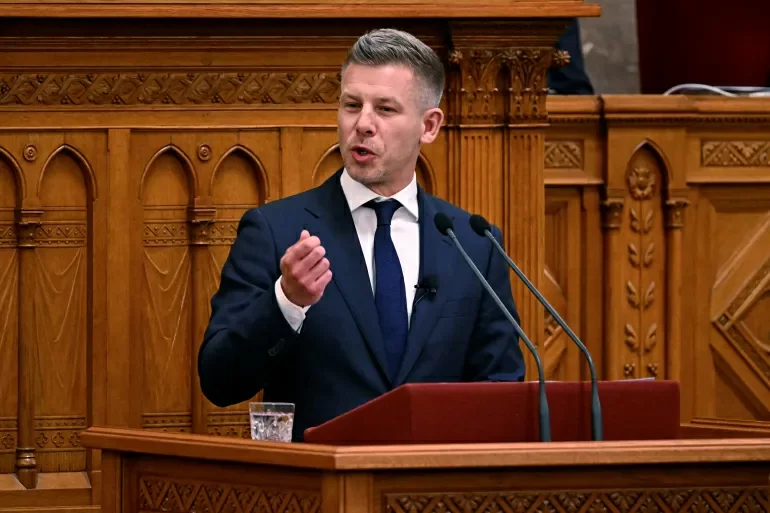
On a historic Saturday in Budapest, Peter Magyar, leader of Hungary’s center-right Tisza Party, took the official oath of office as the country’s new prime minister, bringing an end to Viktor Orbán’s 16-year incumbency. Magyar’s decisive victory in the April 12 parliamentary elections secured his party a constitutional supermajority in the 199-seat National Assembly, where Tisza now holds 141 seats, clearing a path for sweeping political and institutional change after years of national stagnation.
The 45-year-old new leader used his inaugural address to call on Hungarian citizens to step through “the gate to regime change,” promising Hungarians not just a new cabinet, but an entirely transformed governing system. “The Hungarian people have given us a mandate to put an end to decades of aimless drifting,” Magyar told lawmakers and assembled guests during the ceremony in Budapest’s parliament building.
Magyar’s election win has been met with broad positive reaction both from domestic voters and international business communities. In immediate response to the transfer of power, the Hungarian forint climbed to its highest level against the euro in four years, while domestic bond yields dropped in a show of market confidence. Post-election public opinion polls have also recorded growing public support for the Tisza Party as the new administration takes office.
Despite the early wave of optimism, Magyar inherits a set of pressing economic and geopolitical challenges that will test his new government from its first days in office. While Hungary has barely pulled out of a prolonged period of economic stagnation, it now faces new headwinds driven by soaring energy costs spurred by the ongoing Middle East conflict. As a heavily import-dependent Central European economy, these price pressures pose a significant risk to growth. Orbán’s pre-election spending spree has also left public finances in a fragile state: recent data shows that by April, Hungary’s budget deficit had already hit 71% of the full-year target, with Magyar warning that the deficit could reach 7% of gross domestic product by the end of the calendar year.
One of the new prime minister’s top policy priorities is resetting Hungary’s Western alignment, a sharp reversal from Orbán’s administration, which increasingly tilted toward the Kremlin and openly opposed key EU initiatives supporting Ukraine amid its ongoing war with Russia. Magyar has made clear that restoring productive relations with Brussels is a core goal of his government.
Domestically, Magyar has laid out plans for sweeping reform of Hungary’s public media sector, already announcing a temporary suspension of state media news broadcasts. He justified the move by noting that state outlets under Orbán consistently favored the former prime minister and effectively shut out critical political voices. He has also launched an ambitious nationwide anti-corruption program, and has set an aggressive deadline of May 25 to reach a deal with EU leaders to unlock billions of euros in frozen bloc funding, resources that Magyar calls critical to rebooting economic growth and stabilizing Hungary’s public finances.