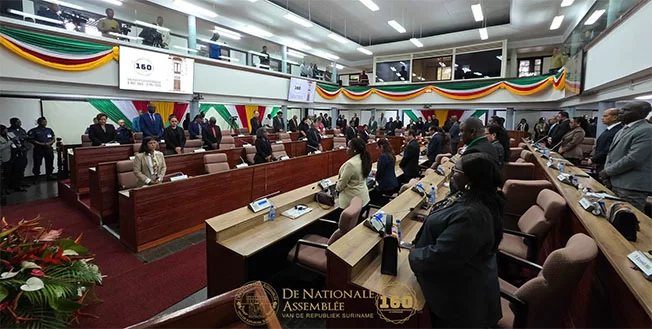
On May 9, Suriname marked a major milestone in its democratic history: 160 years since the founding of its first representative legislative body. At a special public session held to celebrate the anniversary, faction leaders from across the country’s major political parties delivered a shared, consistent call for greater integrity, expertise, national unity, and the restoration of public trust in the national parliament. Despite ideological differences between competing parties, a single unifying message ran through nearly every address: the National Assembly (DNA) must rebuild its connection to the Surinamese people and strengthen the country’s democratic constitutional order.
Political leaders opened the session by reflecting on the 160-year evolution of Suriname’s people’s representation, tracing its origins back to the first meeting of the Colonial States in 1866. Alongside this historical reflection, representatives also offered a critical assessment of the DNA’s current performance and the growing challenges that Suriname’s democracy faces in the modern era.
Acting faction leader Rossellie Coutinho, speaking on behalf of the National Democratic Party (NDP), emphasized that the parliament must urgently confront whether it still retains sufficient public confidence. Coutinho argued that honest self-reflection is a necessary step for the legislative body to evolve into a modern institution that genuinely embodies and represents the “sovereign will of the Surinamese people.” The NDP also highlighted the need for increased female participation in parliamentary governance.
Asis Gajadien, faction leader of the Progressive Reform Party (VHP), outlined his party’s longstanding historical role in advancing democracy and the rule of law in Suriname. He warned that democracy is not an inherent, guaranteed outcome, requiring constant active defense to survive. For Gajadien, people’s representation should not be limited to parliamentary debates, but must deliver tangible, measurable improvements to the daily lives of Surinamese communities. He called for national unity and cross-community collaboration, putting collective interest above division and ethnic polarization.
Jerrel Pawiroredjo, faction leader of the National Party of Suriname (NPS), drew attention to the growing vulnerability of democratic institutions across the globe. Citing ongoing wars, rising extremism, systemic racism, and widespread information manipulation as global threats, he stressed that Suriname must remain vigilant against risks to its own democratic constitutional order. Pawiroredjo added that core democratic principles — representative governance, separation of powers, and press freedom — must be actively protected rather than taken for granted.
Vice Chairman Ronnie Brunswijk, representing the General Liberation and Development Party (ABOP), traced Suriname’s democratic journey from its colonial-era representative system to the broad, inclusive democratic participation the country has today. Brunswijk noted that democracy matures through experience, overcoming challenging moments, and sustained open dialogue. He emphasized that all parliamentary work must center the national interest, rather than fuel division between population groups.
Bronto Somohardjo, faction leader of Pertjajah Luhur (PL), openly acknowledged that public trust in Suriname’s political establishment has declined in recent years. Referencing the difficult living conditions that many ordinary Surinamese citizens currently face, Somohardjo argued that elected representatives cannot look away when much of the population lives in daily economic uncertainty. He stressed that the parliament must realign itself with the pressing needs of the general public.
Ronny Asabina, faction leader of Brotherhood and Unity in Politics (BEP), underlined the non-negotiable importance of morality, integrity, and professional expertise for parliamentary representatives. He warned that public confidence in representative governance will erode further if institutional quality and professionalism are allowed to weaken. Asabina added that parliamentarians must always be mindful of the public example they set for broader society.
Steven Reyme, faction leader of A20, framed political leadership as a temporary position that leaves a permanent legacy for the nation. He described the parliamentary seat as a “seat of influence,” noting that elected representatives carry the responsibility of building a strong foundation of better conditions for future generations of Surinamese. For Reyme, the parliament must remain committed to core values of transparency, integrity, and forward-looking governance to serve the nation well.