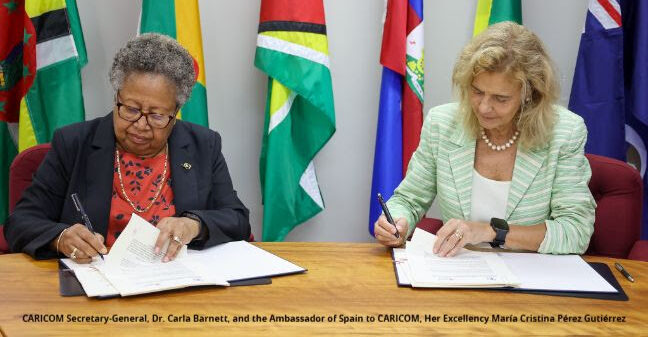
On May 6, 2026, a landmark new cooperation agreement between the Caribbean Community (CARICOM) and the Government of Spain was formally signed during the 10th convening of the Joint Technical Committee (JTC) for the CARICOM-Spain Joint Fund for Scientific and Technical Cooperation, unlocking expanded regional support for Caribbean healthcare systems and marking a new milestone in decades of cross-regional partnership. Dr. Carla Barnett, CARICOM Secretary-General, and María Cristina Pérez Gutiérrez, Spain’s Ambassador to CARICOM, put their signatures to the agreement in an official signing ceremony held alongside the meeting.
Under the terms of the new pact, the Spanish government is committing €400,000 in funding to a targeted regional health initiative named “Strengthening Regional Leadership, Governance and Coordinated Action in Health to Address New and Existing Health Challenges in the Caribbean Community (CARICOM).” The multi-stakeholder project will be executed collaboratively by the CARICOM Secretariat and the Caribbean Public Health Agency, with the ultimate goal of shoring up fragmented local healthcare infrastructure and improving regional capacity to respond to both persistent public health gaps and emerging health threats across the bloc’s member states.
Opening the JTC meeting, co-Chair Elizabeth Solomon, who also serves as Assistant Secretary-General of CARICOM’s Foreign and Community Relations Directorate, emphasized the deep, long-standing collaborative ties between the regional bloc and the European nation. Solomon noted that the CARICOM-Spain Joint Fund has grown far beyond a basic financing mechanism, evolving into a results-driven support program that prioritizes practical, demand-aligned action to advance Caribbean-led regional priorities, delivering measurable, on-the-ground benefits to residents across all CARICOM member states. “The CARICOM-Spain Joint Fund continues to play an important role in advancing regional priorities through cooperation that has evolved into a results-oriented programme of support that is both practical and responsive delivering tangible benefits to the people of the Caribbean Community,” Solomon stated in her opening remarks.
Ambassador Pérez Gutiérrez echoed these remarks, reaffirming Spain’s unwavering commitment to long-term partnership with the Caribbean bloc. “Spain values its partnership with CARICOM and remains committed to supporting initiatives that strengthen resilience, sustainability and regional cooperation,” she said, underscoring the Spanish government’s continued focus on supporting Caribbean development priorities.
Beyond the health agreement, meeting participants also conducted a comprehensive review of two additional proposed regional development projects that have a combined total valuation of $700,000 U.S. dollars. The first proposal, the Greening Caribbean Ports Programme (GCPP), centers on advancing sustainable maritime infrastructure across Caribbean Small Island Developing States, and is slated to be implemented by the Caribbean Centre for Renewable Energy and Energy Efficiency in partnership with the Port Management Association of the Caribbean if approved. The second proposal, focused on disaster preparedness, aims to “Strengthen the Caribbean Emergency Response Capabilities through the Next Level Regional Response Mechanism (RRM),” with the Caribbean Disaster Emergency Management Agency tapped as the lead implementing body for the initiative.
By the close of the meeting, representatives from both CARICOM and Spain issued a joint reaffirmation of the critical role the CARICOM-Spain Joint Fund plays in driving inclusive regional development. Both sides described the fund as an indispensable mechanism for advancing shared development priorities and deepening technical cooperation between the Caribbean bloc and Spain, with future collaborative projects expected to continue targeting climate resilience, public health, and sustainable infrastructure across the region.