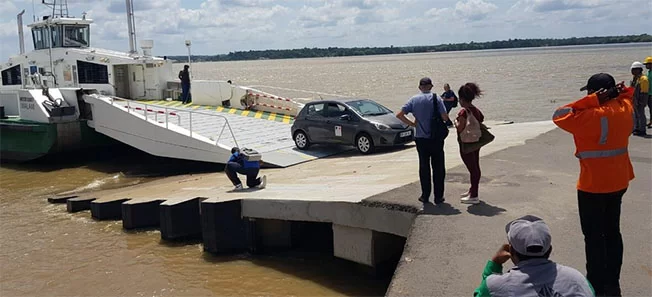
A long-awaited cross-border ferry connection between Albina, Suriname and French Guiana has hit repeated startup delays, and now Suriname’s state-owned port management firm NV Havenbeheer is pushing back against widespread claims that Suriname is responsible for the hold-up. In a formal statement, the company laid out a detailed breakdown of the project, placing the bulk of outstanding uncompleted tasks and root causes of stagnation squarely on French stakeholders.
The infrastructure project centers on the new ferry Le Malani and purpose-built docking terminals along the Marowijne River, which forms the natural border between Suriname and France’s overseas department of French Guiana. In recent weeks, regional media reports have circulated narrative that Suriname has failed to honor its pre-agreed commitments, holding up the full launch of the much-needed connection. NV Havenbeheer refuted that framing as factually inaccurate, saying it misrepresents the actual structure and division of labor of the entire project.
The initiative is part of the European Union’s PO Amazonie regional development program, which grants French Guiana access to EU structural funds for cross-border integration projects in the Amazon basin. Per the program’s governance structure, France holds full ownership of the initiative and overall program management, while Suriname participates only as a cooperating partner. The new Albina ferry terminal itself was constructed strictly in line with technical designs and specifications provided by French project partners.
NV Havenbeheer explained that after Suriname completed construction of the terminal per the approved original plan, French stakeholders requested a series of last-minute technical design adjustments that were not part of the original scope of work. Those adjustments have now been fully completed by the Suriname side, and the terminal has been redelivered for use.
A second major challenge has emerged from falling water levels at the mouth of the Marowijne River. At low tide, the angle between the Le Malani’s loading ramp and the terminal creates access difficulties, particularly for heavy freight traffic. French authorities have selected a solution: install movable adjustable ramps on both banks of the river. The procurement and tendering process for this infrastructure upgrade remains the responsibility of French authorities, and is still ongoing.
NV Havenbeheer also highlighted a lingering financial discrepancy that has yet to be resolved: currently, the Suriname side, via the port authority, covers all ongoing maintenance costs for the Albina terminal, while 100% of revenue from ferry ticket sales goes to the French side. The company confirmed that officials from both countries have held discussions on the issue, and are currently working to find a financially viable arrangement that is fair to Suriname.
Contrary to earlier unsubstantiated claims that navigation on the Suriname side of the river was inadequate, recent depth soundings conducted by the Maritime Authority of Suriname confirm that the channel on Suriname’s side is fully navigable and poses no barrier to operations. NV Havenbeheer confirmed that at high tide, the Le Malani can already safely dock at the new Albina terminal to handle both passenger and freight traffic without issue. All pre-requirements on the Suriname side have been fulfilled, the company said, and the ball is now in the French court to complete the remaining steps needed for the full commercial launch of the new cross-border ferry connection.