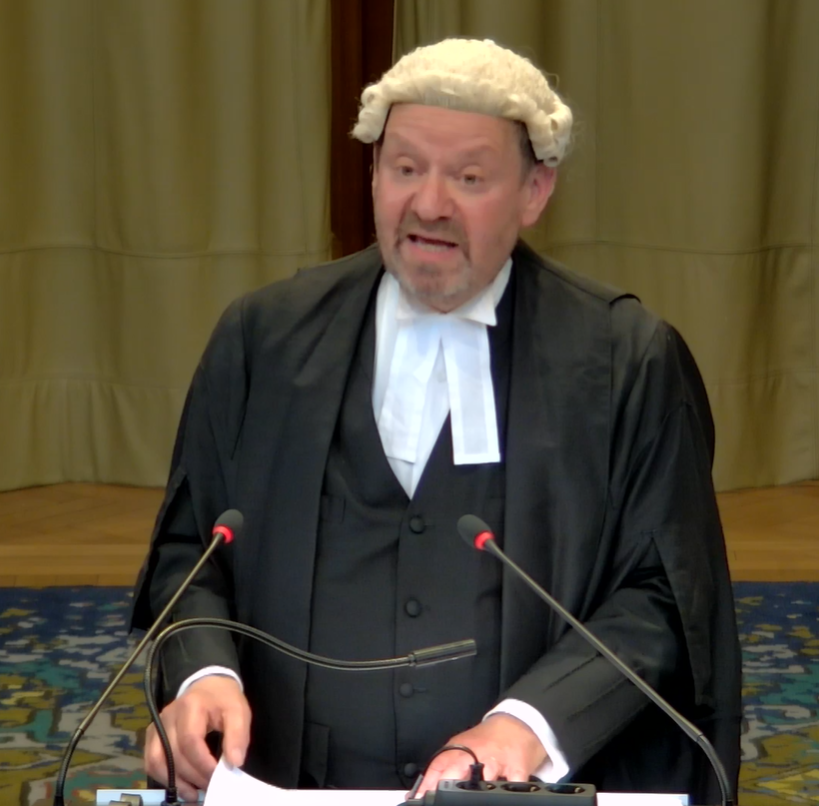
On Friday, May 8, 2026, legal representatives for Guyana presented the country’s formal defense of the 1899 Arbitral Tribunal border award before the International Court of Justice (ICJ), the United Nations’ highest judicial body based in The Hague, pushing back against Venezuela’s claims that the historic ruling was illegitimate.
The decades-long territorial dispute between Guyana and Venezuela centers on the 1899 award, which established the land boundary between the two nations and granted what is now Guyana control over the disputed Essequibo region. Venezuela has long challenged the ruling, arguing that tribunal president Friedrich Martens colluded with British representatives to secure an outcome that favored the United Kingdom, then the colonial ruler of British Guiana. In the current round of proceedings, Caracas has released new documentary excerpts that it claims back up these allegations of foul play.
Presenting Guyana’s second round of oral arguments, international law scholar Alain Pelet addressed Venezuela’s core criticism that the 1899 tribunal failed to include formal reasoning for its final decision. Pelet explained that while including explanatory reasoning for arbitral rulings is standard today, such a requirement was not mandatory in 1899. He confirmed that, with only one minor exception, all arbitrators unanimously signed the final award text after Martens led closed-door negotiations to build consensus. Pelet also referenced the tribunal’s original mandate, which tasked the panel with determining which territories lawfully belonged to the Netherlands and Spain respectively at the time Great Britain acquired the colony of British Guiana.
Fellow legal representative Philippe Sands further refuted Venezuela’s claims of coercion and improper influence by Martens. Sands emphasized that there is no credible evidence to back up assertions that Martens used threats or overstepped his authority to force an outcome favorable to Britain. Even when taking at face value the controversial Mallet Prevost memorandum – the primary document Venezuela relies on to back its collusion claims – Sands noted the text only describes Martens’ efforts to encourage arbitrators to reach a unified ruling, warning that a split majority decision might be less favorable to all parties. He added that Venezuela publicly accepted the 1899 award for more than 60 years, and that Martens’ push for consensus was an act of pragmatic wisdom: had arbitrators failed to reach a unified agreement, Sands argued, Great Britain would have likely laid claim to even more territory, an outcome Martens sought to avoid.
Sands accused Venezuela of leveraging the decades-old memorandum to stoke anti-colonial sentiment for modern political gain. He issued a stark warning about the global ramifications if the ICJ rules in Venezuela’s favor and invalidates the 1899 award and the 1905 follow-up treaty. Such a ruling, he argued, would not only put Guyana at risk of domination by its far larger neighbor, but would also set a dangerous precedent that could open the door to challenges for every colonial-era border settlement and arbitral award around the world. This outcome, Sands warned, would rekindle widespread territorial instability and erase the long-standing international norm that decades-old boundary settlements are final and binding.
Completing Guyana’s arguments, professor Nilüfer Oral added that historical evidence confirms Great Britain strictly abided by the 1899 boundary for the entire colonial period, never attempting to cross the line or seize additional territory. In fact, Oral noted, the award achieved one of Venezuela’s core original goals: it permanently halted the westward expansion of British settlement into territory claimed by Caracas.
The case was originally brought to the ICJ by Guyana eight years ago. Guyana’s Ministry of Foreign Affairs confirmed last Thursday that the court is expected to issue its final ruling by the end of 2026, though anonymous diplomatic sources suggest the decision could be delayed until early 2027.