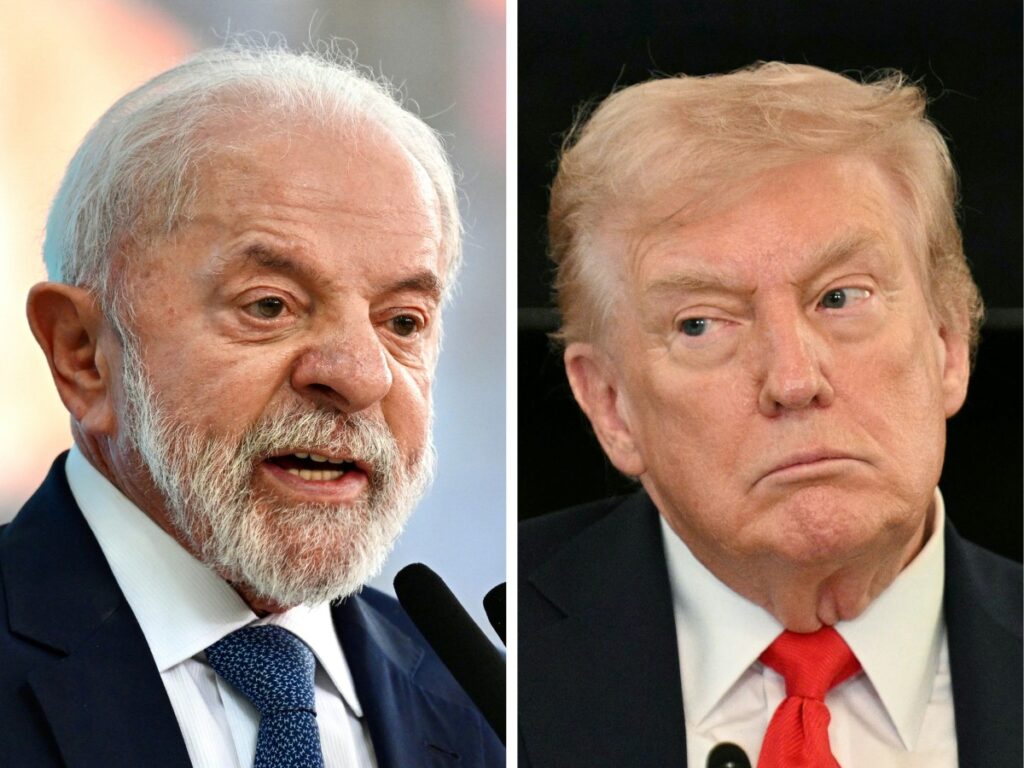
In a surprising turn of diplomatic events that bridges deep ideological divides, former U.S. President Donald Trump and Brazilian President Luiz Inacio Lula da Silva celebrated a unexpectedly constructive three-hour working meeting in Washington on Thursday, where the two ideological foes moved to ease long-running bilateral tensions.
At 79 and 80 years old respectively, the two leaders carry wildly different personal and political backstories: Lula, a leftist who rose from extreme poverty to lead Latin America’s largest economy, and Trump, a right-wing billionaire who has long pushed for aggressive U.S. dominance across the Americas. The pair have a history of public clashes on issues ranging from trade tariffs to regional geopolitics, but their meeting stretched well past its originally scheduled end time, with both leaders appearing upbeat and smiling in post-meeting photographs as they worked to identify shared ground on divisive issues impacting the hemisphere’s two largest economies.
Taking to his Truth Social platform immediately after the talks, Trump offered a positive assessment of the dialogue, writing: “Just concluded my meeting with Luiz Inacio Lula da Silva, the very dynamic President of Brazil. We discussed many topics, including Trade and, specifically, Tariffs. The meeting went very well.” Despite historically rocky diplomatic relations between the leaders’ aligned political blocs, Trump has repeatedly spoken favorably of Lula’s charismatic political style in past comments.
For his part, Lula echoed the positive tone, telling reporters he was “very, very satisfied” with the outcome of the meeting. He even leaned into the power of visual symbolism, joking: “I always feel that a photograph is worth a great deal. And you surely noticed that President Trump smiling is better than him looking grumpy.”
The high-profile, extended meeting comes at a critical political juncture for Lula, who is gearing up for a tight October presidential election contest against Flavio Bolsonaro, son of former Brazilian far-right president Jair Bolsonaro—one of Trump’s closest ideological allies in the region. Lula, a veteran leftist leader, is currently running for a fourth non-consecutive term as Brazil’s head of state.
Relations between the two leaders hit a low point earlier this year, when Trump imposed steep sweeping tariffs on all Brazilian exports in July, framing the move as retaliation for what he labeled a political “witch hunt” against Jair Bolsonaro, who is currently serving a 27-year prison sentence for his role in an attempted coup against Lula’s government. Those penalties were partially rolled back after the pair held an initial diplomatic meeting in Malaysia earlier this year, opening the door for Thursday’s full talks.
When asked if he believed Trump’s overtures would impact the upcoming Brazilian election, Lula pushed back on that suggestion. “I do not believe that Trump will “have any influence on the Brazilian elections,” he said, adding, “I think he will conduct himself like a president of the United States, allowing the Brazilian people to decide their own destiny.”
The meeting did not paper over the deep geopolitical differences that separate the two leaders. Lula has previously derided Trump’s global ambitions, once saying Trump sought to be “emperor of the world,” and has openly criticized Trump’s policy of pushing for regime change in Venezuela and his backing of Israel’s military campaign against Iran. Lula acknowledged to reporters that a single three-hour meeting would not erase those long-held divides. “He isn’t going to change his personality just because of a three-hour meeting with me. What I made a point of telling him was my perspective on things I believe far more in dialogue than in war,” Lula explained.
Notable disagreements remained on the table after the talks: Lula noted that “He thinks the war (in Iran) is already over. That’s not the reality. But that’s what he thinks and, you know, I’m not going to sit there arguing with him over his view of the war. He thinks everything in Venezuela is all sorted out.” The conversation did include moments of levity, however: Lula recalled joking with Trump that he should not revoke visas for the Brazilian men’s national football team ahead of the upcoming World Cup, quipping “because we’re coming here to win.” Lula confirmed that Trump laughed off the joke.
Beyond trade and geopolitics, the pair held extensive discussions on two pressing issues: reform of the United Nations Security Council and transnational organized crime. With public security ranking as the top policy concern for Brazilian voters ahead of the October election, Lula and Trump deepened talks on cooperative efforts to crack down on criminal networks and strengthen customs information sharing. In April, the two governments already signed an agreement to share data—including X-ray scans of shipping containers moving from the U.S. to Brazil—to combat cross-border arms and drug trafficking. Lula outlined an ambitious new plan emerging from the talks, saying Brazil is “prepared to form a working group comprising all the countries of Latin America and, perhaps, all the countries of the world, in order to create a powerful coalition to combat organized crime.”
The talks also touched on Brazil’s enormous untapped reserves of rare earth minerals—critical inputs for manufacturing a wide range of high-tech and clean energy products, which the U.S. has been racing to secure alternative supplies for outside of China. Brazil holds the world’s second-largest reserve of these strategic minerals, trailing only China. Just one day before the meeting, Brazilian lawmakers advanced a new bill that would offer incentives for private investment in rare earth exploration, with the legislation next heading to the Brazilian Senate for debate. When asked about Brazil’s approach to foreign investment in the sector, Lula emphasized an open-door policy, saying: “We have no particular preferences. Our objective is to forge partnerships — to collaborate with American, Chinese, German, Japanese, French, or any other companies — that wish to join forces with us to facilitate mining operations, process these materials, and generate the wealth that these rare earth elements offer us.”