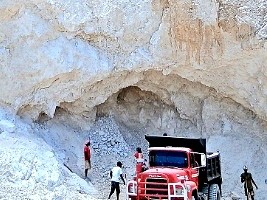
Unregulated sand extraction has emerged as a growing environmental and public safety threat in Haiti’s western region, prompting local environmental authorities to formally request support from the country’s national police and armed forces to curb destructive illegal operations.
In early May 2026, the West Departmental Directorate under Haiti’s Ministry of Environment (DDO-MdE), partnered with the Directorate of Environmental Inspection and Monitoring and deployed a team of trained environmental officials to conduct an on-site assessment of two heavily impacted zones: Pèlerin Laboule and Boutillier. Both areas have become hotspots for unregulated sand quarrying in recent years, a pattern that authorities have repeatedly tried and failed to address over the past decade.
What the inspection team found on the ground confirmed longstanding concerns about noncompliance with national environmental rules. The delegation documented that nearly all ongoing extraction operations are being conducted outside the bounds of Haiti’s existing environmental protection standards, with extractors operating without permits and using reckless methods that clear vegetation and destabilize natural terrain.
These unregulated practices have triggered a cascade of severe environmental and community harms. Geologically, the widespread removal of sand and topsoil has undermined the stability of hillside slopes, drastically increasing the risk of catastrophic landslides—an especially dangerous threat in a hurricane-prone tropical region like Haiti. The activity has also accelerated soil erosion across the region, degraded iconic natural landscapes, and created persistent quality-of-life nuisances for local residents, while also causing gradual damage to nearby roads, water infrastructure and residential properties.
Following the assessment, David Cossy, head of the West Departmental Directorate of the Ministry of Environment, called for a unified, coordinated response from all branches of the Haitian state to reverse the damage and prevent future harm. Cossy formally requested the active involvement of the Haitian National Police (PNH), the Armed Forces of Haiti (FAd’H), judicial authorities, and local community stakeholders to strengthen oversight and enforcement of environmental regulations. Beyond state action, he also issued a public appeal for ordinary Haitians to remain vigilant and collaborate with regulatory bodies, specifically by reporting any observed illegal quarrying activity to the relevant authorities.
The on-site inspection and subsequent request for support are part of a broader national initiative launched by Haiti’s current Minister of the Environment, Valéry Fils-Aimé. The initiative is designed to expand the Ministry’s regulatory capacity to protect Haiti’s fragile natural resources, and officials confirmed that new, more robust regulatory measures for the quarrying sector are currently in development. The updated rules are intended to clarify operational standards, strengthen penalties for noncompliance, and limit the ongoing environmental degradation that has plagued Haiti’s western department for years.
Illegal sand quarrying is not a new issue in Haiti: a decade-long series of government crackdowns, temporary suspensions of operations, and quarry closures in high-risk zones across the west have failed to permanently resolve the problem. Past data has shown that as much as 89 percent of all quarry operations in Haiti’s western department operate without valid permits, highlighting the scale of the regulatory gap that authorities are now seeking to close.