The new growing season’s official rice sowing window kicked off on May 1 and will run through June 30, and rice producers across western Suriname have already kicked off preparation work for the critical planting period. For a cohort of local farmers, a water shortage during the last short growing season left them completely unable to plant their crops, making this main season — which aligns with the annual rainy season — a particularly high-stakes opportunity to recover lost yields. Already, this group has planted several hectares of rice in Middenstandspolder, the low-lying growing zone located between the towns of Wageningen and Henarbrug, near the Nickerie River.
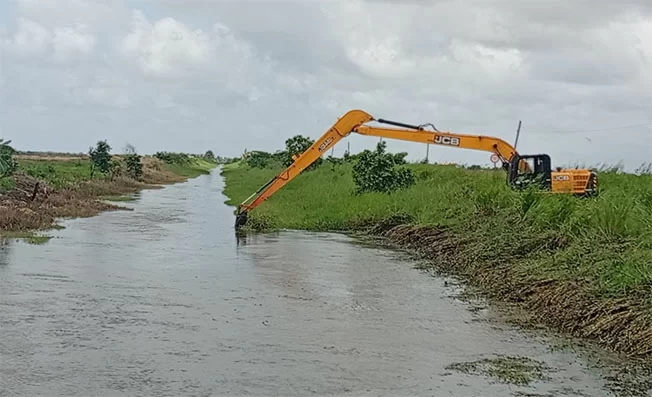
But just days after planting, unexpected heavy rainfall has left portions of these newly sown fields completely submerged, putting the young rice seedlings at severe risk of rotting before they can establish. Faced with this urgent threat, the affected farmers submitted a formal request to agricultural authorities to clear and dredge the region’s existing water retention dam, a structure originally built to hold water for crops during prolonged dry spells.
William Waidoe, deputy director of the Western Region branch of Suriname’s Ministry of Agriculture, Livestock and Fisheries (LVV), confirmed that the ministry has already responded to the request. “We have opened up the dam for this group of farmers, so that excess water can drain freely with the tide out into the Nickerie River,” Waidoe explained in an official statement.
The drainage improvement work is being funded and executed through a public-private partnership between the ministry and the local farming community. Under the collaborative model, LVV contributes heavy excavation equipment and a certified operator to carry out the dredging work, while farmers cover the cost of fuel, lubricants, and water for the construction crew. The project also includes clearing debris from the primary drainage channel that runs from Henarbrug toward Wageningen, expanding the system’s capacity to move large volumes of rainwater quickly.
Waidoe emphasized that fast, efficient drainage of excess rainfall is non-negotiable to protecting planting outcomes during the rainy season. “When heavy rains hit, water needs to be able to flow unobstructed to the Nickerie River,” he said. “This approach lets us manage the irrigation and drainage system with the limited resources we have available.”
For months, this collaborative model of shared responsibility for maintaining regional irrigation and drainage infrastructure has been consistently implemented across western Suriname’s rice belt, all with the core goal of creating safe, reliable conditions for rice planting. Waidoe noted that coordinated action between government authorities and producers delivers widespread benefits to the entire local rice sector, strengthening food security and supporting the livelihoods of thousands of agricultural workers across the region.