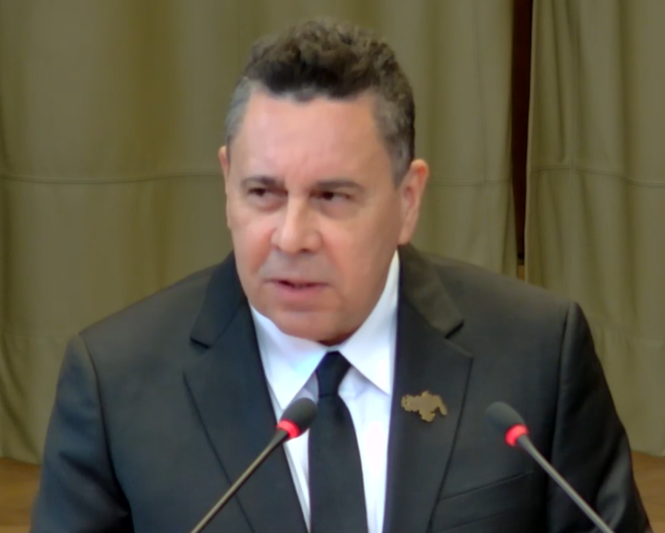
On Wednesday, May 6, 2026, during ongoing oral proceedings at the United Nations’ highest judicial body, the International Court of Justice (ICJ), Venezuela doubled down on its longstanding refusal to recognize the court’s authority to adjudicate a decades-long territorial border dispute with neighboring Guyana centered on the contested Essequibo Region.
Samuel Moncada, Venezuela’s designated agent to the ICJ, opened his remarks to the court wearing a lapel pin displaying a map of Venezuela that explicitly incorporates the 159,000-square-kilometer Essequibo Region – a move that has already drawn formal concern from Guyana through the Caribbean Community (CARICOM), the regional bloc of which Guyana is a member. The appearance comes just two days after Guyana presented its case to the ICJ, calling on the court to issue binding orders requiring Venezuela to remove all official maps labeling Essequibo as Venezuelan territory, and to rescind all domestic laws and constitutional amendments passed following a 2023 Venezuelan national referendum that formalized the country’s claim to the region.
Addressing the court directly, Moncada emphasized that the 2023 popular referendum “unequivocally reaffirmed” Venezuelan voters’ unanimous rejection of the ICJ’s jurisdiction over the long-running disagreement. “That position has not changed. Venezuela has never consented to submitting this dispute to the jurisdiction of any court or arbitral tribunal,” he told the panel of ICJ judges.
Moncada argued that any ruling by the court that interferes with the 1966 Geneva Agreement – the bilateral pact brokered by the United Nations that frames the dispute – would block any path to a resolution that satisfies both nations. “The only option is to allow the agreement to fulfill its purpose and objective without impediments,” he added. He accused Guyana of deliberately disregarding the terms of the 1966 accord, which was designed to address the colonial-era “fraudulent” 1899 Arbitral Award that first granted Essequibo to British Guiana, the predecessor to modern Guyana. Unlike judicial adjudication that produces a winner and a loser, Moncada noted, the Geneva Agreement mandates a mutually acceptable bilateral solution to overcome the harmful legacy of colonial border drawing.
Staking Venezuela’s historical claim to the region, Moncada contended that Essequibo was always part of Spanish colonial territory that later became independent Venezuela. He argued that the Netherlands gained control of territory only east of the Essequibo River under the 1648 Treaty of Munster, in which Spain formally recognized Dutch independence and its territorial claims. This position directly contradicts Guyana’s formal submissions to the court, which have included cartographic and historical evidence showing Spanish colonial forces never established a presence in Essequibo, and that most place names across the region trace back to Dutch colonial settlement.
Carl Greenidge, Guyana’s agent to the ICJ, laid out his country’s historical case during Monday’s proceedings, presenting maps showing the westernmost Spanish colonial outposts sat more than 650 kilometers east of the Venezuelan border, outside the boundaries of Essequibo. Greenidge also submitted a list of 35 existing place names across the region that retain their original Dutch monikers, tracing Guyana’s colonial history back to the first permanent Dutch settlement in 1598. By 1616, the Dutch had formally established the Colony of Essequibo, built Fort Kykoveral along the Mazaruni River as their administrative seat, and began governing territory stretching west to the Orinoco River, Greenidge explained. The Dutch West India Company took over administration of the colony in 1621, before moving the colonial seat to Fort Zealandia in 1744, he added.
Moncada closed his remarks by reaffirming Venezuela’s commitment to a peaceful resolution of the dispute, while rejecting reliance on great power influence or outcomes from what he called “rigged international arbitrations.” “This is what led to our tradition of not recognizing the jurisdiction of arbitral tribunals or courts of any kind when it comes to matters relating to our territorial integrity,” he said. “This is why Venezuela does not accept the jurisdiction of the International Court of Justice, which was erroneously imposed in the 2020 judgment, it respectfully rejects its jurisdiction to hear and decide on this dispute.”