On Tuesday, two leading parliamentary faction leaders from Suriname — Jerrel Pawiroredjo of the National Party of Suriname (NPS) and Asis Gajadien of the Progressive People’s Party (VHP) — delivered pointed, urgent questions to the national government during a sitting of the National Assembly. The inquiry centers on claims of inappropriate political meddling in the operations of state-linked enterprises and the broader domestic financial sector, triggered by recent actions taken by the Surinamese president targeting the Board of Commissioners of the national insurance firm Self Reliance.
Lawmakers have characterized the president’s move as a deeply troubling development that threatens long-standing principles of good governance and transparent corporate oversight. “Shareholding carries responsibility, not unchecked absolute control,” the parliamentarians emphasized in their questioning. According to unconfirmed reporting from local outlet Starnieuws, the controversial intervention is expected to be reversed in the near term, with all formal correspondence related to the plan also withdrawn.
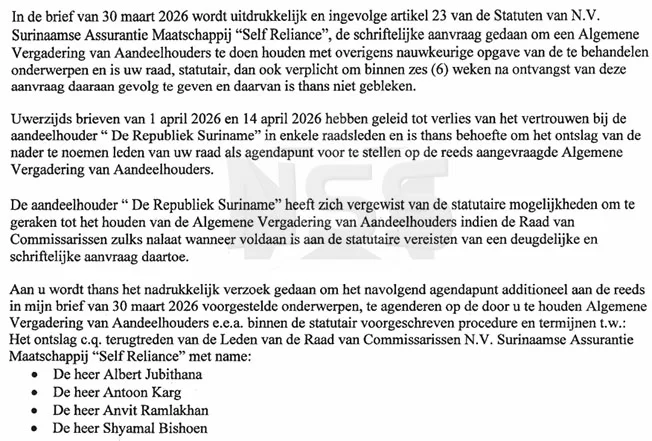
A leaked letter from the president to Albert Jubitana, president-commissioner of Self Reliance, reveals that acting on behalf of the Surinamese state, which holds shares in the company, the head of state pushed for an emergency general meeting of shareholders to be convened. A key item added to the proposed meeting agenda is the dismissal of multiple sitting members of the Board of Commissioners. The request specifically calls for a full review of the performance of board members, with an eye toward potentially removing several from their posts.
In the correspondence, the president cites Article 23 of Self Reliance’s corporate bylaws, which formally grants shareholders the right to request an extraordinary general meeting. The letter also demands the board turn over internal records on ongoing deliberations and disclose the legal basis for recent decisions the board has made.
Critics of the president’s action have raised serious questions about the appropriate boundaries of shareholder influence, particularly in this case: the Surinamese state does not hold a controlling majority stake in the insurer, instead owning only approximately 40 percent of outstanding shares.
Beyond the insurer itself, concerns have also been raised about potential political pressure on the Central Bank of Suriname. Observers warn that unchecked political influence could erode the central bank’s regulatory independence, creating significant unneeded risks to the overall stability of Suriname’s financial sector. In their inquiry, the parliamentary leaders have demanded the national government provide full transparency around the intervention, as well as a clear, legally sound justification for the president’s actions.